OptQC and NTT have announced a capital and business alliance to develop a fault-tolerant optical quantum computer targeting one million physical qubits, with a roadmap spanning hardware, supply chain, and enterprise integration through 2030
OptQC Corp., a Tokyo-based optical quantum computing startup, and telecommunications company NTT, Inc. have formalized a capital and business alliance aimed at developing and commercializing a large-scale optical quantum computer. The agreement, announced in 2026, includes a strategic equity investment from NTT and establishes a multi-year collaboration focused on hardware architecture, supply chain development, and integration with enterprise infrastructure. The companies plan to advance a fault-tolerant optical quantum platform with a target of one million physical qubits, building on an initial research partnership established in late 2025.
System Architecture and Experimental Milestones
The alliance sets out a phased technical roadmap, beginning with the design of system architecture and wavelength-division multiplexing (WDM) strategies to scale photonic qubit counts. Between fiscal years 2026 and 2027, the partners aim to verify a 10,000-qubit prototype and develop integrated quantum-classical software. By 2028, the plan calls for the deployment of a quantum light source and amplification modules, enabling proof-of-concept projects with industry partners in sectors such as finance, manufacturing, and energy. The roadmap culminates in fiscal years 2029-2030 with the goal of demonstrating a fault-tolerant, million-qubit optical quantum platform, establishing supply chain partnerships, and rolling out hardware at data center hubs for commercial use cases.
Physical Platform and Integration Challenges
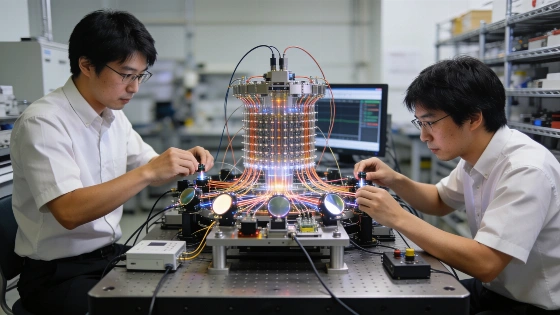
OptQC's approach is based on continuous-variable photonic quantum computing, leveraging room-temperature optical entanglement and time-domain multiplexing. The collaboration will integrate NTT's optical communications, data center infrastructure, and IOWN (Innovative Optical and Wireless Network) technologies with OptQC's photonic platform. The companies aim to address key engineering challenges, including scaling the number of physical qubits, managing optical loss, and ensuring compatibility with existing data center environments. The project also seeks to overcome the cryogenic and scaling limitations that affect many solid-state quantum computing modalities by operating at room temperature and using optical amplification and wave-guided light sources.
Technical Evidence and Remaining Barriers
According to the companies, the first optical quantum processing unit, "MoQuren," is already operational at the National Institute of Advanced Industrial Science and Technology's (AIST) G-QuAT facility, serving as a module for Japan's ABCI-Q quantum-classical hybrid infrastructure. The current roadmap includes the construction of a domestic supply chain for photonic components and the development of a unified software platform for hybrid quantum-classical execution. However, the alliance has not yet demonstrated a logical qubit or full error-corrected operation at scale. The transition from a 10,000-qubit prototype to a million-qubit, fault-tolerant system will require advances in error correction, optical integration, and system reliability. As with other quantum hardware efforts, the practical utility of large-scale photonic quantum computers will depend on sustained improvements in fidelity, loss management, and error correction overhead.
Industry Context and Comparison
The OptQC-NTT partnership reflects a broader trend of industrial alliances seeking to accelerate quantum hardware development and integration with classical infrastructure. While the companies' roadmap is ambitious, it remains subject to the same engineering and scientific uncertainties that have challenged other quantum computing platforms. For context, recent efforts to deploy quantum hardware in real-world network environments, such as the entanglement-based ABQ-Net project in New Mexico, have highlighted the complexity of scaling quantum systems beyond laboratory conditions. A detailed account of such network deployments can be found in this report on quantum hardware integration in Albuquerque.
In quantum computing, a physical qubit is a controllable quantum system-such as a photon, ion, or superconducting circuit-that can encode quantum information. However, physical qubits are highly susceptible to errors from noise, loss, and imperfect control. To achieve fault tolerance, quantum computers must encode logical qubits across many physical qubits using error-correcting codes. This process requires high-fidelity operations, low loss, and robust error detection and correction. The distinction between physical and logical qubits is critical: a million physical qubits does not guarantee a useful quantum computer unless error rates are sufficiently low and error correction is effective. The engineering challenge lies in scaling up the number of high-quality physical qubits while maintaining the performance needed for practical, error-corrected computation.