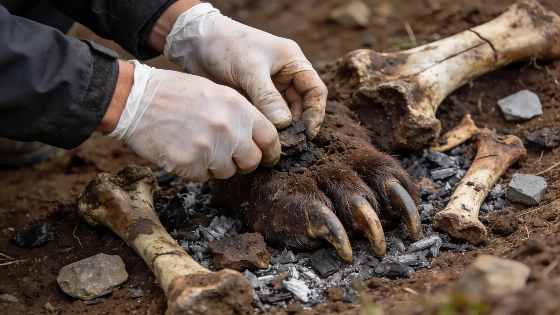
Archaeologists have identified brown bear claws in cremation burials from the sixth and seventh centuries CE on the Kaliningrad Peninsula, offering new evidence for social status and ritual practices among the Aestii population
Excavations in the Zelenogradsky District of the Kaliningrad Peninsula have uncovered a series of sixth- and seventh-century CE cremation burials containing brown bear claw bones. The finds, made by researchers from the Institute of Archaeology of the Russian Academy of Sciences, provide rare evidence for the use of bear remains in funerary contexts among the Aestii, a population living in the southeastern Baltic during the early medieval period.
Bear Remains and Burial Context
Seven cremation burials yielded brown bear claw phalanges, with one grave containing as many as twelve claws-an unusually high number for the region. The claws showed no signs of deliberate modification but did display evidence of exposure to fire, consistent with their placement on funeral pyres. The cremated nature of the burials complicates reconstruction of the original arrangement, but researchers suggest that complete bear paws or skins may have been included as part of the funerary rite.
All seven burials date to the sixth and early seventh centuries CE, a period marked by shifting social structures in the southeastern Baltic. The presence of bear remains in these graves is interpreted as a marker of social prestige, possibly linked to broader Northern European traditions in which bears held symbolic importance. The inclusion of bear claws alongside other high-status grave goods suggests that these individuals occupied elevated positions within their communities.
Grave Goods and Social Status
Six of the burials containing bear claws were associated with adult males, while one belonged to a female. The male graves included weapons, gold and silver jewelry, and horse remains-between two and four horses per burial-along with saddles and decorated bridles. These combinations of grave goods are consistent with displays of wealth and status, and the presence of sacrificed horses further emphasizes the elite character of the burials.
The female burial, while lacking horses, contained three brooches, silver bracelets, beads, and two drinking horns with gold and silver fittings. Bear claws were also present, indicating that the use of bear remains was not restricted to male individuals or to those buried with weapons. This pattern suggests that bear skins or claws may have signified broader concepts of prestige or group identity, rather than being exclusively linked to warrior status.
Interpreting Ritual and Hierarchy
The discovery of bear claws in these burials challenges earlier interpretations of the Aestii as a relatively egalitarian society. The concentration of weapons, precious metals, horses, and unusual animal remains in a limited number of graves points to the emergence of social hierarchy and the deliberate marking of status in death. The symbolic role of bears in funerary practice may reflect connections to wider Northern European traditions, where bears were associated with strength, authority, or ritual power.
While the evidence supports the interpretation of these burials as elite, the precise meaning of bear remains in this context remains uncertain. The lack of modification on the claws and the cremated condition of the remains limit the ability to reconstruct the full ritual sequence. However, the association of bear claws with both male and female individuals suggests that their significance extended beyond gendered roles or martial identity.
Comparative research in other regions has also highlighted the use of animal remains in elite burials as a marker of status and ritual practice. For example, studies of early medieval graves in northern Europe have documented the inclusion of horses and specialized grave goods, as seen in the chamber grave at Gnezdilovo near Suzdal, which contained a man, horse, and dog with weapons and riding gear (see related analysis).
Evidence and Limitations
The identification of bear claws in these burials is based on osteological analysis of cremated remains, which presents significant challenges for interpretation. Cremation destroys much of the original context, making it difficult to determine the exact placement and condition of grave goods at the time of burial. The absence of deliberate modification on the claws suggests that their value lay in their association with the animal rather than in crafted objects.
The research, published in Russian Archaeology, highlights the importance of integrating zooarchaeological evidence with broader mortuary analysis to understand social organization and ritual in early medieval societies. While the findings support the existence of social hierarchy and symbolic animal use among the Aestii, further comparative work and additional excavations will be needed to clarify the full range of funerary practices in the region.
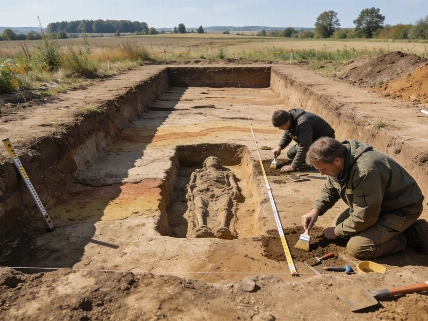
In archaeological research, cremation burials present unique challenges for reconstructing past behavior. The high temperatures involved in cremation can alter or destroy bone and artifact surfaces, complicating identification and analysis. Osteological specialists rely on diagnostic features that survive burning, but the loss of original arrangement and context means that interpretations must be cautious. The presence of animal remains, such as bear claws, in cremated contexts requires careful consideration of both taphonomic processes and cultural practices to avoid overinterpreting limited evidence.