An excavation beneath Warsaw's E. Młynarski Square has recovered burned architectural remains and a mixed collection of lamps, ceramics, sculpture and objects that may connect to the Warsaw Philharmonic, although the attribution remains unconfirmed.
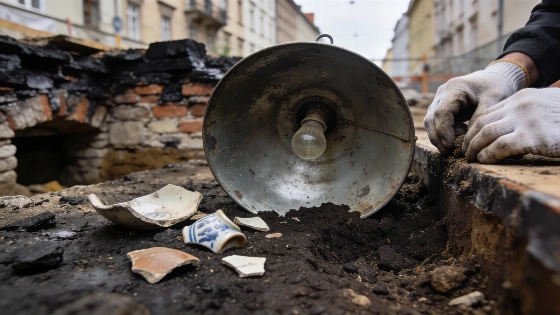
Scorched foundations beneath a former Warsaw car park now hold the material record of a vanished city block: enormous ceiling-lamp fragments, royal portrait ceramics, a bronze rider and a signed sculptural element dated 1881. Some objects may have come from the Warsaw Philharmonic, but the cellar deposit does not establish a single origin for the collection.
The finds were made at E. Młynarski Square in central Warsaw, where the former parking area is being converted into a green public space as part of the Nowe Centrum Warszawy project and reconstruction work on Sienkiewicza Street. Archaeologists first exposed the foundations of a pre-war tenement house and then entered its cellars. The surviving underground rooms produced decorative fittings, glass fragments, metal ornaments, ceramics and domestic objects alongside pieces whose scale suggests a public or ceremonial interior.
The excavation is still in progress. As of 26 September 2026, a second part of the former parking area had not yet been excavated, so the archaeological sample is incomplete and additional objects or architectural associations may still be recovered. This limitation is important: conclusions about the deposit should be treated as provisional rather than as a final inventory.
The strongest possible Philharmonic connection comes from fragments of huge ceiling lamps. Their size and decorative character have led researchers to consider whether they once illuminated a concert hall, foyer or another institutional interior. That interpretation is plausible, not proven: the fixtures were recovered from a cellar rather than from a documented original architectural setting, and no complete lamp or secure installation point has yet been reported.
A group of metal decorative elements, including a wreath made from laurel and oak leaves, offers another possible link. Such motifs commonly expressed achievement, commemoration or honor, and the excavated example may resemble decoration visible in an archival photograph of the Philharmonic's interior. Comparison with historical images, building plans and inventories will be needed before resemblance can become an identification. The Warsaw City Conservator has described the connection as something the artifacts may have, not as an established attribution.
The collection also includes fragments of two large ceramic plates bearing portraits of Sigismund III Vasa and John III Sobieski, as well as a bronze figurine of a rider on horseback. These objects could reflect the contents of the neighboring residence, material moved from another building or items gathered in the cellar during the destruction of Warsaw. The royal portraits provide cultural context, but they do not by themselves identify the building in which the plates were originally used.
The numerical record is modest but precise: the sculptural element is dated 1881; the ceramic fragments belong to two large plates; the portraits represent two monarchs; and archaeologists have so far examined only part of the former car park. No published excavation report in the available accounts gives a complete artifact count, a measured sample size, confidence intervals or statistical tests. That absence is not unusual during an active excavation, but it means the present interpretation rests on object descriptions and archaeological context rather than on a completed quantitative study.
The most useful warning against an easy attribution is the signed sculptural element showing a man's head in profile. It bears the name Sławomir Celiński, the date 1881 and the inscription "Warsaw". Because the Warsaw Philharmonic building was constructed considerably later, the sculpture predates it by around two decades. It therefore cannot be assigned to that building solely because it was found among objects that may have belonged there.
The piece may have been moved from another structure or may have belonged to the tenement house itself. Its presence demonstrates the central archaeological problem at E. Młynarski Square: survival in one deposit does not mean that every object was made, owned or used in the same place. Urban deposits can combine demolition debris, salvage, concealment, household refuse and later disturbance. A scientifically defensible attribution must therefore distinguish the find location from the object's original provenance.
That distinction also determines what laboratory work could contribute. Conservation scientists may document manufacturing traces, corrosion, pigments, ceramic fabrics and joining methods, while non-destructive imaging or elemental analysis could help compare fragments with surviving objects from known interiors. Such tests would not automatically prove ownership, but they could identify shared materials, production techniques or repair histories. Any results should be reported with the instrument, calibration procedure, sample selection and uncertainty, rather than presented as a definitive match without a comparative reference collection.
Fire traces remain visible on the walls of the surviving foundations, and the building above was completely burned out. Some possessions may have been placed in the cellar for protection before or during wartime destruction, but the evidence does not show which objects were deliberately hidden, which were already stored there and which arrived through collapse or later movement.
The mixed deposit should therefore be read as evidence of destruction and survival rather than as a ready-made inventory of the Warsaw Philharmonic. In that respect, the burned foundations provide the strongest context while the proposed institutional connections remain interpretive. A comparable archaeological problem appears in this earlier fire study, where charred material also required interpretation alongside the physical traces of burning rather than assumption of a single event.
Fire archaeology depends on separating direct evidence of heat from later effects such as collapse, weathering and redeposition. Researchers must record the position of each object, the relationship between artifacts and wall layers, the direction of collapse and the distribution of soot or heat alteration. The same logic underlies reproducible work in journals such as Nature's archaeology research: a dramatic object becomes scientifically meaningful only when its context, dating and comparison set are documented.
Archival photographs, historical inventories and close examination of the fittings may help separate the tenement's domestic material from architectural decoration brought from elsewhere. Investigators could also compare dimensions, fastening points, surface finishes and manufacturing marks. Matching fragments recovered from the unexamined section would strengthen a proposed association, while objects found in unrelated layers could weaken the idea of a single institutional source.
The excavation places a group of artifacts within the ruins of a pre-war Warsaw building and documents the fire that ended its use. It also preserves several distinct glimpses of urban life: elaborate public interiors, household possessions, patriotic decorative art and the work of a named nineteenth-century sculptor. It does not yet prove that the lamps or wreath came from the Philharmonic, nor that the sculpture and royal ceramics belonged to one household.
The work is being conducted under the supervision of the Warsaw City Conservator of Monuments. That oversight matters because the remaining excavation may provide the contextual evidence now missing from the collection: matching fragments, clearer architectural associations or deposits that show when the objects entered the cellar. The responsible account of the site is consequently not that a lost Philharmonic interior has been recovered, but that a damaged urban deposit is being carefully separated into its likely histories.
Archaeological provenance means more than finding objects in the same place. It includes the relationship between an artifact and its original setting, the layer or structure in which it was deposited and the later processes that moved or altered it. At E. Młynarski Square, the secure evidence is the cellar, the burned building remains and the objects recovered from that context; their first locations remain uncertain. This distinction is not a weakness to conceal but the basis for a credible reconstruction, and it makes the excavation valuable precisely because it preserves both Warsaw's material past and the limits of what that past can now tell us.