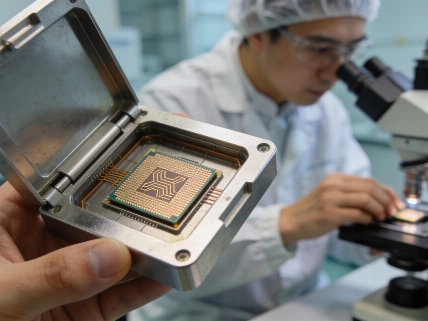
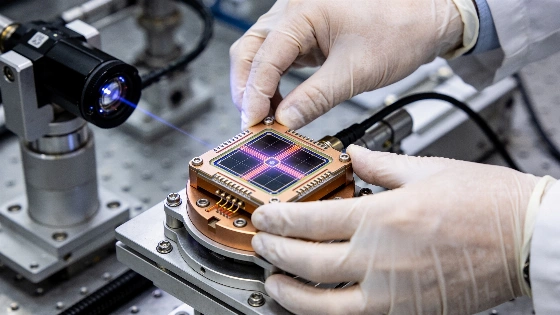
Pasqal has demonstrated trapping individual neutral atoms with laser light routed through a silicon nitride photonic chip, replacing bulk optics and addressing a key scaling challenge for neutral-atom quantum processors
Pasqal, a developer of neutral-atom quantum hardware, has reported the experimental trapping of individual neutral atoms using laser light generated and routed entirely within a silicon nitride photonic integrated circuit (PIC). This approach replaces the conventional use of free-space bulk optics with a solid-state photonic chip, aiming to address a major engineering bottleneck in scaling neutral-atom quantum processors.
Photonic Chip Integration
The demonstration was carried out in collaboration with Aeponyx, a photonics company acquired by Pasqal less than 18 months prior. The experiment involved generating four optical micro-traps-also known as optical tweezers-using a single photonic chip embedded within a quantum processing unit. These micro-traps successfully confined four individual rubidium atoms, with the integrated photonic platform achieving atom trapping lifetimes of approximately 27.5 seconds, comparable to Pasqal's previous bulk-optics setups. The use of silicon nitride as the photonic material enables compatibility with established semiconductor foundry processes, which is critical for reproducibility and potential large-scale manufacturing.
Scaling and Engineering Constraints
Transitioning the optical trapping and laser routing subsystems onto wafer-scale photonic chips is projected to reduce the physical footprint of the optical control hardware by up to a factor of 50 compared to traditional bulk optics. However, the demonstration remains at the proof-of-concept stage, with only four atoms trapped in this configuration. Achieving reliable control and readout for thousands of neutral-atom qubits will require further advances in photonic integration, optical loss management, and device yield. The company's roadmap targets scaling from current systems with over 1,000 physical qubits to architectures supporting more than 10,000 physical atoms and 100 logical qubits, but these projections depend on overcoming significant engineering and fabrication challenges.
Performance Benchmarks and Comparison
In the reported experiment, the photonic chip-based system matched the atom trapping performance of Pasqal's established bulk-optics platforms, with measured single-atom lifetimes of around 27.5 seconds. This metric is important for quantum computing applications, as longer trapping times can support more complex quantum operations before decoherence or atom loss occurs. The demonstration did not include multi-qubit gate operations, error correction, or logical qubit encoding, and the results have not yet been independently replicated or peer reviewed. For context, other quantum hardware platforms, such as trapped-ion systems, are also pursuing scalable architectures, as seen in efforts to reach higher logical qubit counts described in recent research on trapped-ion quantum design.
Commercial and Research Implications
Pasqal's integration of photonic chips into its neutral-atom quantum processors is intended to support vertical control over the optical layer as the company prepares for a potential public listing on NASDAQ. While the technical milestone demonstrates the feasibility of on-chip atom trapping, the transition from laboratory prototype to a manufacturable, large-scale quantum processor remains unproven. Key open questions include the scalability of the photonic routing architecture, the stability of atom trapping under increased device complexity, and the reproducibility of performance across multiple chips and fabrication runs. The company has not yet released detailed technical documentation or peer-reviewed publications on the experiment, and independent verification will be important for assessing the broader impact of this approach.
Neutral-atom quantum computing platforms use individual atoms as physical qubits, typically trapped and manipulated using tightly focused laser beams. Photonic integrated circuits offer a route to miniaturize and stabilize the optical control systems required for these operations. However, scaling from a handful of trapped atoms to thousands of high-fidelity, controllable qubits involves challenges in optical loss, crosstalk, device yield, and error correction. The distinction between physical and logical qubits is central: while physical qubits are the directly controlled atoms, logical qubits require encoding across many physical qubits to detect and correct errors. Demonstrating robust logical qubits and fault-tolerant operation remains a key milestone for all quantum hardware platforms.