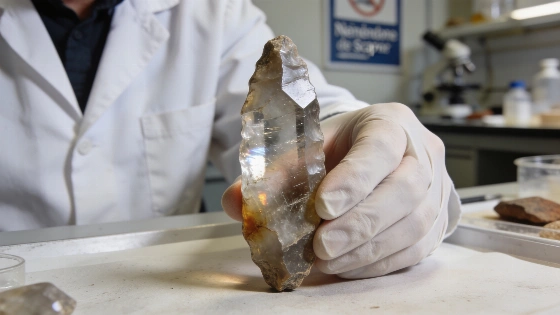
Archaeologists have reexamined a rare rock crystal scraper from Abri des Merveilles, France, revealing how Neanderthals selected unusual materials and challenging outdated views of their cognitive abilities
Nearly a century ago, excavations at the Abri des Merveilles site in southwestern France uncovered a set of seven stone tools crafted from transparent rock crystal, a form of microcrystalline quartz. These artifacts, attributed to Neanderthals, were recovered by a team from the American School of Prehistoric Research in 1924. The discovery provided early evidence that Neanderthals were capable of selecting and working with distinctive raw materials, prompting a reevaluation of their technological and cognitive capacities.
Excavation and Context
The Abri des Merveilles site is located in the Dordogne region, an area known for its rich Paleolithic record. The rock crystal tools were found within a cave context, alongside flakes and chips indicating on-site tool production. The presence of a Neanderthal molar in the same stratigraphic layer supports the attribution of these artifacts to Neanderthal populations. While the site itself has not been directly dated, the combination of stratigraphic evidence, tool typology, and associated remains suggests an age between 45,000 and 80,000 years ago.
Most Neanderthal stone tools in Europe were made from flint or chert, materials that fracture predictably and are widely available. The use of rock crystal is rare, with only a handful of sites yielding such artifacts. The Abri des Merveilles assemblage stands out for the clarity and quality of the crystal, which would have required careful selection and skillful knapping. The tools include scrapers and points, with one particularly well-preserved scraper displaying a yellow-tinged transparency.
Material Selection and Interpretation
The choice to use rock crystal, despite its challenging fracture properties compared to flint, has been interpreted as evidence of Neanderthal discernment in material selection. The presence of production debris suggests that the crystal was worked at the site, likely sourced from river gravels in the Vézère basin. While the functional advantages of rock crystal over flint are limited, its visual qualities may have held significance for the toolmakers. This challenges earlier 20th-century portrayals of Neanderthals as lacking aesthetic awareness or technological innovation.
At the time of discovery, prevailing scientific opinion-shaped by analyses such as Marcellin Boule's study of the La Chapelle-aux-Saints skeleton-depicted Neanderthals as physically and intellectually inferior to Homo sapiens. The Abri des Merveilles tools contributed to a gradual shift in perspective, highlighting the diversity and adaptability of Neanderthal behavior. Recent research has further complicated the picture, with evidence for symbolic practices, pigment use, and even interbreeding with modern humans.
Evidence and Uncertainty
The rock crystal scraper and its associated artifacts remain in the collection of France's National Archaeological Museum, where they continue to be studied. The precise dating of the site is limited by the absence of direct radiometric analysis, relying instead on stratigraphic association and comparative typology. The sample size-seven tools and associated flakes-provides a rare but limited window into Neanderthal material culture. While the tools demonstrate technical skill and possible aesthetic preference, their broader social or symbolic meaning remains uncertain.
Comparative finds from other European sites suggest that the use of unusual materials was not unique to Abri des Merveilles, but the rarity of such discoveries makes it difficult to generalize about Neanderthal behavior. The interpretation of material selection as evidence for aesthetic sensibility is plausible but not definitive, as functional, social, or symbolic motivations may have overlapped. For context on how artifact discoveries can reshape our understanding of ancient societies, see this analysis of Iron Age burial practices in France.
Reevaluating Neanderthal Capabilities
The Abri des Merveilles rock crystal tools have played a role in challenging outdated stereotypes of Neanderthals. Their manufacture demonstrates technical competence and the ability to exploit a range of raw materials. While direct evidence for symbolic or artistic intent is limited, the selection of visually striking crystal suggests a degree of discernment beyond mere utility. Ongoing research continues to refine our understanding of Neanderthal cognition, adaptation, and interaction with their environment.
As new analytical techniques and discoveries emerge, the archaeological record increasingly reveals the complexity of Neanderthal lifeways. The Abri des Merveilles assemblage remains a key example of how material evidence can prompt the reassessment of long-held assumptions about our closest extinct relatives.
Stratigraphy is a fundamental method in archaeology for establishing the relative sequence of deposits at a site. By analyzing the layering of sediments, artifacts, and remains, researchers can reconstruct the chronological order of occupation and activity. In the absence of direct dating methods, stratigraphic association with diagnostic artifacts or fossils provides a framework for estimating the age of finds. However, disturbances, mixing, or incomplete records can complicate interpretation, making it essential to combine stratigraphy with other lines of evidence when reconstructing past human behavior.