

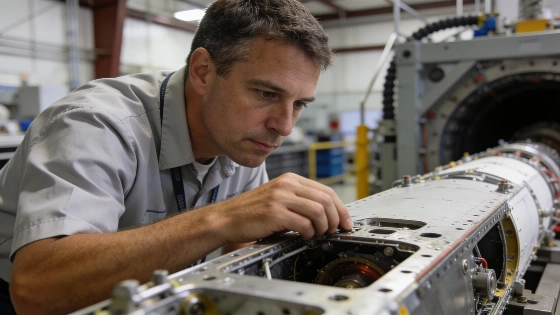
A NASA Kennedy team has adapted finite element modeling software to assess shock and vibration risks in launch hardware, using a standardized workflow during certification of a commercial provider's rocket for a NASA mission
During certification of a commercial launch provider's rocket for a NASA mission, engineers found that the company had supplied vibration testing but no shock testing. NASA's Dynamic Environments Group used a new modeling workflow to assess the gap and examine how launch hardware could respond to those forces.
Filling a test gap
The group, part of the Launch Services Program Office at NASA's Kennedy Space Center in Florida, used commercial software for the first time on this certification effort. Engineers determined that shock testing was needed, then applied a standardized template they had developed for finite element modeling.
The template let the team compare what-if cases and visualize structural behavior. It also helped answer questions that previously required extensive manual modeling. The engineers used the analysis to check the provider's test results against flight environments and to examine shock during transport.
Vibration, acoustic and shock loads represent different physical conditions. Vibration reaches hardware through its mounting points, while acoustic testing applies pressure through the air; shock is a brief, sharp impulse that can occur during events such as stage separation or the operation of mechanisms. As NASA/JPL explains in its descriptions of spacecraft testing, these test types address distinct environments. A vibration test alone does not characterize a component's response to shock.
Brian Beaver, chief of the Flight Analysis Division with the Launch Services Program Office, has described the method as a way to predict how rockets and spacecraft may behave before hardware is built. Such modeling can help engineers locate weak areas and assess potential failure risks early enough to address them.
What the model adds
Finite element analysis divides a complex structure into smaller parts that a computer can calculate. Engineers assign properties and conditions to the model, then use simulations to estimate how the assembled structure may respond to applied forces. The result is a prediction based on the model, not a direct measurement of a rocket in flight. Model inputs such as boundary conditions, mass distribution, damping, mounting points and the direction and frequency of the applied loads shape the calculated response.
For decades, engineers estimated shock and vibration conditions using rules of thumb or by scaling data from earlier missions. That approach relied substantially on engineering judgment and simplified comparisons. The new workflow offers a repeatable template for engineers who use these modeling tools infrequently, reducing the need to relearn complicated procedures each time.
Alex Hardt, an aerospace engineer with the Launch Services Program Office, has said the group is applying a longstanding software tool in a relatively new area of dynamics. The team could conduct analysis independently instead of waiting for outside analysis reports or data. The workflow has already saved months, according to the source account.
Testing spacecraft environments
A separate NASA/JPL example illustrates how physical testing and instrumented measurements are used alongside structural analysis. During environmental testing of the Griffin-1 lunar lander, hundreds of sensors monitored the spacecraft on a shaker table as it was vibrated in three directions. Acoustic testing used compressed-nitrogen horns to generate sound levels of up to 153 decibels. The campaign also included vacuum and thermal tests, followed by work in JPL's 25-Foot Space Simulator.
NASA/JPL also rotated Griffin-1 on a specialized stand to measure its mass properties, which help assess the spacecraft's balance and support flight-navigation and landing preparations. The full campaign put the lander through vibration, acoustic, vacuum, thermal and mass-properties testing, with each procedure addressing a different aspect of the mission environment, as described in NASA/JPL's Griffin-1 test campaign.
Finite element analysis is a numerical method for approximating how a structure responds to forces. It represents the object as many connected elements, then calculates how those elements may deform or transmit loads under specified conditions. The quality of the estimate depends on how accurately the model represents the hardware and the forces applied to it. It can guide engineering decisions, but it remains a simulation rather than a flight measurement.
NASA's Launch Services Program Office manages launches for spacecraft ranging from weather satellites to Mars rovers. Its work includes assessing whether launch vehicles can carry mission hardware through the physical demands of ascent. Earlier NASA reporting on a separate mission described Swift servicing lessons after communications and orientation problems affected an attempted orbit boost.







