NASA will install SpaceX Starlink laser communication terminals on the Artemis III Orion spacecraft, aiming to boost high-definition video and data transmission capabilities during the mission scheduled for 2027
NASA has announced plans to enhance the Artemis III Orion spacecraft with advanced laser communication technology, partnering with SpaceX to integrate Starlink laser terminals. This upgrade is intended to increase the volume and quality of data transmitted between Orion and mission control, including the possibility of live high-definition video from orbit. The Artemis III mission, currently targeted for the second half of 2027, represents a significant step in NASA's ongoing efforts to return astronauts to the lunar surface and establish a sustainable human presence on the Moon.
Starlink Lasers on Orion
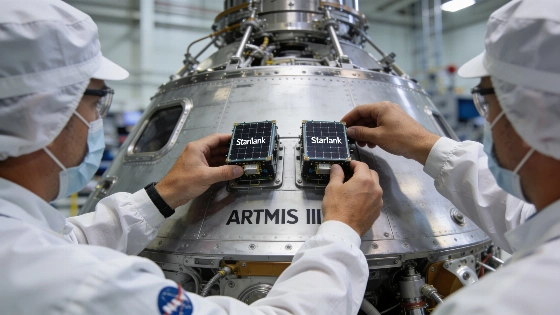
The Artemis III Orion capsule will be fitted with two Starlink mini laser terminals, mounted externally to supplement its existing radio-based communication systems. These terminals are designed to operate within SpaceX's Starlink satellite network, which currently consists of more than 10,000 satellites in low Earth orbit (LEO). Each Starlink satellite is equipped with multiple laser links, enabling high-speed, inter-satellite data transfer and global coverage. By leveraging this infrastructure, NASA aims to overcome traditional bandwidth limitations and enable more robust downlink of mission data, including real-time video and large scientific datasets.
SpaceX has previously demonstrated the use of its Starlink constellation as a relay network for space missions, notably during the Fram2 mission in 2025, which carried the first human into a polar orbit around Earth. The company routinely uses Starlink's high-data-rate capabilities to stream live video from Falcon 9 and Starship launches, providing a proven foundation for its role in Artemis III communications.
Mission Objectives and Technical Context
Artemis III is the third mission in NASA's Artemis program, which is focused on returning astronauts to the Moon and developing the infrastructure for long-term exploration. Unlike Artemis II, which sent Orion and its crew on a 10-day journey around the far side of the Moon, Artemis III will remain in low Earth orbit for key mission phases. The mission will serve as a rehearsal for Orion's rendezvous and docking with commercial lunar landers, including SpaceX's Starship and Blue Origin's Blue Moon, before future lunar surface operations.
The addition of Starlink laser terminals is expected to simplify communication challenges compared to deep-space operations. During Artemis II, NASA used laser communications between Orion and ground stations at the Jet Propulsion Laboratory in California and the White Sands Complex in New Mexico to transmit data volumes that exceeded the capacity of conventional radio networks. With Artemis III operating closer to Earth, the integration of Starlink's optical links is anticipated to further increase data throughput and reliability.
Data Capacity and Scientific Impact
The Starlink network's more than 25,000 operational lasers in LEO, according to NASA, provide a dense mesh for high-bandwidth data relay. For Artemis III, this means the potential for continuous, high-definition video streams and rapid transmission of scientific data collected during the mission. The ability to send large volumes of imagery and telemetry in near real time could improve mission oversight, enable more responsive ground support, and enhance public engagement with the mission's progress.
NASA's approach reflects a broader trend toward commercial partnerships in space exploration, leveraging private-sector infrastructure to augment government mission capabilities. The Artemis III mission will also rely on SpaceX's Starship as a lunar lander, underscoring the growing role of commercial providers in both transportation and communications for lunar exploration.
Looking Ahead to Artemis IV
If Artemis III achieves its communication and operational objectives, NASA plans to proceed with Artemis IV, which is scheduled for launch in 2028. Artemis IV is intended to deliver the first Artemis program crew to the lunar surface, with Starship selected as the lunar lander. The success of Starlink-enabled communications during Artemis III could inform future mission architectures, potentially shaping how data is managed and transmitted for subsequent lunar and deep-space missions.
SpaceX's expanding role in both launch and communications infrastructure has drawn attention across the space sector. For context, the company's technical challenges and mission milestones, such as the recent Starship test launch abort, have been covered in detail in related reporting, including a recent analysis of Starship's evolving role in scientific and defense missions.
Laser communication systems represent a significant advance over traditional radio-frequency links, offering higher data rates and reduced signal interference. In the context of Artemis III, the integration of Starlink laser terminals is expected to provide a testbed for future deep-space communication strategies, though the system's performance in the operational environment will be closely monitored. The outcome will help determine the feasibility of scaling such technology for more distant missions, including those to the lunar surface and beyond.
Laser communications in space rely on the transmission of tightly focused beams of light between terminals, either on spacecraft or ground stations. Unlike radio waves, which spread out and can suffer from interference, laser links can carry much more data over the same period, provided that the terminals remain precisely aligned. Atmospheric conditions, spacecraft orientation, and pointing accuracy all affect the reliability of these links. The use of a dense satellite network like Starlink's in low Earth orbit helps mitigate some of these challenges by providing multiple potential relay paths, increasing the likelihood of maintaining a stable, high-bandwidth connection throughout the mission.