

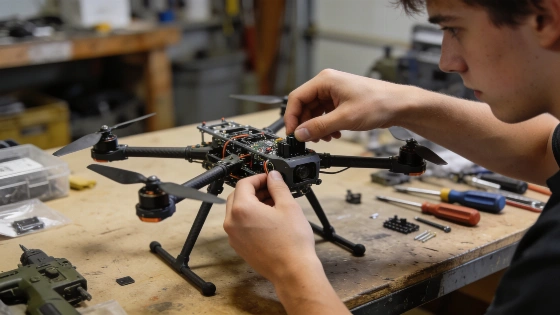
A NASA student grant gave Gavin Gardner experience with budgets and fundraising alongside drone engineering. He later co-founded AG3 Labs with USRC alumni; the company builds drones for military training exercises.
AG3 Labs' production capability was reported to support thousands of drones each month after an initial U.S. Army award led to further contracts. NASA reports that Gavin Gardner and other alumni of its University Student Research Challenge (USRC) founded the company in 2024; Gardner's brother was also among the founders. AG3 Labs builds drones for military training exercises.
From Lab to Company
Gardner's route to co-founding the business began with engineering research at Michigan State University. The grant-funded work taught him that running a technical project also meant learning how to manage budgets and handle large sums of money. His team had little experience promoting its work to potential funders. Through USRC, Gardner gained experience in drone design, project management, budgeting and technical commercialization.
That gap is basic to USRC, which gives grants to college teams pursuing research tied to NASA's aeronautical goals. NASA's wider portfolio also includes spaceflight planning, covered in this JPL mission overview.
Two Drone Projects
In 2021, a friend told Gardner that a team had received a USRC grant for Aerial Intra-city Delivery Electric Drones (AIDED) and needed help building a new aircraft. The idea was to have a cargo drone land on a city bus, recharge while travelling and resume its delivery afterward. The team built and flew a full-scale drone to demonstrate the concept, then decided not to pursue a commercial venture because of the regulations involved in flying over people in a dense city.
Federal Aviation Administration rules generally restrict flights over people unless the operation meets specified conditions, including qualifying under one of the regulatory categories. Category 3 operations, for example, cannot involve sustained flight over open-air assemblies of people. The FAA also sets separate requirements for drones flown over people inside moving vehicles: under 14 CFR § 107.145, Category 1 through 3 operations must take place at a closed or restricted-access site with notice to people in the vehicles, or the aircraft must not maintain sustained flight over moving vehicles. Category 4 operations require an airworthiness certificate issued under Part 21. The general rule for operations over people is set out in 14 CFR § 107.39.
The work led to a second NASA USRC award in 2023. The Laser Energized Aerial Drone System (LEADS) explored transferring power to a drone in flight using a laser, and the team flew a prototype. Through the project, Gardner built contacts in the drone community, including at NASA's Glenn Research Center in Cleveland. Those connections alerted him to internships; he applied and was accepted while in graduate school. He also interned at NASA in 2024.
Lessons Beyond Engineering
As Gardner approached completing his master's degree in spring 2025, he began taking steps to establish AG3 Labs. A friend had suggested that the military could use low-cost drones to test counter-drone systems. The company's early Army award brought additional contracts and supported its expansion. NASA reported that AG3 Labs' production capability reached thousands of drones per month.
Gardner has credited USRC with strengthening the business skills that helped him and his teammates build the company. His experience reflects the challenge the program is designed to address: turning student engineering work into projects that others can understand and support.







