

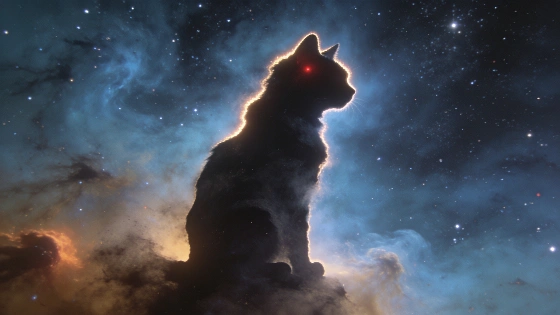
Hubble's visible-light image and Webb's infrared observations show how dust and gas shape a star-forming pillar in the Carina Nebula while revealing structures hidden at shorter wavelengths
Radiation and winds from massive stars are eroding gas around a dense pillar in the Carina Nebula. Denser material inside the pillar resists that erosion longer than the surrounding gas, helping preserve its narrow shape. The filament's outline resembles a cat sitting with its back to the viewer; "Cat's Head Nebula" is an informal nickname for the feature, not a separate official designation.
Radiation Shapes the Pillar
The region lies about 7,500 light-years from Earth, within the much larger Carina Nebula, a major star-forming complex in the Milky Way. NASA and the Space Telescope Science Institute describe the Hubble and Webb observations as complementary views of the same dusty structure. Hubble captured it in visible light, while Webb observed it in near- and mid-infrared wavelengths.
In Hubble's image, the pillar appears as opaque, dark-brown dust edged by a luminous rim of gas. The rim marks gas illuminated and affected by nearby stars; blue regions include ionized gas and starlight scattered by dust. The cat's head turns to the right, where a red feature may mark a young star partly embedded in dust. The scene shows a temporary phase in a star-forming environment, where radiation and stellar winds continue to reshape the cloud.
What Infrared Reveals
Webb's near-infrared view makes portions of the pillar more transparent, revealing surface structure and a dense field of stars, along with faint background galaxies. Wisps of dust and gas appear to its left, exposed to radiation from nearby massive stars. The shape of the filament remains broadly recognizable across wavelengths, but each view reveals different details.
Webb's mid-infrared image traces warm dust and carbon-based molecules excited by starlight. Changes in local conditions and composition produce variations in color and brightness. Hubble's visible-light image, taken with its Wide Field Camera 3, shows dust blocking much of the light behind the pillar; its filters also capture light from oxygen and hydrogen, sulfur emission, and starlight scattered by dust. The contrasting images record different emissions and absorption, not simply different levels of sharpness.
A Candidate Embedded Star
A bright source to the pillar's right appears yellow in the mid-infrared image against reddish emission from surrounding material. NASA describes it as a likely infant star embedded in dust. A narrow filament appears to cross the source, but the image alone cannot establish whether the two are physically connected.
NASA's wider space-science work also includes experiments aboard the International Space Station; a Crew-12 mission report describes that separate research. The nebula images themselves show how different wavelengths reveal distinct features in the same region.
Infrared light has longer wavelengths than visible light and can pass through some dust that blocks visible observations. Near-infrared imaging can so reveal structures within the pillar, while mid-infrared emission traces warm dust and carbon-based molecules energized by starlight. As the Space Telescope Science Institute explains, Hubble's visible-light silhouette and Webb's infrared views offer complementary perspectives on this dusty filament in Carina.







