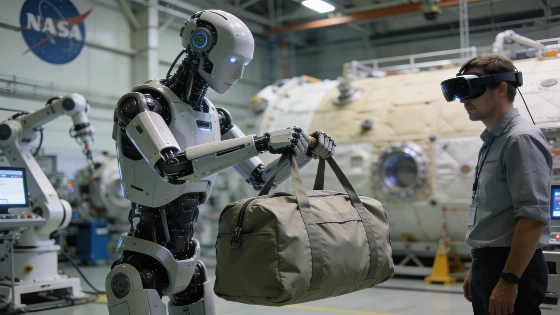
NASA is testing robots that can recognize hatches, open heavy doors, move cargo and service equipment while astronauts provide high-level commands across the communication delays of lunar and Mars missions.
A robotic arm that recognizes a spacecraft hatch, turns its latch, opens the door and transfers cargo is offering NASA a practical answer to one of deep-space exploration's hardest constraints: people cannot respond instantly to machines operating far from Earth.
NASA's 16-member Dexterous Robotics Team at Johnson Space Center is developing human-supervised robots for lunar logistics, maintenance and science. The near-term emphasis is supporting a sustained human presence on the Moon, while the agency is also considering future Mars applications and preparing technologies for a forthcoming public challenge focused on Mars exploration.
The control problem changes sharply with distance. Communication between Earth and the Moon can involve delays of a few seconds, while a signal to Mars can take more than 20 minutes one way. Continuous joystick-style control would therefore be unsuitable for many tasks. Instead, a person can issue a high-level instruction while the robot manages detailed perception, movement and hand-eye coordination.
That distinction matters. NASA describes these systems as human-supervised rather than fully autonomous explorers. The robot can perform a defined physical action, but a person remains responsible for objectives, oversight and intervention when conditions fall outside the tested task.
The approach is consistent with NASA's broader lunar planning. The agency's Moon Base learning materials describe an outpost that would begin with robotic systems and develop toward continuous human operations, linking lunar infrastructure to preparation for eventual crewed missions to Mars.
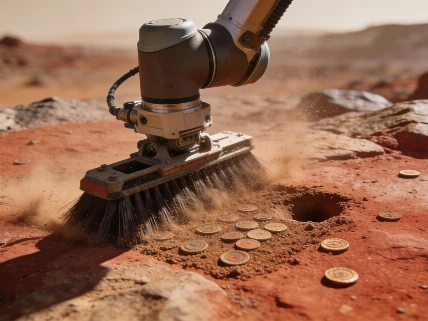
NASA is using the Integrated Mobile Evaluation Testbed for Robotics Operations, or iMETRO, to test that division of labor. The facility combines open-source software, simulation assets, space-vehicle and habitat mockups, "house robots" and an outdoor rock yard. It is available not only to NASA programs but also to external partners, allowing hardware and software to be evaluated in environments more representative of operational work than a clean laboratory.
One test used software developed by PickNik Inc. to guide a robotic arm through a sequence that included recognizing a hatch, turning its latch, pulling open a heavy door and transferring cargo bags inside. A separate project tested a commercial arm for inspecting and maintaining a station-style cold-stowage freezer. The available account does not report a trial count, success rate, confidence interval or independent evaluation for either demonstration, so these examples show task capability rather than established field reliability.
NASA's earlier machines provide the team with an engineering base. Robonaut 2 spent seven years aboard the International Space Station, and Valkyrie became NASA's first bipedal humanoid. Those systems do not eliminate the gap between a successful demonstration and dependable operation on another world, but they give the current program a history of testing physical machines in space-related environments.
Robotic performance also depends on the environment built around the machine. Testing at iMETRO illustrates how habitat design can affect operation: larger handles and brighter lighting may make tasks easier for robots as well as astronauts. Handles, latches, lighting and workspace geometry therefore become part of the control problem, alongside software and mechanical design.
Space gives these machines a clear operational advantage. Radiation, extreme temperatures, vacuum and abrasive dust can threaten human survival, while robots do not need oxygen, water, food or bulky spacesuits. That makes them potential candidates for exterior repairs, damaged-hardware inspections and surface scouting where a failure could expose a crew member to serious danger.
The argument is not that robots remove risk. A machine that fails to locate a hatch or properly handle a latch could delay operations or require human intervention. The reported tests also do not establish how these systems perform after hardware wear, communication interruptions, unexpected obstacles or other conditions absent from a controlled evaluation. No evidence in the available material shows routine deployment on the Moon or Mars.
The measurable facts are limited but concrete: the Dexterous Robotics Team has 16 members; Robonaut 2 operated aboard the International Space Station for seven years; lunar communication may involve delays of a few seconds; and Mars communication can take more than 20 minutes. Within iMETRO, NASA and its partners have demonstrated software-assisted hatch handling and freezer inspection tasks, but the available account provides no numerical performance rate or comparison with an alternative system.
That limitation should shape how the work is described. The demonstrations support the case for supervisory control in delayed communications and show why robots could take on hazardous physical work. They do not prove that a general-purpose humanoid can maintain a lunar base, operate without human oversight or perform reliably across the unpredictable conditions of Mars.
NASA's strategy is strongest where it treats robots as force multipliers rather than artificial astronauts. Humans would still set objectives and handle unusual situations while machines perform repetitive or dangerous manipulation. For lunar and Mars exploration, that is a more credible path than promising full autonomy: build systems that can execute defined tasks, test the surrounding habitat as carefully as the robot itself and keep the boundary between assistance and independence visible.
As in other areas of aerospace engineering, the decisive evidence will come from repeatable testing under representative conditions. iMETRO's combination of simulation, mockups, outdoor terrain and partner access is designed to expose failures before deployment. The program therefore represents a serious engineering effort with useful demonstrations-not a finished robotic workforce already ready to operate independently on another world.