NASA's DAVINCI engineering model completed six thermal cycles at 465 C, reproducing the heating rate expected during a descent through Venus' atmosphere and clearing an important hardware-readiness test.
NASA's DAVINCI descent probe engineering model has cleared a thermal test designed to reproduce the brutal heating it will face while falling through Venus' atmosphere. The result applies to a ground-based engineering unit rather than a flight probe already operating at Venus, but it removes a critical hardware concern from the mission's path.
The Thermal Trial
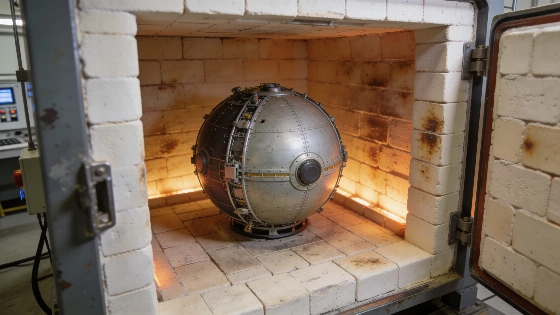
From Aug. 28 to Sept. 10, the DAVINCI team evaluated a roughly yoga-ball-sized engineering unit inside a ceramic-lined chamber. The model was heated to 869 F, or 465 C, in about one hour. Engineers selected that temperature ramp to match the expected rate at which the spacecraft will warm during its descent through Venus' atmosphere.
The campaign was repeated six times, and the model reportedly completed the cycles without damage. Independent coverage identified Rex Heat Treat in Bedford, Pennsylvania, as the testing facility, one of the relatively few industrial sites able to reproduce Venus-like temperatures at the required heating rate. The INAF test report places the work in the context of the mission's continuing hardware development.
That ramp rate was not incidental. A spacecraft can experience different stresses when exposed to the same peak temperature quickly or gradually, because heat moves through its shell, insulation, fasteners, and internal components over time. Matching both the peak temperature and the expected warming pace therefore provides a more relevant engineering check than simply placing a model in a hot environment.
What Was Measured
The evidence here is an engineering performance result: the model underwent six controlled temperature increases and successfully passed the evaluation. It is not a measurement of Venus' atmosphere and does not provide new chemical, geological, or biological data from the planet.
The test also should not be confused with a completed mission milestone at Venus. No descent data, surface observation, or atmospheric composition measurement came from this campaign. The result is narrower and more concrete: the engineering model survived a thermal profile designed to represent the heating it is expected to experience during descent.
NASA says the mission is still working toward approval to enter final design and fabrication. Current planning reported by mission summaries retains a tentative launch target of June 2029, although that schedule remains subject to the program's formal development decisions.
Why Venus Matters
DAVINCI stands for Deep Atmosphere Venus Investigation of Noble gases, Chemistry, and Imaging. Its planned scientific purpose is to study Venus' atmosphere, origin, and evolution in detail, with the larger objective of assessing whether the planet may once have been wet and potentially habitable in ways that offer a comparison with Earth.
Venus is now a profoundly hostile world, with a dense carbon-dioxide atmosphere, crushing pressure near the surface, and temperatures capable of destroying conventional spacecraft hardware. That environment makes a surviving descent system essential to the science: instruments must remain functional long enough to sample and image the atmosphere as the probe falls through it.
The mission's questions also connect planetary science with the broader comparative work pursued by NASA and ESA. By examining why Venus followed such a different evolutionary path from Earth, researchers can test ideas about climate stability, atmospheric loss, and the conditions that allow-or prevent-long-term surface habitability.
Engineering Before Evidence
The distinction between hardware readiness and scientific discovery matters. This was a ground-based thermal evaluation rather than an observation of Venus, unlike an earlier Webb report, which concerned astronomical observations. DAVINCI's test establishes a condition for collecting future measurements; it does not establish what those measurements will find.
For a mission aimed at reconstructing Venus' past, that is still a substantive step. The model survived six rises to 465 C in about an hour while following the expected heating pace for descent. The strongest reading of the result is therefore also the most disciplined one: DAVINCI's engineering hardware has passed a demanding thermal check, giving the mission a firmer foundation without turning a test result into evidence that Venus was once habitable.
Thermal testing works by comparing a vehicle's response with the temperature profile it is designed to endure. In this case, the important variables supplied are the peak temperature, the rate of increase, and the model's condition after repeated exposure. There is no p-value or confidence interval to report because this was not a statistical scientific experiment; it was a qualification-oriented hardware campaign.
That makes the test a practical gate for future observations. Its value lies precisely in its limits: it shows that the engineering model survived the modeled heat without reported damage, while the questions of Venus' atmospheric history, surface conditions, and possible ancient habitability still require measurements from the mission itself.