

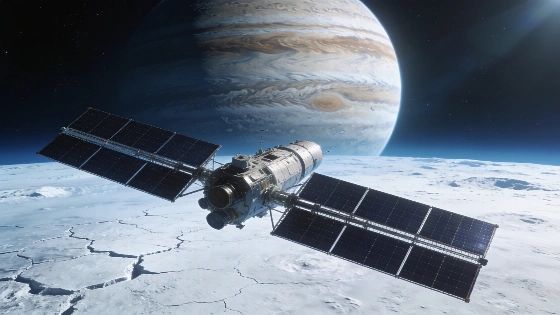
Europa Clipper's 2013 development effort and 2024 launch anchor "The Europa Concept," a film about the engineering behind a Jupiter-bound mission. It is available from Nov. 23 on NASA+ and the NASA app, with NASA's website also hosting it
A spacecraft built to endure Jupiter's radiation will make repeated close passes of Europa, a moon with a vast ocean thought to lie beneath its icy shell. The mission will investigate whether that ocean has ingredients and physical conditions that could support life; it is not designed to detect life directly. NASA describes the goal as determining whether places below Europa's surface could support life.
Built for Europa
NASA's documentary "The Europa Concept" follows the mission from its early vision through spacecraft development and launch. Its focus is the long effort to turn a proposed journey to Jupiter's moon into a working deep-space mission, including the challenge of protecting the spacecraft from one of the solar system's harshest radiation environments. Work on the mission officially began at NASA's Jet Propulsion Laboratory in 2013, and the documentary follows the 11-year effort leading to the 2024 launch.
The team had 11 years to build the spacecraft and its nine dedicated science instruments before a specific planetary launch opportunity. Europa Clipper also uses its telecommunications system for a gravity experiment. Its instruments will examine Europa's surface, interior, magnetic environment and interactions with Jupiter's plasma; an ice-penetrating radar, cameras and a thermal instrument are among the payload. The mission launched from Kennedy Space Center aboard a SpaceX Falcon Heavy on Oct. 14, 2024, after delays and other challenges that included a global pandemic, a Category 5 hurricane and tornadoes near Kennedy Space Center.
Jupiter's radiation belts pose a major engineering challenge. NASA says a special aluminum-zinc alloy vault shields the spacecraft's sensitive electronics, while the mission's trajectory is designed to limit time in the most hazardous radiation zones. Rather than orbit Europa directly, the spacecraft will orbit Jupiter and make dozens of targeted Europa flybys, including passes as close as about 16 miles (26 kilometers) above the moon's surface.
A Long View
Europa has been known since Galileo Galilei discovered it in 1610, but spacecraft gradually changed what scientists could learn about the moon. NASA's Pioneer 10 gathered data in 1973, followed by Pioneer 11 the next year. Voyager 1 provided the first detailed view during its 1979 flyby; later observations came from Voyager 2, Galileo, Cassini and Juno. Europa Clipper is the first mission designed for a detailed study of the moon, extending that history of observations into a dedicated reconnaissance campaign.
The documentary places that history alongside the people who built the mission. NASA's broader record of turning spaceflight into scientific observation includes Gemini-era Earth photography, which helped support the case for satellites dedicated to observing Earth's resources.
The Journey Ahead
Europa Clipper is the largest spacecraft NASA has sent into deep space. NASA describes the roughly 6-ton explorer as traveling about 1.8 billion miles (2.9 billion kilometers) to the Jupiter system. The spacecraft launched in October 2024 and is following a gravity-assist route: NASA scheduled a Mars flyby for February 2025 and an Earth flyby for December 2026 to build the velocity needed to reach Jupiter. Arrival is planned for April 2030.
After reaching Jupiter, Europa Clipper will conduct repeated flybys from different locations and viewing angles to survey the moon's geology, icy shell, interior and subsurface ocean. The measurements are designed to assess whether Europa has conditions suitable for life, not to establish that life is present. NASA's mission fact sheet outlines the spacecraft's science objectives and instruments, while the mission's NASA+ documentary follows its development and journey.
The film is available starting Nov. 23 on NASA+, the NASA app and NASA's website. NASA has also announced that it is coming to YouTube, without giving a date for that release.
What Habitability Means
A potentially habitable environment has conditions that could support life; the term does not establish that life is present. Europa Clipper will study the moon's ice shell and interior, investigate its ocean indirectly, and look for evidence such as warmer regions of ice or possible water activity. The spacecraft's nine instruments and telecommunications-based gravity experiment will help characterize Europa's environment without directly sampling the ocean beneath the ice.







