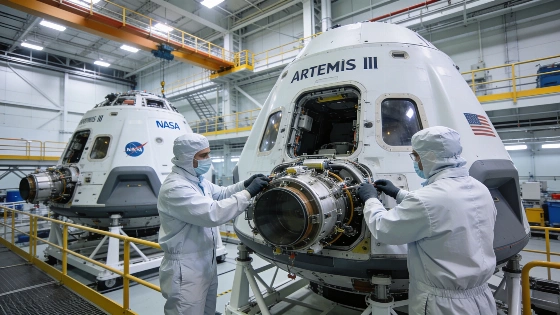
Technicians at Kennedy Space Center have integrated the Orion crew and service modules for Artemis III, a key milestone ahead of the mission to test lunar landing system rendezvous and docking in lunar orbit
NASA has completed a major assembly step for Artemis III, joining the Orion crew module with its European-built service module inside the Neil Armstrong Operations and Checkout Building at Kennedy Space Center on July 30, 2026. This integration marks a critical milestone as the mission team prepares for the first planned crewed lunar landing attempt of the Artemis program.
Orion's Role in Artemis III
The Orion spacecraft is designed to transport astronauts beyond low Earth orbit, providing life support, navigation, and reentry capability for deep space missions. For Artemis III, the crew module will carry NASA astronauts Randy Bresnik, Andre Douglas, and Frank Rubio, along with ESA astronaut Luca Parmitano. The service module, developed by the European Space Agency, supplies propulsion, electrical power, thermal control, and consumables for the journey to lunar orbit and back.
During the mission, Orion will test rendezvous and docking procedures with test articles-non-operational versions-of commercial human landing systems developed by Blue Origin and SpaceX. These operations are intended to validate critical systems and procedures before attempting a crewed lunar surface descent.
Assembly and Testing Milestones
The integration of the crew and service modules follows a series of subsystem verifications, including pressure vessel checks, avionics installation, and environmental testing. The joined spacecraft will undergo further functional tests and system checkouts before being transferred for integration with the Space Launch System (SLS) rocket.
Artemis III is scheduled to launch from Kennedy Space Center's Launch Complex 39B. The mission's timeline remains subject to technical readiness and the completion of landing system development. The Orion spacecraft's assembly is a prerequisite for final mission rehearsals and flight certification.
International Collaboration and Mission Context
The Artemis III mission represents a collaboration between NASA and the European Space Agency, with the ESA-provided service module playing a central role in Orion's performance. The mission will also test interfaces with commercial lunar landers, reflecting NASA's strategy of integrating international and private-sector contributions for lunar exploration.
Recent NASA missions have highlighted the agency's commitment to public engagement and international partnership. For example, a memory card carrying over a million names was recently installed on the Nancy Grace Roman Space Telescope, as described in a recent Science Report article on the Roman mission's preparations for launch to the L2 point.
Technical Details and Remaining Challenges
The Orion crew module is equipped with advanced life support and safety systems, while the service module provides 8.6 metric tons of propellant for main engine burns and attitude control. The spacecraft's avionics and power systems are designed for extended operations in deep space, with redundancy to mitigate single-point failures. However, the mission's success depends on the readiness of commercial lunar landers and the reliability of new docking systems, both of which remain under active development and testing.
NASA has emphasized that Artemis III's schedule may be adjusted based on technical progress and the resolution of outstanding integration challenges. The agency continues to conduct risk assessments and simulations to ensure crew safety and mission success.
Spacecraft commissioning is the process of verifying that all systems function as intended after assembly and before launch. This phase includes electrical, mechanical, and software tests, as well as simulated mission operations. Only after successful commissioning can a spacecraft proceed to final integration with its launch vehicle and, ultimately, to flight. For Artemis III, commissioning will confirm that Orion's crew and service modules operate together as a single, flight-ready system capable of supporting astronauts on a lunar mission.