A memory card carrying 1,350,144 names has been mounted on NASA's Nancy Grace Roman Space Telescope ahead of its planned launch to an orbit about one million miles from Earth
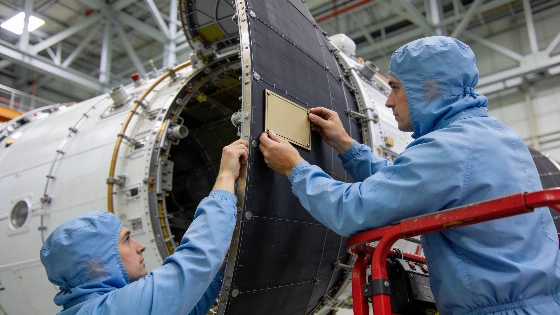
NASA's Nancy Grace Roman Space Telescope is set to leave Earth with more than a million human names attached to its mission. Technicians at NASA's Kennedy Space Center in Florida installed a memory card containing 1,350,144 names on July 27, placing it inside a commemorative plaque that will travel with the observatory.
The names aboard
The names were submitted by people around the world as part of a public participation campaign. The list includes astronauts from Artemis II and Artemis III, connecting the observatory's journey with NASA's wider program of human and robotic exploration.
The memory card is a symbolic payload rather than a scientific instrument. It will not collect images, measure infrared light, or influence the telescope's observations. Its role is commemorative: the names will accompany an observatory designed to investigate how the universe changes across enormous distances and timescales.
That distinction matters because the presence of the card does not add scientific capability to Roman. The observatory's future results will depend on its telescope, detectors, pointing accuracy, calibration, and data analysis-not on the number of names carried on the plaque.
Destination L2
After launch, Roman is intended to travel to the Sun-Earth Lagrange point 2, commonly called L2. The region lies about one million miles, or approximately 1.6 million kilometers, from Earth on the side away from the Sun. At L2, the gravitational relationship between the Sun and Earth provides a useful location for a space observatory operating with them.
Roman will not sit motionless at a mathematical point. Spacecraft operating near L2 follow an orbit around the region and require trajectory control. The destination is nevertheless valuable because it allows a distant observatory to remain aligned with the Earth-Sun system while carrying out long-duration observations beyond the blurring effects of Earth's atmosphere.
The mission's scientific purpose is to conduct wide-field observations of the cosmos, including studies relevant to dark energy, exoplanets, and the growth of cosmic structure. Those investigations will begin only after launch, deployment, commissioning, and instrument calibration. The name-bearing plaque is therefore part of the observatory's pre-launch preparation, not evidence that Roman has started science operations.
Launch remains scheduled
NASA and SpaceX are targeting a launch no earlier than 7:26 a.m. Eastern Daylight Time on Sunday, August 30, 2026. The planned vehicle is a SpaceX Falcon Heavy launching from Launch Complex 39A at Kennedy Space Center. A target date is not a guarantee: weather, technical checks, range availability, or other operational factors could change the schedule.
The launch itself would be only the first major milestone. Roman would still need to separate from the rocket, establish communications, deploy its spacecraft systems, and undergo commissioning before routine observations could begin. Each stage tests a different part of the mission, so a successful ascent would not by itself demonstrate that the observatory is ready to produce scientific data.
The mission also sits within a continuing sequence of NASA operations that depend on careful hardware handling before flight. Recent work elsewhere in the agency's exploration program included the movement of a large hydrogen tank for future core-stage testing, while an astronaut has completed an extended International Space Station mission. The Roman installation is a different kind of milestone, but it illustrates the same pre-launch reality: space science begins with precise engineering and verification on Earth.
Roman is named for Dr. Nancy Grace Roman, NASA's first chief astronomer and a major advocate of space-based observatories. She supported the use of telescopes above Earth's atmosphere and emphasized broad access to astronomical data. The observatory bearing her name is intended to extend that approach through a large survey of the universe, while the plaque offers a separate, human record of the people who chose to be associated with its journey.
For readers following NASA's human-spaceflight activity, the wider schedule can be viewed alongside the recent return of an astronaut after an eight-month station mission. That comparison also highlights the different timescales involved: crewed missions measure time in months, while a space observatory such as Roman is built to support astronomical investigations over years.
Lagrange points are locations defined by the combined motion of two orbiting bodies and the gravity acting within that system. They are not places where gravity disappears, nor are they perfectly stationary parking spots. A spacecraft near L2 must still orbit and make occasional corrections, but the geometry can reduce the effort needed to remain in a useful observing configuration. For Roman, that orbital environment is part of the mission design; the names on its plaque are a record carried into deep space alongside the hardware that will perform the measurements.