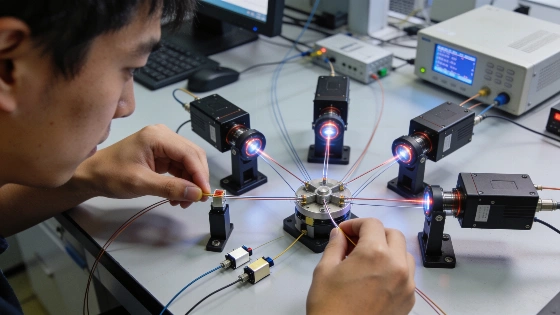
Nanjing University has demonstrated a three-user measurement-device-independent quantum conferencing network that retains O(η) loss scaling and uses timestamped event pairing and software phase correction instead of global laser locking.
A three-user quantum communication network has retained secure key generation across 59.6 decibels of total loss while avoiding the hardware burden of globally phase-locking independent lasers. The demonstration by Nanjing University's Xiao-Song Ma group is an experimental implementation of asynchronous measurement-device-independent quantum cryptographic conferencing, or AMDI QCC. The result was reported as a peer-reviewed Physical Review Letters publication in September 2026 and represents a change in how loss scales as more users join the network.
Loss scaling
In conventional multi-user measurement-device-independent conferencing, a useful key event depends on simultaneous multi-photon detections from all N users. If η denotes the single-user channel transmittance, the resulting key rate scales as O(ηN). That dependence becomes increasingly punishing as optical loss rises or the number of participants grows.
The asynchronous protocol separates the detection events in time. Rather than requiring all users to produce matching detections at one instant, it records compatible single-photon events with timestamps and pairs them during classical post-processing. In the ideal N-user case, this changes the reported leading scaling from O(ηN) to O(η), so the number of users no longer introduces an additional power of η into the loss dependence. The idea builds on earlier theoretical work associated with Zeng-Bing Chen, Hua-Lei Yin, and collaborators, who proposed asynchronous pairing as a way to avoid the simultaneous-detection bottleneck.
That is a protocol-level result rather than evidence that optical loss has been removed. Photons are still lost, and the secret-key rate remains very small at the highest attenuation. The achievement is that the number of users no longer adds an extra power of η to the leading scaling behavior. This distinction is important in the same way that demonstrations reported by institutions such as MIT or CERN must be separated from claims about operational infrastructure: a favorable scaling law does not by itself establish a deployed network.
Phase without locking
The second obstacle is phase stability. Independent free-running continuous-wave lasers do not maintain a fixed relative phase indefinitely, yet the central GHZ multipath fiber interferometer requires phase information to be tracked well enough for the measurement to remain useful.
Nanjing University's team inserted interleaved reference pulses and used a fast Fourier transform to estimate frequency differences between the lasers. The inferred drift was then compensated in software during post-processing. This turns a changing optical phase into a correction calculated from recorded data instead of requiring an active global phase-locking system across the network.
The approach is closely related to the broader engineering problem discussed in an earlier analysis of how classical processing can manage imperfections around quantum hardware, although the present experiment concerns photonic communication rather than superconducting quantum circuits. In practical terms, the strategy shifts part of the stabilization burden from specialized optical control hardware to reference-pulse design, timestamp accuracy, numerical estimation, and calibration.
Measured limits
The reported benchmarks were obtained at three total system-loss settings. At 39.3 dB, the secure key rate was 3.940 × 10-8 bits per pulse with asynchronous single-photon mode pairing and O(η) scaling. At 48.6 dB, the rate was 3.937 × 10-8 bits per pulse while FFT-based frequency-drift estimation tracked changes at 0.4-second intervals. At 59.6 dB, the system produced 4.470 × 10-9 bits per pulse after phase drift was compensated with passive thermal stability.
The 59.6 dB result substantially exceeds the approximately 21.5 dB loss tolerance reported for the group's earlier polarization-encoded MDI quantum conferencing experiment. The comparison indicates a major increase in experimentally demonstrated loss resistance, although it should not be interpreted as a direct distance guarantee because fiber attenuation, detector performance, interferometer visibility, finite-key analysis, and other implementation parameters also determine usable range.
The phase correction had a measurable effect on the X-basis quantum bit error rate. The reported value fell from 50.02% before correction to 40.76% afterward. That reduction indicates improved interference control, but it is not the same as eliminating errors or demonstrating a field-ready network. The experiment established a three-user laboratory network; the available reporting does not establish independent replication, repeater operation, or deployment over intercity infrastructure.
The result was described in a paper published in Physical Review Letters, with an associated preprint and public data release. A research report on the demonstration identifies the work as an experimental realization intended to strengthen the prospects for longer-distance, multiuser quantum conferencing. Peer review provides an important checkpoint, as it does for work appearing in Nature or other leading journals, but it does not remove the need to test whether the same control strategy remains stable across different fiber environments, detectors, laser sources, and longer operating periods.
Engineering meaning
Measurement-device-independent protocols are designed to reduce the security dependence on the measurement apparatus by moving the measurement to a central node, but they do not make every component automatically secure. The users, sources, channels, classical authentication, and implementation details still matter. The reported result therefore addresses two specific bottlenecks-loss scaling and phase coordination-rather than establishing an unhackable communication system.
The practical value lies in the division of labor between optics and computation. Asynchronous pairing relaxes the timing requirement for multi-user detections, while FFT estimation and post-processing replace part of the active stabilization hardware. That can simplify a network architecture, but it also places demands on timestamping, reference-pulse quality, thermal stability, calibration, and the classical processing pipeline. These requirements are familiar in precision photonics, where the difference between a laboratory demonstration and a network service can depend on long-term drift, automation, maintenance, and authenticated classical control.
For quantum networking, this is the right kind of advance to take seriously: not a claim that a quantum internet has arrived, but a hardware demonstration that removes a severe scaling penalty under measured conditions. The next test is reproducibility across independent systems and more demanding channels. Until that evidence exists, the Nanjing experiment should be regarded as a strong protocol and control result with clear engineering relevance, not as proof of a deployable intercity service.
Here, O(η) describes how the leading key-rate dependence changes with single-user transmission, not a promise of constant performance as distance increases. Measurement-device independence also does not mean the network is independent of all device imperfections. The experiment's importance is narrower and more defensible: asynchronous mode pairing and software phase tracking made a three-user photonic protocol substantially more tolerant of loss without requiring complex global phase locking.