An Argonne and UIUC team coupled propagating spin waves to a superconducting resonator on one chip, reporting 4 dB of power isolation at a specific transmission peak. The result is a proof of concept rather than a complete microwave isolator
Microwave noise traveling backward through a superconducting circuit can disturb signals in quantum devices, making direction control a practical hardware problem. Between October 13 and 15, 2026, researchers at Argonne National Laboratory and the University of Illinois Urbana-Champaign (UIUC) reported a chip that couples propagating magnetic excitations directly to a superconducting resonator. Yi Li, an Argonne scientist and first author of the study, described the experiment as a proof of concept for coupling spin waves to a superconducting resonator.
Direction through spin waves
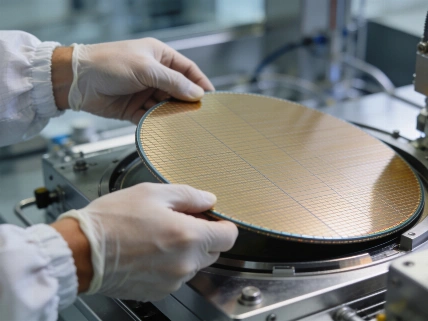
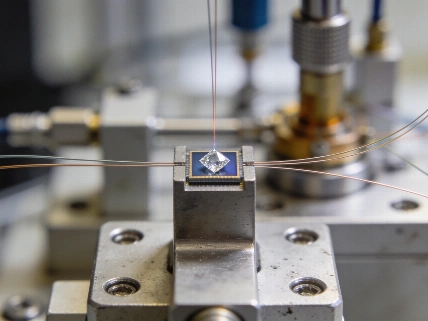
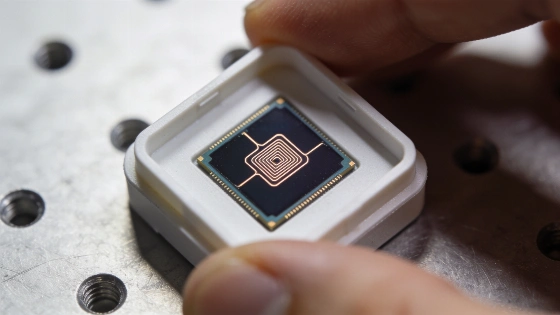
The device combines a 100-nanometer-thick epitaxial yttrium iron garnet (YIG) film with a niobium nitride (NbN) coplanar waveguide resonator fabricated directly on the magnetic film. YIG supports spin waves-collective disturbances of magnetic order-with low propagation damping. As a spin wave travels through the film, it excites microwaves in the circuit above it, enabling the magnetic and superconducting components to interact on the same chip.
The team reports strong coupling between microwave photons and two propagating spin-wave modes: Damon-Eshbach and backward-volume modes. For the Damon-Eshbach mode, the reported coupling strength reached up to 150 MHz for g/2π, with a cooperativity of 662. The device showed 4 dB of power isolation at the degenerate-mode transmission peak in a configuration using a 10 dB antenna. This is a measurement of directional behavior at that peak, not a system-wide isolation figure.
Spin waves can carry excitation along the magnetic film, while their coupling to the resonator produces a hybrid mode with direction-dependent propagation. The researchers present the architecture as a proof of concept for future on-chip microwave isolators, which could help protect quantum circuits from backward microwave noise. The reported peak isolation does not by itself characterize forward insertion loss or performance across a frequency band.
Changing the substrate
Integrating magnetic films with superconducting electronics at cryogenic temperatures has faced a materials bottleneck: the conventional gadolinium gallium garnet (GGG) substrate can absorb microwave signals at low temperatures. The researchers used rare-earth-free yttrium scandium gallium garnet (YSGG) instead. This substrate choice enabled the specific YIG-superconductor device demonstrated in the study; the design does not establish that every YIG film can be integrated with superconducting circuits without added loss.
Device fabrication took place at Argonne's Center for Nanoscale Materials. The study, titled "Strong Coupling between Propagating Spin Waves and Microwave Photons in a Superconducting Resonator," was published in Physical Review Letters and is also identified as preprint arXiv:2606.27279. The research team presented the result as a first demonstration of a hybrid circuit system linking propagating spin waves in a magnetic material with a superconducting circuit.
What the result establishes
The 4 dB measurement applies to the degenerate-mode transmission peak and demonstrates directionality in the hybrid circuit. The work is a proof-of-concept architecture, rather than a complete microwave isolator characterized for use across a quantum processor's operating range. The paper is available through Physical Review Letters.
A separate quantum repeater analysis also examined the hardware needed to connect quantum systems; this experiment addresses a different link in that chain, controlling microwave propagation within a chip. Argonne's description of the work emphasizes the coupling of spin waves to microwaves and the one-way propagation of a hybrid mode. The reported measurement supports those coupling and directionality results, while the proposed application is the development of compact microwave isolators.
A spin wave is a collective disturbance of magnetic order moving through a material; its quantum of excitation is called a magnon. Under specific conditions, these waves propagate nonreciprocally, meaning transmission can differ by direction. Coupling them to a superconducting resonator allows magnetic dynamics to interact with microwave photons on the same chip. The measured 4 dB isolation quantifies the reported directional effect at the specified peak.