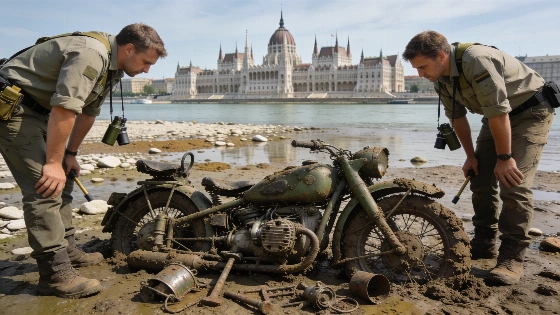
Exceptionally low water levels in the Danube have exposed the remains of two German soldiers, their identification tags, a military motorcycle, and anti-tank mines in Budapest, offering new evidence of the conflict's final months and the challenges of identification decades later
Unusually low water levels on the River Danube in Budapest have exposed a rare archaeological context: the remains of two German soldiers, their intact military identification tags, a motorcycle, and several anti-tank mines, all preserved beneath river sediment since the Second World War. The discovery was made on the riverbed opposite the Hungarian Parliament building, where receding water revealed material evidence of the intense fighting that engulfed the city in late 1944 and early 1945.
Recovery and Preservation
The remains were recovered by an exhumation worker affiliated with the Volksbund Deutsche Kriegsgräberfürsorge, the German War Graves Association, which is responsible for locating and caring for German war dead abroad. The two sets of human remains were found in close association with two German military identification tags-commonly known as dog tags-both reportedly intact and undivided. Alongside the bodies, investigators documented a German military motorcycle and several anti-tank mines, all preserved in a state that suggests the river's sediment shielded them from extensive deterioration.
German military identification tags from this period were designed to be split after death, with one half remaining with the body and the other sent to military authorities for official record-keeping. The fact that both tags were found complete and undivided may indicate that the deaths were never formally recorded, leaving the soldiers officially missing for more than 80 years. The preservation of these tags is particularly significant, as they may allow researchers to match the information with wartime records and potentially identify the individuals and notify any surviving relatives.
Context of the Find
The archaeological context of the find is shaped by the final months of the Second World War, when Budapest became the site of one of Europe's most destructive urban battles. German and Hungarian forces, encircled by Soviet and Romanian troops, fought for control of the city, with the Danube serving as both a strategic barrier and a potential escape route. Many soldiers killed during the siege were never recovered or identified, and the presence of anti-tank mines alongside the remains highlights the ongoing hazards of unexploded ordnance in former battle zones.
The motorcycle, recovered separately by staff from Hungary's Military History Institute and Museum, was found in a remarkable state of preservation despite decades underwater. River sediment appears to have protected the vehicle and associated material, allowing for detailed examination of its construction and potential wartime use. Such finds are not isolated: periods of low water have previously revealed submerged wartime wreckage and, in some cases, human remains. In a related context, archaeological surveys during extreme weather have also exposed previously hidden sites, as seen when a Bronze Age communal tomb in the UAE was uncovered during construction work.
Identification and Uncertainty
The intact identification tags offer a rare opportunity for positive identification, but the process remains complex. Information from the tags must be cross-referenced with surviving military records, which may be incomplete or lost. If successful, the identification could resolve the status of these individuals, who may have remained officially missing since the war. The remains are expected to be reburied at a German war cemetery near Budapest following examination and, if possible, identification.
Numerically, the find includes two sets of human remains, two intact identification tags, one military motorcycle, and several anti-tank mines, all recovered from a single riverbed location. The context dates to the final months of the Second World War, specifically the siege of Budapest from late 1944 to February 1945. The preservation of both organic and inorganic material is attributed to the protective effect of river sediment and the absence of disturbance until the recent drop in water levels.
Hazards and Ongoing Work
The presence of anti-tank mines underscores the risks associated with such discoveries. Unexploded ordnance remains a persistent danger in former battlefields across Europe, and exposed riverbeds can pose hazards even decades after the conflict. The Volksbund Deutsche Kriegsgräberfürsorge continues to investigate and recover remains of missing soldiers, working with local authorities to ensure safe recovery and respectful reburial.
While the precise circumstances of the soldiers' deaths remain uncertain, further analysis of the remains, tags, and associated artifacts may clarify whether they died during the siege, an attempted river crossing, or another event. The discovery highlights the ongoing process of recovering and identifying individuals lost in conflict, and the role of environmental change in revealing new archaeological evidence.
Understanding the significance of this find requires attention to taphonomy-the study of processes affecting remains after death. In riverine contexts, sediment can protect both organic and inorganic material from decay, but fluctuating water levels and human activity may expose or disturb archaeological deposits. The preservation of identification tags and a motorcycle in this case illustrates how environmental conditions can both conceal and eventually reveal evidence of past conflict, while also complicating efforts to reconstruct individual histories from incomplete records.