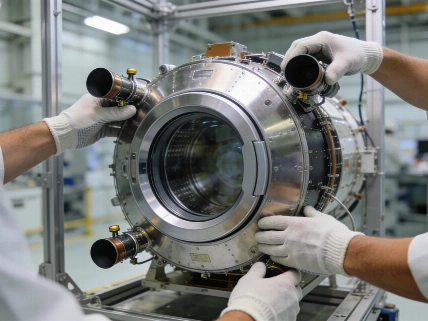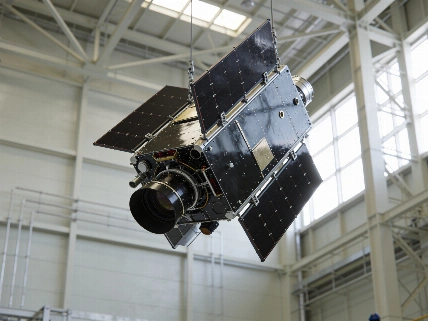
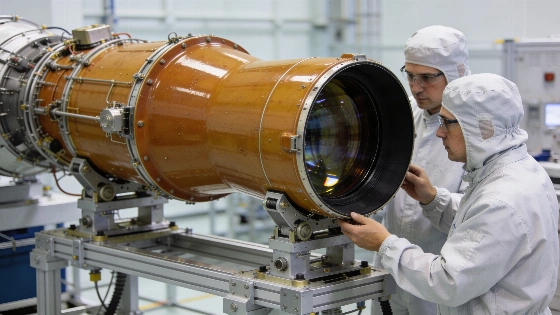
NASA has commissioned L3Harris Technologies to build an engineering test telescope for LISA. The all-glass unit will test the design before production of hardware intended for the mid-2030s mission, while ESA advances the broader observatory toward its planned 2035 launch.
NASA is moving its LISA telescope contribution into the last major test stage before flight hardware production. L3Harris Technologies will design, assemble and integrate an Engineering Test Unit made from the same type of precision ceramic glass planned for the mission's telescopes. The unit is intended to verify the optical and mechanical design rather than make astronomical observations.
The step is technical rather than observational. The new telescope will not detect gravitational waves in space; it will test a design that must preserve optical alignment under the changing thermal conditions of a long-duration mission. NASA describes the unit as its last pre-flight telescope before production hardware and as the first optical telescope it intends to deliver to the European Space Agency.
The design builds on a prototype that L3Harris delivered to NASA in 2024. Engineers subjected that earlier development unit to rigorous testing and will carry the resulting lessons into the new telescope. In June earlier this year, the team also delivered a metal structural model, providing a separate way to examine the telescope's mechanical architecture before relying on the glass-ceramic flight design.
The choice of material is central to the instrument. Each telescope will be made entirely from Zerodur, an amber-colored ceramic-glass composite used in high-precision applications because it resists changes in shape across a broad range of temperatures. That stability matters because even small dimensional changes could affect the optical path used to compare laser signals between spacecraft.
LISA will use three spacecraft in heliocentric orbits to form a triangular observatory. Each side of the triangle will span about 2.5 million kilometers, or 1.6 million miles. Each spacecraft will carry two telescopes that simultaneously transmit and receive infrared laser beams from neighboring spacecraft, allowing the mission to measure changes in their mutual separations.
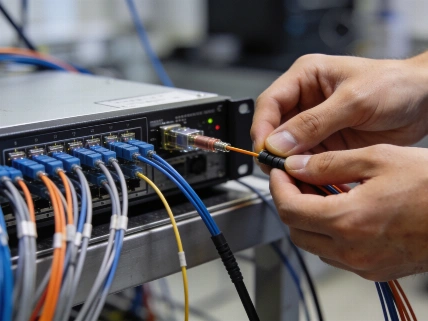
The measured effect will be extraordinarily small: a passing gravitational wave is expected to alter those separations by less than the width of a helium atom. The telescope is therefore not simply an imaging device. Its job is to provide a stable optical route for an interferometric measurement in which laser signals reveal minute changes in distance.
Each spacecraft will also contain a free-floating gold-platinum cube called a proof mass. The spacecraft will control its environment and fly around the cube so that the mass falls through space as freely as possible under gravity alone. NASA's contribution includes the laser system, the telescopes and devices that manage electric charge accumulating on the proof masses.
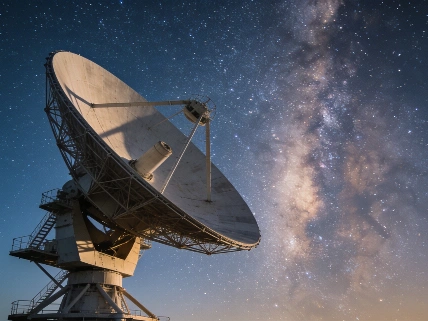
Ground-based observatories detected gravitational waves for the first time in 2015 after Albert Einstein's general theory of relativity predicted them in 1916. Those facilities observe higher-frequency signals than LISA is designed to target. The space mission is intended to access a lower-frequency gravitational-wave population that cannot currently be measured from Earth, complementing the frequency ranges studied by terrestrial observatories.
LISA is expected to study mergers involving supermassive black holes billions of light-years away and compact pairs of white dwarfs, neutron stars and stellar-mass black holes in the Milky Way. It may also test gravity in a regime unavailable to ground-based detectors. Those are scientific objectives rather than results already in hand: LISA is slated for launch around 2035 and has not yet begun collecting gravitational-wave data.
The engineering logic is familiar from other demanding space projects. NASA's earlier servicing lessons show why hardware performance and mission ambition must be treated separately. For LISA, the relevant question is whether the telescope can maintain the optical stability needed for the measurement chain, not whether a ground test itself constitutes a gravitational-wave detection.
ESA leads the LISA mission, while NASA is providing the telescopes, additional critical hardware, engineering and scientific support. NASA will also contribute data analysis intended to identify and characterize individual gravitational-wave sources, along with further expertise in the mission's laser and proof-mass systems. ESA is responsible for constructing the spacecraft, launching the observatory and operating it after deployment. The ESA mission overview describes the three-spacecraft architecture and its low-frequency science goal.
ESA formally approved LISA's transition into the development phase in 2024, with launch still targeted for approximately 2035. In parallel, Thales Alenia Space received a 26.1 million euro contract in May 2026 to develop LISA telescopes, indicating that the European industrial supply line is advancing even as the future scale of NASA's financial commitment remains uncertain.
The funding picture illustrates the importance of the partnership. The U.S. Congress preserved NASA's LISA funding for fiscal year 2026, despite efforts to reduce the American contribution. However, the administration's proposed fiscal-year 2027 budget again sought to cancel LISA funding, leaving NASA's longer-term participation subject to future decisions. ESA has estimated the mission's development budget at 1.75 billion euros in 2024 prices, excluding the full U.S. contribution and certain national contributions from ESA member states; NASA's own contribution has been estimated at roughly 1 billion dollars. These figures describe planned development costs, not a completed scientific return.
ESA's LISA Pathfinder mission demonstrated in 2016 that non-gravitational forces acting on proof masses could be reduced to the level required for gravitational-wave detection. That result addressed a fundamental feasibility problem. The telescope program now addresses another: building an optical system stable enough to turn the spacecraft triangle into a working interferometer. As NASA and ESA advance the hardware, the project remains an example of how precision engineering connects laboratory validation with space-based fundamental physics.
The new telescope is therefore a meaningful milestone but not a scientific discovery. It converts a tested prototype into a final engineering test unit and moves NASA closer to delivering flight hardware. That distinction matters: LISA's promise rests on the eventual performance of the complete spacecraft network, while this stage can establish only whether the telescope design is ready for that next manufacturing step.
Gravitational waves are disturbances that travel through spacetime at the speed of light after massive objects accelerate. LISA will not photograph these waves. It will infer them from changes in laser-measured distances between spacecraft whose separation is millions of kilometers. The telescopes provide the optical measurements, while the proof masses define the near-free-fall reference needed to separate gravitational effects from forces produced by the spacecraft themselves.