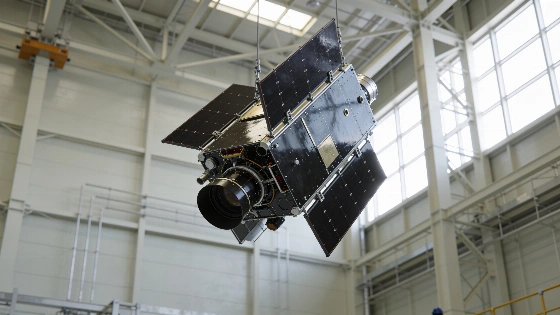
NASA's SPHEREx has analyzed 37 brown dwarfs across an extreme temperature range, detecting spectral signatures of water, methane, carbon monoxide and carbon dioxide while revealing how atmospheric chemistry changes as these objects cool.
Brown dwarfs are proving far more chemically varied than their dim appearance suggests. NASA's SPHEREx has measured infrared spectra from 37 nearby examples and identified spectral signatures of water, carbon dioxide, carbon monoxide and methane across nearly the full known temperature range of these star-like objects.
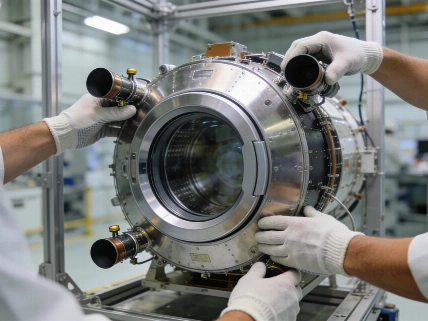
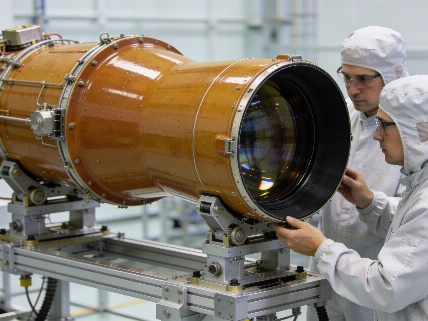
The result, published in The Astrophysical Journal, does not come from a conventional photograph of a brown dwarf. SPHEREx records brightness across 102 color bands, extending from deep red visible light into infrared wavelengths where molecules leave characteristic absorption patterns. A complete spectral set is assembled as an object passes through 17 observing positions on each of the telescope's three detectors: 51 measurements per channel and 102 values across the two infrared ranges. The instrument's wide-field design is described in an instrument overview.
Unlike a conventional observatory that photographs selected targets one at a time, SPHEREx creates spectral information for every point across the sky. That approach can include objects too faint or crowded to be cleanly resolved as separate stars or galaxies, while still providing a standardized way to compare the light from many brown dwarfs.
The sample spans objects from about 2,200 degrees Celsius down to minus 20 degrees Celsius. That range covers almost the full known temperature domain of brown dwarfs and matters because these objects change as they cool: cloud structures evolve, atmospheric chemistry shifts and methane becomes increasingly prominent in some classes. The observations let researchers compare those transitions directly rather than relying only on theoretical calculations.
For a field that has studied only a few dozen brown dwarfs in detail with space-based telescopes, the scale of the survey is its most important feature. The 37 objects represent an initial analysis, while researchers at Caltech's IPAC are processing thousands more. Once processed, the SPHEREx data are archived at IPAC and made available to the scientific community and the public, allowing independent teams to examine the measurements.
Brown dwarfs occupy an unusual category. Like stars, they form when clouds of gas collapse, but they never accumulate enough mass to sustain hydrogen fusion in their cores. They glow faintly from internal heat and can share atmospheric traits with Jupiter and Saturn, yet they drift through space without a host star supplying external illumination.
That independence makes them useful laboratories for atmospheric physics. A free-floating brown dwarf can be studied without the glare of a nearby star, but its clouds and chemistry are still difficult to predict. The objects also cool over time, creating a moving sequence in which temperature and atmospheric composition are linked but not perfectly.
SPHEREx's view complements earlier work with NASA's James Webb Space Telescope and the retired Spitzer Space Telescope. Its advantage is not simply sensitivity to infrared light. By surveying the sky in a broad set of wavelength bands, it can place many objects on the same spectral framework and expose differences that a small number of detailed observations might miss.
The spectra broadly follow the chemical trends predicted by current models, but the agreement weakens during transitions in which thick clouds begin to thin and methane-rich atmospheres emerge. Brown dwarfs with similar temperatures can show notably different spectra, indicating that temperature alone does not determine what an observer will measure.
That mismatch is not evidence of an unknown substance or a new physical law. It is a more specific problem: models capture the general chemistry while struggling to reproduce the detailed behavior of clouds. The missing ingredients could involve how atmospheric particles form, move and disperse, but the study does not establish which process is responsible.
The finding also benefits from comparison with earlier Hubble work on planetary chemistry around a dead star. The two studies address different environments, but together they show why spectra are powerful: chemical signatures can reveal properties that ordinary visible-light images cannot provide.
Brown dwarfs are a secondary target for SPHEREx rather than its primary mission. Launched in March 2025, the telescope takes about 3,600 unique images each day to build maps of the entire sky. Its main program includes tracing the distribution of hundreds of millions of galaxies, investigating the earliest moments after the big bang, searching for chemical ingredients associated with life and locating interstellar ice.
That mission design gives the brown-dwarf study unusual reach. The telescope is not spending its observing time on one nearby object; it is repeatedly collecting standardized measurements while scanning the sky. The resulting dataset can test whether the diversity seen in the first 37 targets is typical, rare or concentrated in particular temperature ranges.
J. Davy Kirkpatrick of Caltech's IPAC described the current paper as an opening sample rather than a final inventory. The observations show molecular signatures and their variation from object to object across the brown-dwarf temperature range, but they do not yet explain why two brown dwarfs at comparable temperatures can behave so differently.
Spectroscopy is the key idea behind the result. Molecules absorb particular wavelengths, removing small amounts of energy from the light that reaches the detector; the pattern across many wavelengths acts as a chemical fingerprint, although clouds and temperature can reshape it. SPHEREx therefore measures light first and infers atmospheric composition through comparison with models. Its expanding survey makes brown dwarfs a strong test of those models, and that is the real significance of the NASA mission: not a catalog of miniature stars, but a large empirical challenge to simplified views of their weather and chemistry.