OptQC has closed a JPY 7 billion Series A2 round and plans a Tokyo R&D hub for photonic quantum processors, while Mitsubishi Electric expands its strategic role in Japan's quantum-hardware ecosystem.
OptQC is targeting a processor with approximately 10,000 qubits after closing a JPY 7.0 billion Series A2 financing round and securing plans for a new Tokyo research headquarters. The scale is significant, but it remains a development target rather than a demonstrated machine: the available announcements establish financing, infrastructure and commercial milestones while leaving processor performance and engineering delivery still to be shown.
The round was led by NTT, Inc. and included Mitsubishi Electric through its ME Innovation Fund. OptQC said the financing was oversubscribed and brought its combined equity and public-grant funding above JPY 20.0 billion. The 21-investor group also includes KDDI, Canon Marketing Japan, Kyocera, ANA Holdings, SBI Holdings and the Japan Science and Technology Agency.
Mitsubishi Electric formally confirmed its investment on September 15, 2026, describing it as the 16th transaction completed through the ME Innovation Fund. The company did not disclose financial terms. Its announcement identifies OptQC as a Japanese optical-quantum-computing hardware startup originating from the University of Tokyo's Furusawa Laboratory. A Japanese corporate release lists Takase Hiroshi as CEO and says the company, founded in 2024, focuses on the research, development and supply of optical quantum-computer hardware.
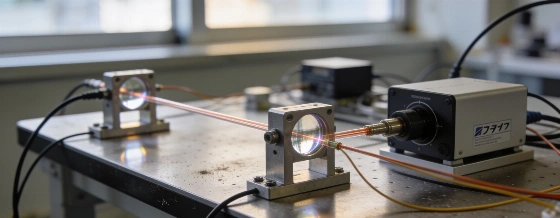
OptQC emerged from the University of Tokyo's Furusawa Laboratory in September 2024. Its stated platform uses continuous-variable optical quantum-processing units designed to operate at atmospheric pressure and without the dilution refrigeration required by some other quantum-computing architectures. In continuous-variable systems, information can be encoded in properties such as the amplitude and phase of optical fields rather than only in two-level states. That design choice may reduce some infrastructure demands, but it does not remove the need to control optical loss, state preparation, interference, detection, error management and system integration.
Photonic processors generally depend on nonclassical light generation, interferometric circuits and measurements such as homodyne or photon-counting detection. Squeezing and other optical resources can provide useful quantum states, while loss is especially consequential because a missing photon can erase computational information rather than merely perturbing a gate. These are established principles of photonic quantum information, not measurements of OptQC's particular device. The company has not publicly supplied a peer-reviewed device characterization with sample sizes, confidence intervals or independently replicated error statistics for the planned processor.
The company plans to use the Series A2 proceeds to develop a next-generation processor aimed at roughly 10,000 qubits and a 100-fold computational-performance increase over its first-generation commercial system, MoQuren. The available material does not provide the benchmark definition behind that comparison, nor does it report qubit fidelity, optical loss, circuit depth, readout performance or an independently verified quantum advantage. As in work reported across the field in journals such as Nature, a meaningful comparison would need a precisely defined task, baseline hardware, runtime, error model and verification procedure.
OptQC was selected for a Tokyo Metropolitan Government subsidy program supporting a 1,225-square-meter R&D headquarters at IT tower TOKYO in Nishi-Ikebukuro. The facility is scheduled to begin operating in February 2027, with hardware development, optical experiments and control work planned for the 15th floor. Theory, software, application studies and intellectual-property strategy are assigned to the 23rd floor.
The proposed layout matters because photonic quantum computing is a full-stack engineering problem. A processor is not just an optical chip or a count of modes. Sources must produce usable quantum states, optical circuits must preserve the relevant interference, detectors must resolve outcomes and control systems must coordinate the experiment. Classical calibration, thermal stability, optical alignment and data analysis can all influence the measured output. OptQC plans to connect the Tokyo site with the Global Research and Development Center for Business by Quantum-AI Transformation, or G-QuAT, at AIST in Tsukuba through NTT's high-speed IOWN(R) network.
MoQuren went live at the G-QuAT center in July 2026, according to the announcement. That deployment establishes a named commercial system and a physical site for the company's work, but it does not by itself establish that the planned 10,000-qubit processor has been built or that its projected performance has been measured. The distinction is important because a physical count of optical modes, a count of encoded qubits and a count of error-corrected logical qubits are not interchangeable metrics.
For comparison, the MIT quantum-information community and other research groups typically separate hardware scale from computational quality by reporting measures such as state-preparation and measurement error, gate or operation fidelity, loss, circuit depth and reproducibility. Those measures would help determine whether a larger photonic system offers more usable computational capacity rather than simply more optical channels.
Mitsubishi Electric's involvement extends beyond venture financing. NEDO selected the company to lead two national quantum hardware-control projects with AIST and academic institutions. One addresses high-power laser systems and FPGA controllers for neutral-atom and trapped-ion platforms. The other focuses on cryogenic low-noise amplifier modules for superconducting quantum processors.
Those projects span hardware families that impose very different operating conditions. Optical processors seek to manage light and detection; neutral-atom and trapped-ion systems require precise laser control; superconducting processors depend on low-noise electronics at cryogenic temperatures. Mitsubishi Electric's parallel position therefore places it across several control and integration layers rather than tying its contribution to OptQC's photonic architecture alone.
The investment also gives Mitsubishi Electric access to OptQC's photonic-QPU hardware perspective for work involving industrial software compilation, automation and logistics frameworks. Industry reporting characterizes the investment as a route to early knowledge of components, potential customers and the direction of the photonic-hardware market, rather than as a completed internal deployment. That could support hybrid quantum-classical workflows, but the available material does not identify a completed industrial application, a measured speedup or a task that has outperformed a classical method.
This distinction is also relevant to earlier quantum training efforts, where access and integration are not the same as evidence of useful computational advantage. A software curriculum, a hardware partnership and a benchmarked production workload represent different stages of technology adoption.
The public facts support a substantial financing and infrastructure commitment. They do not yet supply the measurements needed to evaluate the 10,000-qubit target as a working quantum-computing milestone. No qubit or mode count for the planned processor is reported as achieved, and no figures are given for state-preparation fidelity, gate or operation fidelity, detector efficiency, coherence, error rates, optical loss, calibration stability or reproducibility across devices. No peer-reviewed study, laboratory sample size, p-value or confidence interval is identified for the projected performance increase.
The claimed 100-fold improvement also needs a defined baseline. A credible comparison would specify the task, the first-generation system used, the classical and quantum parts of the workflow, runtime, resource assumptions and verification method. It should also explain whether the figure refers to raw optical throughput, a particular algorithm, end-to-end application time or another metric. Without those details, computational performance remains a company-defined projection rather than a result that can be compared with an optimized classical system or independently reproduced.
OptQC's approach has a clear engineering attraction: avoiding dilution refrigeration could simplify some aspects of deployment. It does not remove the need to control quantum states accurately or to recover useful information from imperfect optical measurements. A larger processor can also accumulate more loss and control complexity, so qubit count alone cannot establish capability. The Tokyo facility and the NEDO projects may provide the infrastructure to address those problems, but they are evidence of a development program rather than proof that the problems have been solved.
That distinction is the central fact of this partnership. Japan is assembling financing, laboratory space, network infrastructure and control expertise around photonic and other quantum platforms, while Mitsubishi Electric is positioning itself as a system-level hardware supplier. The strategy is technically serious because it targets the unglamorous components that determine whether quantum devices can operate outside a laboratory. It should still be judged by delivered processors, transparent benchmarks and reproducible measurements-not by the size of the investment or the ambition of the roadmap.
A physical qubit is an individual controllable quantum system, while a logical qubit encodes information across multiple physical elements so errors can be detected or corrected. The reported target of approximately 10,000 qubits does not specify whether the figure means physical qubits, optical modes or another architecture-specific quantity, and no logical-qubit count is provided. That missing distinction matters: increasing hardware scale is not equivalent to achieving fault-tolerant computation, especially when loss, imperfect detection and control errors have not been quantified.