Superpositions and the European Business Institute of Luxembourg have launched a partnership to embed quantum computing and hybrid algorithm workflows into business education, giving students direct access to quantum software platforms and real hardware backends
Superpositions, a European quantum software company, has announced a partnership with the European Business Institute of Luxembourg (EBU) to incorporate quantum computing into business education. The collaboration centers on EBU's Q-Ready academic initiative, which aims to prepare students for the emerging intersection of quantum technology and business decision-making. Under the agreement, EBU will integrate quantum computing concepts and hybrid quantum-classical algorithms into its business school curriculum, providing students with hands-on access to the Superpositions Studio software platform.
Non-Technical Quantum Integration
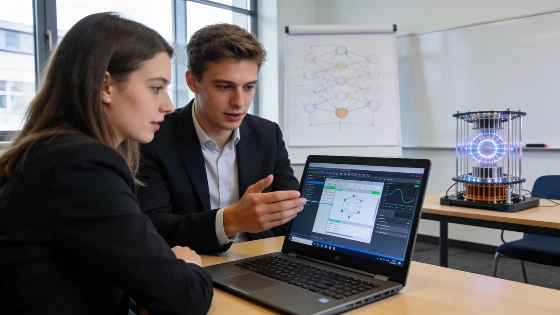
The educational approach adopted by EBU and Superpositions is designed to lower the technical barrier for business students. Rather than requiring advanced mathematics or quantum physics, the curriculum uses a problem-first methodology. Students describe business use cases in natural language, which the Superpositions Studio platform then translates into quantum and hybrid algorithmic workflows. The platform automates the generation of executable code, performance reports, and comparative analyses between classical and quantum execution, allowing students to evaluate the potential benefits and limitations of quantum approaches for specific business problems.
Hardware Access and Benchmarking
Superpositions Studio connects directly to a range of quantum hardware backends, including systems from IBM Quantum, IonQ, IQM, and Rigetti. This hardware-agnostic integration enables students to run combinatorial optimization, machine learning, and simulation tasks on different quantum processing unit (QPU) architectures. By comparing results across multiple platforms, students can observe how algorithm performance varies with hardware characteristics such as qubit connectivity, coherence time, and gate fidelity. The platform also provides cost-benefit analyses, helping students understand the practical trade-offs between classical and quantum computation in real-world scenarios.
Curriculum Scope and Industry Context
The Q-Ready initiative will introduce dedicated quantum courses and embed practical quantum concepts into existing degree tracks, including Bachelor of Business Administration (BBA), Master of Business Administration (MBA), and executive education programs. The goal is to equip future business leaders with the skills to critically assess quantum advantage claims and make informed decisions about technology adoption. This educational model reflects a broader trend in quantum workforce development, where interdisciplinary training is increasingly seen as essential for bridging the gap between quantum research and commercial deployment. Similar efforts to integrate quantum workflows into applied domains have been reported elsewhere, such as the recent partnership between ORIENTOM and Fondazione LINKS to test quantum algorithms for finance (see coverage of quantum algorithm evaluation in financial modeling).
Limitations and Open Questions
While the integration of quantum software into business curricula represents a step toward broader quantum literacy, several limitations remain. The current generation of quantum hardware is constrained by noise, limited qubit counts, and short coherence times, which restrict the size and complexity of problems that can be meaningfully addressed. Most business-relevant tasks remain within the reach of classical algorithms, and claims of quantum advantage must be evaluated against strong classical baselines. The educational value of hands-on quantum access depends on the transparency of performance metrics and the ability to interpret results in the context of hardware limitations. As quantum technology evolves, ongoing curriculum updates and critical assessment of commercial claims will be necessary to ensure that business graduates are prepared to navigate a rapidly changing landscape.
Quantum computing relies on the manipulation of quantum bits, or qubits, which can exist in superpositions of states and exhibit entanglement. Unlike classical bits, qubits are highly sensitive to environmental noise, leading to errors and decoherence that limit computation time and reliability. Hybrid quantum-classical algorithms attempt to leverage quantum resources for specific subroutines while relying on classical computation for the remainder of the workflow. Understanding the distinction between physical qubits (the actual hardware elements) and logical qubits (error-corrected, encoded units of information) is essential for interpreting performance claims. As quantum education expands beyond physics departments, clear explanation of these foundational concepts will be critical for meaningful engagement with quantum technology in applied fields.