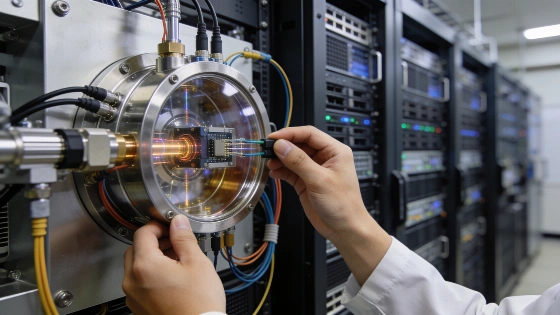
Pasqal and LG CNS have agreed on a three-year plan to connect neutral-atom quantum processors with AI data-center infrastructure while leaving deployment, technical benchmarks, and commercial performance to be demonstrated.
Pasqal and LG CNS signed a three-year Memorandum of Understanding on 10 September 2026 to pursue hybrid data centers that combine neutral-atom quantum processing units with conventional AI infrastructure across South Korea and the wider Asia-Pacific region. The agreement creates an integration roadmap rather than reporting a completed deployment or a demonstrated quantum advantage.
The partnership links Pasqal's neutral-atom QPUs to LG CNS's AI Haus environments and commercial AI Data Center infrastructure. LG CNS contributes enterprise cloud administration and system-integration capabilities, while Pasqal supplies the neutral-atom hardware platform described in the agreement. The announcement followed a France-Korea state visit in Paris, and an executive visit by LG CNS to Pasqal's facility in Palaiseau accompanied the launch of the cooperation.
The proposed architecture is intended to let quantum and classical resources operate within the same data-center framework. Its stated targets include compute-intensive workloads in industrial, scientific, and enterprise AI applications, together with operational processes for resource management and dynamic workload execution. In practical terms, this means coordinating a quantum processor with conventional CPUs, GPUs, storage, networking, monitoring, and scheduling software rather than treating the QPU as an isolated laboratory instrument.
The technical aim is not to replace classical processors with quantum machines. It is to connect different types of computing resources so that selected workloads can be assigned within a hybrid architecture. The announcement does not identify a specific algorithm, qubit count, circuit depth, benchmark, runtime, error rate, or classical comparison, and it reports no demonstrated quantum advantage.
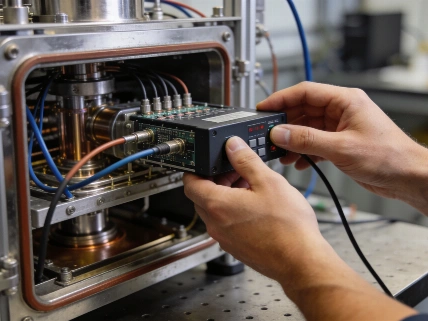
That missing information matters. Neutral-atom quantum computing generally relies on laser-cooled atoms held in optical traps or tweezer arrays, with state preparation, laser or microwave control, and optical readout. Interactions between highly excited Rydberg states can be used to create entangling operations, but the usefulness of the resulting processor depends on control fidelity, atom loss, calibration stability, measurement quality, connectivity, and the classical overhead required to operate the experiment. These are general characteristics of the platform, not performance claims about the Pasqal-LG CNS project.
A physical qubit is also not the same as a logical qubit protected by quantum error correction. A production system would need to document how physical errors are measured, how calibration is maintained, how failed or lost atoms are handled, and what software layer maps an enterprise workload onto the available hardware. Research programs at MIT quantum research and elsewhere illustrate why hardware demonstrations and fault-tolerant computing are separate stages of development; the MoU reports no logical-qubit system or fault-tolerant computation.
The MoU therefore establishes cooperation and an operational roadmap, not a production quantum service, a commercially validated workload, or a completed hybrid data center. As in other experimental fields covered by Nature's quantum-information research, meaningful comparison requires a defined task, a specified baseline, repeated trials, and transparent reporting of uncertainty and failure modes.
South Korea is positioned in the agreement as Pasqal's primary hub for APAC operations. Under CEO Wasiq Bokhari, the company is using the partnership to deepen its commercial and institutional presence in the country, building on industrial ties and backing from Korean institutional investors including LG Electronics and Dunamu & Partners.
The regional strategy fits a practical infrastructure logic. LG CNS is an AI-transformation and IT-integration company within the LG ecosystem, while Pasqal brings a specialized quantum platform. The difficult work will be converting that organizational alignment into stable scheduling, workload selection, calibration procedures, data movement, security controls, and measurable performance inside real hybrid systems.
The announcement also follows Pasqal's business combination with Bleichroeder Acquisition Corp. II and its Nasdaq listing, a corporate milestone that expands the company's stated hardware footprint but does not itself provide evidence about processor performance. Independent market reviews have additionally cited approximately €340 million in financing in March 2026, following €100 million in 2023. Those figures help explain the scale of the company's international expansion, but financing is not a substitute for technical validation.
For the agreement to become a technical result, the partners would need to show how neutral-atom QPUs are connected to the AI Haus environment and how workloads move between quantum and classical resources. They would also need to report operating conditions, available hardware, control and readout performance, system availability, queueing behavior, and the criteria used to decide whether a workload benefits from quantum processing.
Those questions are central because quantum hardware is not evaluated by processor count alone. Useful assessment depends on the physical qubits available, their control quality, measurement fidelity, connectivity, calibration stability, atom-retention behavior, and the overhead imposed by classical orchestration. A serious benchmark would specify the workload, input distribution, compilation settings, repetitions, confidence intervals or other uncertainty measures, and the classical hardware and software used for comparison. None of those performance figures is supplied in the announcement, and no independent verification or completed deployment is reported.
The commercial significance therefore lies in the proposed bridge between a quantum processor developer and a major enterprise infrastructure integrator. The partnership is designed around the same systems question that appears across modern scientific computing: how specialized processors can be exposed through dependable software and data-center operations without overstating what the underlying hardware can yet deliver.
Readers tracking the wider field should distinguish this infrastructure plan from the separate challenge of making quantum resources useful in production; an earlier quantum report likewise examined how specialized quantum technology must fit within existing communications infrastructure.
As of 19 September 2026, available authoritative secondary reporting confirms the MoU and planned future integration but not a deployed Pasqal-LG CNS production installation, a commercial hybrid quantum data center, or the outcome of a pilot. Its value will ultimately be determined by disclosed measurements, reproducible experiments, and repeatable deployments-not by the partnership announcement alone.