Quantum B has received European Patent EP 4462727 for a Quantum Conference Key Agreement protocol that uses multipartite entanglement to help independent network nodes reach consensus, although no deployment or performance benchmark has yet been reported.
Quantum B has secured European Patent EP 4462727 for a protocol that uses multipartite quantum entanglement to coordinate decisions across independent network nodes. The award covers a proposed architecture for distributed consensus rather than evidence that a commercial quantum network has replaced proof-of-work or conventional voting.
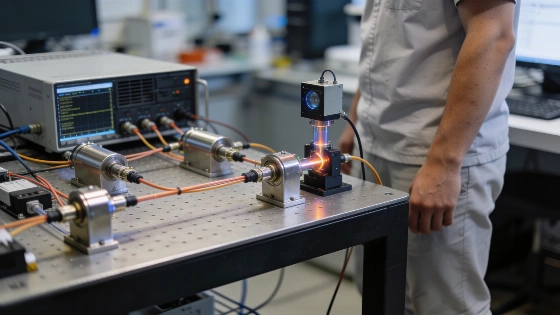
The protocol begins with a central quantum server that emits photons encoded in time bins. Those photons are transformed into multi-qubit Greenberger-Horne-Zeilinger states, or GHZ states, in which several quantum systems share a joint state that cannot be described as independent local bits. In an ideal GHZ state, measurements made by separated participants can exhibit correlations that are stronger and more structured than correlations produced by independently generated random values.
Participating nodes receive qubits through quantum links while exchanging ordinary coordination data over classical Internet channels. Each node performs a local measurement on its distributed GHZ state and obtains a bit value. The nodes then compare those values through the classical channel. When the locally calculated values reach majority agreement across the network, the protocol is designed to verify and execute operations on shared data blocks.
The patent's central idea is therefore not faster-than-light communication and not the elimination of classical networking. It is the use of quantum-correlated measurement outcomes as an additional verification layer for multi-party coordination. Quantum mechanics does not permit the measurement results to be used for superluminal messaging; the classical exchange remains necessary to establish which measurements were performed and how the outcomes should be interpreted.
The broader quantum-network field, discussed in Nature's quantum-internet review and pursued in research environments including MIT and CERN, also treats entanglement as a physical resource that must be generated, distributed, measured and authenticated within a larger communication system.
The European Patent Office granted EP 4462727 to Quantum B, Inc. under application EP23461579. The company was formerly known as Quantum Blockchains. CEO Mirek Sopek and co-inventor Miriam Kosik are identified with the development of the protocol at the company's Łódź and Lublin base.
Independent reports describe the invention as a Quantum Conference Key Agreement protocol for distributed agreement: nodes obtain correlated measurement outcomes from entangled states and then confirm the result through a classical channel. Miriam Kosik has presented the work as an effort to determine whether entanglement can simplify the simultaneous coordination of a result among several participants.
The announcement describes the system as an alternative to classical consensus mechanisms such as proof-of-work and voting algorithms. That comparison should be read as an architectural claim. The supplied material gives no benchmark showing lower latency, lower energy use, higher throughput or stronger security than a defined classical baseline. It also does not establish that the protocol replaces established Byzantine-fault-tolerant voting, quorum systems or cryptographic authentication.
Its stated target environments include multi-party data-sharing platforms, low-trust distributed databases, enterprise blockchain networks and networks containing nodes operated by multiple organizations. Those applications would require more than a patent: they would need reliable photon generation, state distribution, detector operation, synchronization, authenticated classical communication and protection against implementation faults.
The patent is a legal milestone and the supplied material identifies the physical mechanism in considerable detail. It does not report a deployed network, a measured key rate, a measured entanglement rate, a distance between nodes, detector efficiency, fidelity, error rate or number of operating nodes. It also does not establish independent replication or show that the protocol has been tested against a current and optimized classical consensus system. No p-values, confidence intervals, sample sizes or peer-reviewed experimental results are reported for this implementation.
That distinction matters because entanglement is a physical resource rather than a complete networking service. A GHZ state can create correlations among measurements, but photon loss, decoherence, imperfect state preparation and detector inefficiency can prevent nodes from obtaining usable outcomes. In a practical system, the fidelity of the distributed state and the rate at which valid events are produced would be central engineering metrics.
The classical channel remains necessary for coordination, and the security or reliability of the full system would depend on how the quantum hardware and classical software are implemented. A complete security analysis would also need to specify the threat model, authentication method, assumptions about the server, treatment of dishonest nodes and the effect of device imperfections. These questions are distinct from demonstrating that entanglement exists.
For context, the company's wider portfolio includes its emulated Quantum Key Distribution platform called pQKD and participation in the EU-funded POSEIDON project on post-quantum digital identity protection. Those activities sit alongside a separate European effort described in an earlier quantum-network report but should not be treated as evidence that this patented consensus protocol is already operating in the field.
Quantum B says the protocol is intended to reduce the communication overhead associated with classical multi-party synchronization. The supplied material does not provide a measured overhead reduction, a workload, a traffic model or a comparison with a specified consensus algorithm, so the claimed benefit remains a design objective rather than a quantified result.
The practical test will be whether the server-assisted arrangement can distribute usable multipartite states as the network grows while maintaining accurate measurements and manageable classical coordination. A central server may simplify dispatch, but it also creates an architectural dependency that would have to be assessed alongside link loss, hardware reliability and the consequences of server failure. Scalability would likely depend on how the state-generation rate changes as more links, detectors and participating nodes are added.
The patent gives Quantum B a defined intellectual-property position around a quantum consensus architecture. On the information available, there are no reported judicial disputes, cancellation proceedings or official challenges to the grant of EP 4462727. Public descriptions instead focus on the grant and on the company's presentation of the technology at events.
It does not by itself demonstrate quantum advantage, operational security or scalable deployment. The strongest reading is also the most useful one: this is a technically specified proposal that connects entanglement distribution with distributed data verification, while the measurements needed to judge its practical value have not been reported in the supplied material.
In this setting a GHZ state is not a collection of ordinary shared random bits. It is a joint quantum state whose measurement correlations depend on how the nodes measure their qubits. Once measured, the nodes hold classical outcomes and must exchange them through conventional channels. That is why the protocol combines quantum links with the Internet rather than replacing classical communication; the quantum resource supplies correlated evidence while the classical network carries coordination and execution instructions.