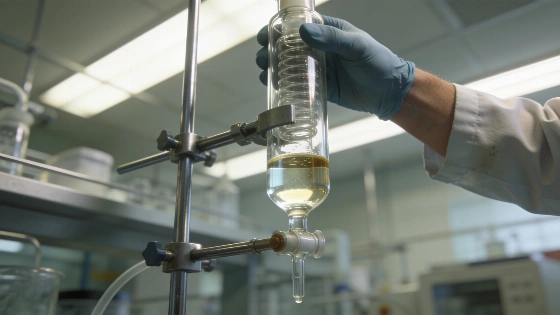
USA Rare Earth, Pasqal and Riven Systems are developing a quantum-machine-learning workflow to identify selective extractants for separating mixed rare earth carbonate into individual oxides, using thousands of automated experiments and feedstocks from mining and recycling.
Quantum machine learning is being applied to a concrete industrial problem: finding chemical extractants that can separate rare earths more selectively. On September 17, 2026, USA Rare Earth, Pasqal and Riven Systems announced a strategic partnership combining automated laboratory experiments with neutral-atom quantum processors. The stated objective is to discover and test new separator molecules, not to claim that quantum computing has already demonstrated an advantage.
The chemistry target is the conversion of mixed rare earth carbonate into individual rare earth oxides. This separation step is among the most technically demanding and expensive parts of the supply chain, and the partners note that it is currently dominated to a significant extent by Chinese producers. The project focuses in particular on heavy rare earths including dysprosium, terbium and yttrium, elements valued in high-performance magnets and other advanced technologies.
Rare earth ions are chemically difficult to separate because many of them have similar charge states and closely related ionic sizes. In solvent-extraction processes, performance depends on how an extractant coordinates with a specific ion, how that complex partitions between liquid phases, and whether the molecule remains stable across repeated process cycles. A model can help search this chemical space, but only measurements can establish selectivity, recovery, phase behavior and compatibility with a complete flowsheet.
USA Rare Earth will contribute feedstocks and existing processing knowledge. The material is expected to include resources from the Round Top deposit in Texas, Brazilian assets and recycled magnet swarf. The company's Wheat Ridge, Colorado, research and development facility is intended to provide a site for validating promising extractants and assessing how they perform with realistic materials rather than idealized laboratory solutions.
Riven Systems plans to conduct thousands of automated experiments to generate training data describing extractant selectivity across different rare earth elements and chemical conditions. An autonomous laboratory can make or screen compounds, vary concentrations and operating parameters, and record experimental outcomes in a structured form. The value of such a system depends not only on the number of experiments but also on reproducibility, representative feedstocks, measurement uncertainty and the balance between successful and unsuccessful candidates in the dataset.
Pasqal will apply quantum machine-learning models on neutral-atom quantum processing units and compare them with classical models. The supplied announcement does not report a qubit count, circuit depth, model accuracy, runtime, confidence interval, p-value or measured quantum advantage. It also does not identify a completed benchmark showing that a quantum method has outperformed a classical approach on the rare earth separation task.
That distinction is important. Quantum machine learning still requires data encoding, repeated quantum measurements and classical interpretation. A fair comparison would need to include data-generation costs, classical preprocessing, model-training time, sampling requirements, postprocessing and the quality of the chemical predictions. Work associated with MIT and the broader quantum-information community has made clear that the usefulness of a quantum workflow must be assessed against a well-defined classical baseline, not inferred from the presence of a quantum processor alone.
The proposed workflow therefore has three linked components: Riven's automated chemistry platform, Pasqal's quantum and classical modeling comparison, and USA Rare Earth's process-validation capability. Candidate extractants selected by the models are expected to undergo physical testing at Wheat Ridge using the company's stated mining and recycling feedstocks. This hardware-in-the-loop design creates a path from molecular prediction to chemical measurement and eventually to process engineering.
The practical test will involve more than binding strength. A useful extractant must distinguish neighboring rare earth ions under relevant acidity and phase conditions, permit efficient stripping or recovery, resist degradation, and operate within a manageable solvent-extraction circuit. Its performance would also need to be evaluated against existing alternatives using metrics such as separation factor, distribution coefficient, recovery, solvent consumption and cycle stability.
The partners describe potential reductions in cost, energy use and the size of future processing facilities if new molecules can bind target elements more selectively. Those benefits remain conditional. No energy reduction, equipment reduction, commercial yield, separation-stage reduction or production-scale deployment has been demonstrated in the supplied material.
The collaboration extends Pasqal's stated industrial application work into materials chemistry and critical-mineral processing. References to industrial engagements with Saudi Aramco and Crédit Agricole CIB indicate an effort to develop practical use cases, but they do not provide independent evidence that this rare earth workflow will succeed. Likewise, general advances reported in Nature materials research do not substitute for a project-specific separation benchmark.
The distinction is important for readers tracking quantum technology. In an earlier quantum report the central question was hardware behavior under a defined error-correction test. Here the central question is whether a quantum model can improve a chemical search once laboratory data and real feedstocks are included. The two problems should not be judged by qubit count alone.
Research institutions such as CERN and NASA illustrate how demanding computational methods are normally evaluated: through defined tasks, documented instruments, reproducible procedures and independently inspectable results. The same standards apply here. A convincing result would require a disclosed dataset, a pre-specified comparison with competitive classical chemistry or machine-learning methods, uncertainty estimates, repeat experiments and confirmation that predicted molecules perform in real separation conditions.
Nothing in the supplied announcement establishes independent replication, peer review, a completed separation experiment or production-scale deployment. It also does not show that the quantum models are superior to modern classical chemistry or machine-learning methods. Those are the tests that would convert a strategic partnership into technical evidence.
For now, the project is best understood as an integrated research proposal linking autonomous chemistry, neutral-atom quantum hardware and industrial process validation. That is a sensible way to test whether quantum methods contribute anything beyond promotional language because candidate molecules must eventually face physical experiments. The partnership has identified a demanding application and a route to evaluate it, but it has not yet demonstrated that quantum computation can separate rare earths more efficiently.
Quantum machine learning combines a classical data workflow with a quantum model or quantum subroutine. In this project, the decisive evidence would be a reproducible improvement in extractant prediction or process performance against a fair classical baseline, followed by validation on mixed rare earth carbonate and conversion to individual oxides. Until those results are reported, the announcement represents a structured research program rather than a demonstrated technological breakthrough.