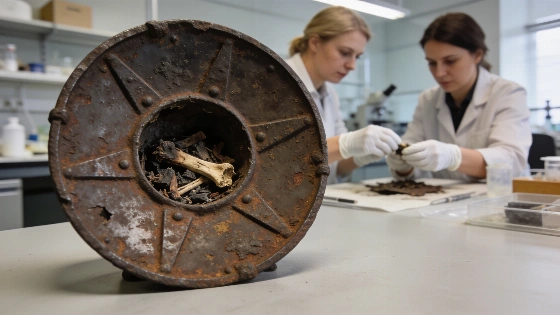
A corroded iron shield boss containing cremated human bone was recovered from a scrap yard in eastern Poland, offering rare evidence of a disturbed 2nd-century CE Przeworsk culture burial and highlighting the challenges of reconstructing lost archaeological contexts
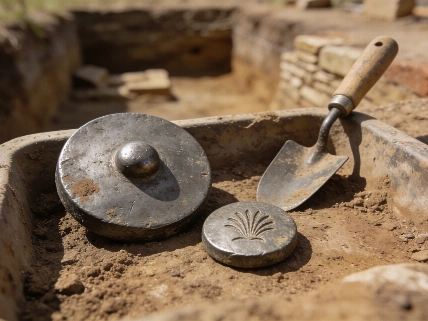
An iron shield boss dating to the 2nd century CE has been recovered from a scrap yard in Hrubieszów, eastern Poland, after being recognized as an archaeological artifact rather than ordinary metal waste. The object, known as an umbo, was identified by a local resident searching for vintage vehicle parts, who contacted museum specialists after suspecting its antiquity. Upon examination, the shield boss was found to contain a compact mass of soil and, crucially, fragments of cremated human bone.
Evidence of a Disturbed Burial
The shield boss displays clear signs of exposure to high temperatures, consistent with placement on or near a funeral pyre. The presence of burnt bone within the umbo, combined with traces of crop stubble embedded in the soil, suggests the object was originally part of a cremation burial that was later disturbed-likely during agricultural activity. The shield boss is attributed to the Przeworsk culture, a group associated with the Vandal communities of the Roman period in present-day Poland. Comparable burials from this culture have been documented in the region, often containing weapons and personal items, but the original context of this find has been lost.
Archaeologists estimate the artifact is approximately 1,800 years old, based on typological parallels and regional burial practices. The iron umbo measures several centimeters across and features a prominent central spike. Its recovery from a scrap yard, rather than a controlled excavation, means that most of the associated grave goods-such as swords, spearheads, or brooches-are likely missing or destroyed. The shield boss itself survived largely by chance, and its journey from a cultivated field to the scrap yard has erased much of its archaeological context.
Challenges of Context Loss
The absence of precise findspot information severely limits what can be reconstructed about the original burial. Without knowledge of the burial's location, orientation, or associated objects, archaeologists cannot determine the full range of grave goods or the social status of the individual. The cremated remains are too fragmentary to allow for reliable estimation of biological sex or age at death. While the shield boss and burnt bone are consistent with a Przeworsk culture warrior's grave, the evidence does not permit confirmation of the deceased's identity or role.
Similar challenges have been encountered in other cases where disturbed or unprovenanced burials are recovered outside of archaeological projects. For example, the recent recovery of a 10th-century chamber grave near Suzdal, which preserved both human and animal remains along with grave goods, illustrates the interpretive value of intact burial contexts compared to isolated finds (see analysis of an early medieval elite burial in Suzdal).
Appeal for Provenance Information
Museum staff have appealed to the unknown individual who delivered the shield boss to the scrap yard, urging them to come forward with any information about the original findspot. Even basic details about the field or locality could help archaeologists identify the disturbed burial and assess whether any additional material survives. The shield boss is now preserved in a local museum, but its interpretive value remains limited by the loss of context. The case highlights the importance of archaeological provenance for understanding past societies and the risks posed by accidental or undocumented discoveries.
In mortuary archaeology, context refers to the spatial and material relationships among human remains, grave goods, and the surrounding environment. Secure context allows archaeologists to reconstruct burial practices, social status, and cultural identity with greater confidence. When objects are removed from their original setting without documentation, much of this information is irretrievably lost. The recovery of the shield boss from a scrap yard underscores the need for public awareness and reporting of potential archaeological finds, as well as the challenges of interpreting material with uncertain provenance.