Archaeologists have identified two miniature bird carvings from mammoth ivory in Hohle Fels cave, Germany, dating to around 40,000 years ago. The finds expand evidence for symbolic art among early Homo sapiens in Upper Paleolithic Europe
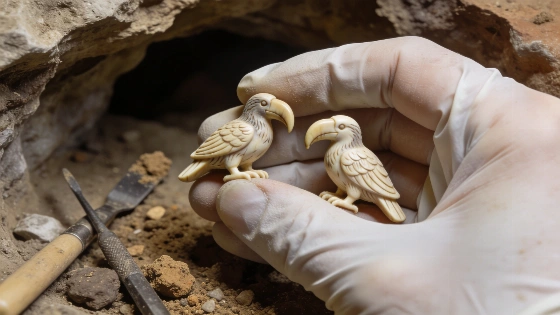
Two newly discovered bird figurines from Hohle Fels cave in southwestern Germany are providing fresh insight into the symbolic and artistic practices of early Homo sapiens in Europe. Excavated from a stratified Aurignacian layer and carved from mammoth ivory, the objects are among the smallest known examples of Paleolithic portable art, each measuring roughly the size of a human thumbnail. Their recovery adds to a growing body of evidence for complex symbolic behavior among the first modern humans to settle the region after the decline of Neanderthals.
Context and Recovery
The Hohle Fels cave, located in the Swabian Jura, has yielded some of the earliest known examples of figurative art, including the Venus of Hohle Fels and a previously discovered bird carving. The two new figurines were found in 2025, lying approximately 1.5 meters apart within a layer dated to around 40,000 years ago. The stratigraphic context and associated artifacts confirm their placement within the Aurignacian period, a time marked by the emergence of symbolic objects, musical instruments, and personal ornaments in Upper Paleolithic Europe.
Both figurines are carved from mammoth ivory, a material commonly used by Aurignacian artisans. Despite their small size, the carvings display detailed anatomical features, suggesting careful observation of living birds. One figure appears to depict a bird in a brooding posture, possibly a ptarmigan, while the other shows a bird with outstretched wings, interpreted as either in flight or engaged in courtship display. The identification of the species remains tentative, but the presence of ptarmigan bones in the same archaeological layers supports this hypothesis.
Interpretation and Significance
The function and meaning of these miniature carvings remain uncertain. They may have served as personal ornaments, talismans, or markers of group identity, but no direct evidence clarifies their use. Their detailed execution and naturalistic features distinguish them from more stylized or schematic Paleolithic art, indicating a sophisticated level of skill and observation among their makers. The presence of bird figurines at Hohle Fels is unique among known Ice Age cave sites, raising questions about the cultural or environmental factors that inspired their creation.
With the addition of these two objects, Hohle Fels now has three known bird figurines, all recovered from secure archaeological contexts. The site has also produced a range of other symbolic artifacts, including animal figurines, musical instruments, and tools. The diversity and quality of these finds highlight the Swabian Jura as a key region for understanding the emergence of symbolic and artistic expression in early Homo sapiens populations.
Comparative Evidence and Ongoing Questions
The discovery of these carvings contributes to ongoing debates about the origins and spread of symbolic behavior in the Upper Paleolithic. While similar objects have been found elsewhere in Eurasia, the concentration and variety of figurative art at Hohle Fels are exceptional. The reasons for this regional florescence remain under investigation, with hypotheses ranging from ecological abundance to social or demographic factors.
Questions also persist regarding the broader significance of animal imagery in early human societies. The choice of birds as subjects may reflect their ecological importance, symbolic associations, or simply the availability of suitable models in the surrounding landscape. As with other Ice Age sites, the meaning ascribed to these objects by their makers is ultimately inaccessible, but their careful manufacture and deposition suggest they held value beyond mere decoration.
Recent research at other prehistoric sites, such as the long-term use of communal tombs in the Near East, has similarly highlighted the diversity of symbolic and social practices among early human groups. For example, the extended use of a Bronze Age tomb in the UAE, as described in archaeological investigations at Qattarah Necropolis, demonstrates how material culture can illuminate changing beliefs and identities over time.
The two new bird figurines from Hohle Fels are currently on display at the Museum of Prehistory and Ice Age Art in Blaubeuren, Germany, where they will remain accessible to the public through 2027. Further analysis, including microscopic examination and experimental replication, may clarify aspects of their production and use, but many questions about their original significance are likely to remain open.
Understanding the archaeological context of portable art objects like the Hohle Fels bird figurines depends on careful stratigraphic excavation and secure association with dated layers. Stratigraphy-the study of layered deposits-allows archaeologists to reconstruct the sequence of human activity at a site and to relate artifacts to specific periods. In the case of Hohle Fels, the Aurignacian layer containing the figurines is well documented, supporting confident assignment to the early Upper Paleolithic. However, even with strong context, the interpretation of symbolic objects remains challenging, as their meaning and function are rarely preserved in the archaeological record.