A Formula One team is piloting hybrid quantum-classical simulation tools to model complex physics in car development, integrating quantum algorithms and post-quantum security hardware under strict computational budgets
Formula One's relentless search for performance is now testing the limits of quantum-classical hybrid simulation. The BWT Alpine Formula One Team and SEALSQ Corp have launched a technical initiative to deploy quantum-enhanced solvers for multiphysics modeling in racing car engineering, aiming to extract more predictive power from tightly regulated computational resources.
Quantum Algorithms Meet Engineering Constraints
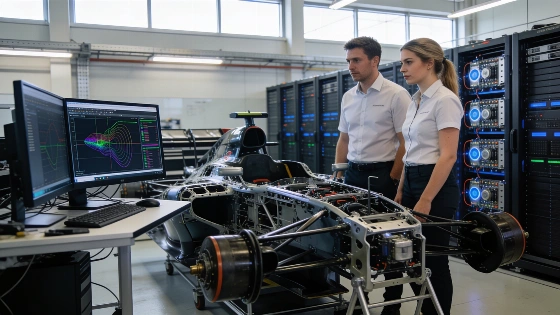
At the core of the project is ColibriTD's Hybrid Differential Equation Solver (H-DES), a proprietary algorithm designed to tackle the coupled differential equations that govern computational fluid dynamics, thermal management, and structural analysis in Formula One car design. Unlike standalone quantum processors, H-DES operates alongside Alpine's existing high-performance computing clusters, integrating quantum routines where they can offer a computational edge without exceeding the FIA's strict simulation budget. The workflow is managed through ColibriTD's MPQP platform, which is hardware-agnostic and intended to maximize compatibility with both classical and quantum resources.
The technical teams convened at Alpine's Enstone headquarters in July 2026 to define a proof-of-concept deployment. The immediate goal is to validate whether hybrid quantum-classical solvers can deliver higher simulation accuracy or faster convergence on key engineering problems, all while remaining within the governing body's computational cost cap. The project's success will depend on whether quantum routines can be integrated without introducing instability, excessive noise, or unpredictable error propagation into the simulation pipeline.
Post-Quantum Security and Hardware Integration
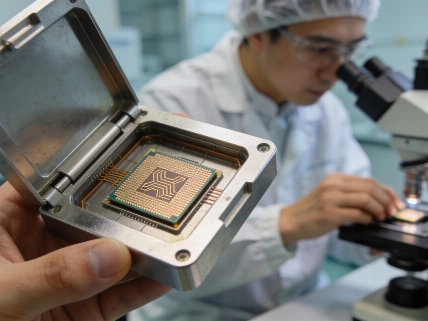
SEALSQ's contribution extends beyond quantum algorithms to the hardware stack. The company is deploying its "Quantum Vertical Sovereign Stack," which combines post-quantum cryptography (PQC) with custom semiconductor security chips. This architecture is designed to protect both intellectual property and real-time sensor telemetry from emerging cryptographic threats, including those posed by future fault-tolerant quantum computers. The stack includes hardware Root-of-Trust chips and PQC layers, which have already been validated in commercial contracts with silicon spin-qubit developer Quobly.
SEALSQ's $200 million Quantum Fund has allocated over $60 million to date, targeting companies that can bridge the gap between quantum research and commercial deployment. The fund's investment in ColibriTD and Quobly is structured to generate both equity and direct hardware revenue, with recent contracts covering Cryo-CMOS ASICs and quantum security modules for prototype quantum processors. Quobly's industrial agreements with TNO and Orange Quantum Systems provide additional evidence that SEALSQ's hardware stack is being tested in real-world quantum device environments.
Simulation Accuracy and FIA Budget Rules
Formula One's technical regulations impose strict limits on the computational resources teams can use for simulation and design. This constraint forces teams to prioritize simulation accuracy and efficiency, making any potential quantum advantage highly conditional on real-world engineering tradeoffs. The Alpine-SEALSQ collaboration is not a wholesale replacement of classical simulation but a targeted integration of quantum routines where they can be justified by measurable gains. The proof-of-concept phase will focus on benchmarking simulation outputs against established classical baselines, with attention to error rates, convergence speed, and reproducibility under operational conditions.
While the companies have not disclosed detailed performance metrics, the project's structure reflects a broader trend toward hybrid quantum-classical workflows in industrial simulation. Previous efforts, such as those described in reported earlier, have shown that quantum processors can model complex systems beyond the reach of classical simulation, but only for carefully selected problems and at modest system sizes. The Alpine-SEALSQ initiative will be judged by its ability to deliver tangible engineering value within the constraints of Formula One's regulatory and operational environment.
Commercial Strategy and Technical Uncertainty
SEALSQ's approach is to link strategic investment with immediate commercial contracts, using its Quantum Fund to accelerate both hardware and software deployment. The company's portfolio includes quantum algorithm developers, semiconductor designers, and hardware security specialists, all positioned to supply components for emerging quantum-classical systems. However, the practical impact of hybrid quantum simulation in Formula One remains unproven. The integration of quantum solvers into established engineering workflows introduces new sources of error, calibration challenges, and potential bottlenecks in data transfer between classical and quantum resources.
For now, the Alpine-SEALSQ partnership is best understood as a controlled experiment in quantum-classical integration under real engineering and regulatory constraints. The outcome will depend on whether the hybrid approach can deliver measurable improvements in simulation fidelity or design iteration speed without exceeding the FIA's computational limits or introducing unacceptable uncertainty. Until detailed benchmarking data is released, claims of quantum advantage in this context should be treated as provisional and subject to independent verification.
Hybrid quantum-classical simulation refers to computational workflows that combine quantum algorithms-typically run on small, noisy quantum processors or simulators-with conventional high-performance computing. In engineering applications, these hybrid methods are used to solve parts of complex equations that are computationally intensive for classical hardware alone. The promise is that quantum routines can accelerate convergence or improve accuracy for specific subproblems, such as optimization or sampling, but the overall benefit depends on the quality of the quantum hardware, the integration overhead, and the suitability of the problem. In practice, hybrid simulation is still an experimental approach, with most demonstrations limited to proof-of-concept studies on small system sizes. The challenge is to scale these methods to industrially relevant problems while maintaining reliability, reproducibility, and compliance with operational constraints.