A photon with record-breaking energy from the gamma ray burst GRB 221009A reached Earth despite theoretical barriers. New analysis suggests a possible explanation involving axion-like particles and Lorentz invariance violation
When a photon with unprecedented energy from the gamma ray burst GRB 221009A-known as the BOAT-arrived at Earth, it presented a direct challenge to established physics. According to current models, such a photon should have been absorbed long before completing its two-billion-light-year journey. Yet the signal was detected, forcing researchers to reconsider the limits of what photons can survive in the universe.
The BOAT Event and Its Detection
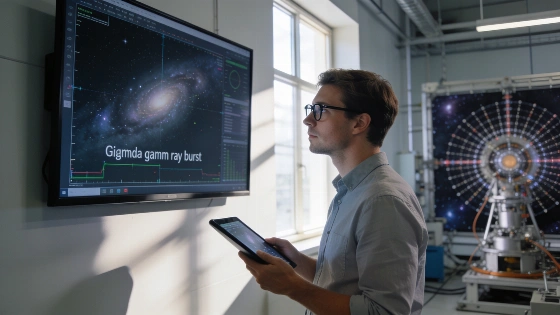
GRB 221009A was first recorded on October 9, 2022, and quickly earned the nickname BOAT for being the brightest gamma ray burst ever observed. The event released a torrent of photons, but one stood out: a photon with the highest energy ever detected from a gamma ray burst. This photon was captured by the Carpet cosmic-ray detector at the Baksan Observatory in the Russian Caucasus, a facility designed to register ultra-high-energy cosmic rays and photons.
The distance involved is critical. The BOAT originated more than two billion light-years away. According to standard physics, space is filled with the cosmic microwave background (CMB)-a pervasive field of low-energy photons left over from the early universe. High-energy photons traveling such distances are expected to interact with CMB photons, producing electron-positron pairs and losing their identity as photons. The detection of this photon, therefore, was not just surprising-it was at odds with the predictions of special relativity and quantum electrodynamics.
Testing the Limits of Physics
To explain the survival of this photon, researchers from the Italian National Institute for Astrophysics and the National Institute for Nuclear Physics explored mechanisms beyond the standard model. They considered axion-like particles (ALPs), hypothetical particles that could allow photons to temporarily transform and evade destructive interactions with the CMB. In this scenario, a photon could convert into an ALP, travel unimpeded, and then revert to a photon upon entering the Milky Way.
However, the energy of the detected photon exceeded what this mechanism alone could explain. The team therefore combined the ALP hypothesis with a possible violation of Lorentz invariance-a foundational principle of Einstein's special relativity stating that the laws of physics are the same for all observers regardless of their motion. If Lorentz invariance breaks down at extremely high energies, the rules governing photon propagation could change, allowing some photons to avoid interactions that would otherwise destroy them.
Evidence and Theoretical Implications
The researchers' model predicts that a photon taking this "fast lane" through the universe would arrive at Earth later than lower-energy photons from the same event. Observational data from the BOAT supports this: the highest-energy photon was detected about an hour after the initial burst of lower-energy light. This timing is consistent with the proposed mechanism, lending weight to the idea that both ALPs and Lorentz invariance violation may be involved.
The findings, now accepted for publication in Physical Review Letters and available as a preprint on arXiv, suggest that the universe may be more transparent to high-energy photons than previously thought-at least under certain conditions. If confirmed by future observations, this would open a new window for studying quantum gravity and fundamental physics at energy scales far beyond the reach of terrestrial accelerators. For context, related work on the large-scale structure of the universe and the propagation of ancient signals has been reported earlier using radio telescopes to map hydrogen across billions of light-years.
Remaining Questions and Next Steps
Despite the appeal of the new model, significant uncertainties remain. The existence of axion-like particles has not been confirmed experimentally, and any violation of Lorentz invariance would have far-reaching consequences for physics. The observed delay in photon arrival is suggestive but not definitive proof of the proposed mechanism. Further detections of high-energy photons from distant gamma ray bursts will be essential to test the robustness of these ideas and to rule out alternative explanations, such as unknown astrophysical processes or instrumental effects.
For now, the BOAT event stands as a rare opportunity to probe the limits of established physics using natural cosmic laboratories. The next generation of detectors and observatories will be crucial for determining whether this photon's journey was a statistical fluke, a sign of new physics, or a combination of both. The scientific community will be watching closely as more data accumulates and theoretical models are refined.
Understanding how photons interact with the cosmic microwave background is central to this debate. The CMB is a relic radiation field that fills all of space, providing a background against which high-energy photons must travel. When a photon's energy is high enough, it can interact with a CMB photon to produce an electron and a positron, effectively removing the original photon from the observable universe. This process sets a theoretical limit on how far high-energy photons can travel. Any observation that appears to violate this limit forces physicists to reconsider the completeness of current models and to explore new physics that could alter the transparency of the cosmos at extreme energies.