Researchers using South Africa's MeerKAT radio telescope have detected faint hydrogen signals from galaxies 4 to 5 billion light-years away, offering a new approach to mapping the universe's large-scale structure through radio intensity mapping
Signals from hydrogen atoms that traveled for billions of years have now been detected by the MeerKAT radio telescope, marking a technical advance in how astronomers can chart the universe's structure. This detection, achieved without relying on visible-light surveys, demonstrates that radio intensity mapping can directly reveal the distribution of hydrogen gas across vast cosmic distances.
Hydrogen Mapping With Radio Waves
Neutral hydrogen emits a faint radio signal at a wavelength of 21 centimeters. As the universe expands, this signal is stretched-an effect known as redshift-allowing astronomers to estimate how long the light has traveled and from which era it originated. By measuring the intensity of this redshifted signal across the sky, researchers can map the collective hydrogen content of galaxies, even when those galaxies are too faint to be seen individually.
Until now, most attempts to map hydrogen in this way required cross-referencing radio data with optical surveys. The new MeerKAT result bypasses that step, using only radio observations to build a three-dimensional map of hydrogen spanning distances comparable to the gap between the Milky Way and Andromeda galaxies. The data, collected over 96 hours of observing time, reveal hydrogen from a period when the universe was roughly two-thirds its current age.
Instrument and Data Challenges
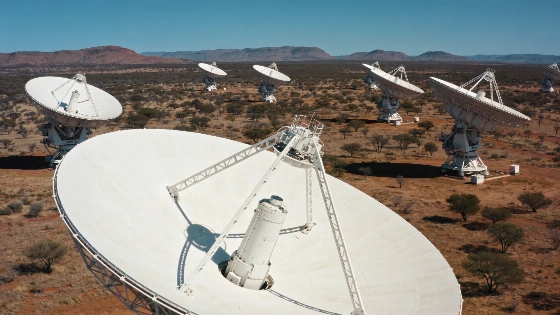
MeerKAT, located in South Africa's Northern Cape, consists of 64 radio dishes designed for high-sensitivity observations. Detecting the 21-centimeter hydrogen signal at such distances is technically demanding: the signal is extremely faint and easily masked by foreground radio emissions, terrestrial interference, and instrumental noise. The research team developed specialized data analysis techniques to isolate the cosmological hydrogen signal from these contaminants.
The observations targeted hydrogen from 4 to 5 billion years ago, corresponding to a lookback time when dark energy began to dominate the universe's expansion. The ability to extract this signal from data originally collected for other purposes highlights the versatility of MeerKAT's dataset. As noted in reported earlier, large-scale mapping projects increasingly rely on multi-purpose observatories to maximize scientific return.
Scientific Implications and Next Steps
Hydrogen intensity mapping offers a way to study the distribution of matter on the largest scales without cataloging every individual galaxy. This approach can reveal how galaxies form and evolve, and how cosmic structures such as filaments and voids emerged over time. The MeerKAT result demonstrates that the method is now practical for cosmological studies, not just technical demonstrations.
Future surveys, including those planned with the Square Kilometre Array Observatory (SKAO), are expected to extend hydrogen mapping to even greater distances and larger sky areas. The MeerKAT team plans to analyze additional data covering wider regions and longer observing periods, aiming to refine the map of hydrogen and improve constraints on the universe's evolution.
Limits and Remaining Questions
Despite the progress, significant challenges remain. The hydrogen signal is still difficult to separate from foreground sources, and systematic uncertainties in calibration and data processing can affect the results. The current map covers only a fraction of the sky and a limited range of cosmic time. Independent confirmation from other instruments and further methodological improvements will be needed to fully establish hydrogen intensity mapping as a standard cosmological tool.
While the detection is a technical milestone, it does not yet provide a complete picture of the universe's structure or resolve outstanding questions about dark energy and galaxy formation. The published results, appearing in The Astrophysical Journal Letters, represent a step forward but not a final answer.
Redshift is a key concept in cosmology, describing how the wavelength of light or radio waves stretches as the universe expands. The greater the redshift, the farther and older the source. By measuring the redshift of the 21-centimeter hydrogen line, astronomers can reconstruct when and where the hydrogen existed, building a timeline of cosmic structure formation. This method depends on precise calibration and careful separation of the faint cosmological signal from much brighter foreground emissions, making it both powerful and technically challenging.