Quantum Effects 2026 has recognized four application-focused projects spanning quantum annealing hardware, open-source software, atomic magnetometry and photon timing for networked QKD, with the winners set for public presentation in Stuttgart on 6-7 October 2026.
Four projects spanning quantum hardware, software, sensing and networking have won the Quantum Effects Award 2026 after evaluation at Technology Readiness Level 5 or higher. The selection matters less as a prediction of near-term quantum supremacy than as a map of where developers are attaching quantum methods to defined engineering tasks.
Quantum Effects 2026 is scheduled for 6-7 October 2026 at Messe Stuttgart. The event's applied orientation is also reflected in plans by the Kompetenzzentrum Quantencomputing Baden-Württemberg to present current research and demonstrators there, placing industrial prototypes and usable technology alongside the underlying science.
The jury for the international Quantum Effects 2026 conference and exhibition chose one winner in each category. C12 and Thales received the hardware award for QuantumTrack, Fraunhofer FOKUS won in software, QSENSATO SRL took the sensing category and PicoQuant GmbH was recognized for networking.
TRL 5 indicates that the entries are being judged as application-oriented developments rather than purely theoretical proposals. The published information does not establish that any of the four systems has achieved mass deployment or a demonstrated quantum advantage over the best classical alternative. It does establish a more concrete threshold: each project is presented as having a path toward direct industrial use.
That distinction follows the evaluation discipline used across major research ecosystems, from MIT engineering laboratories to CERN instrumentation programs and the peer-reviewed Nature quantum-information coverage: a quantum mechanism is only one component of a complete system, whose value depends on calibration, control, reliability and comparison with established methods.
QuantumTrack links a conventional radar-processing problem to an unconventional quantum architecture. C12 and Thales mapped Multiple Hypothesis Tracking data association onto a carbon nanotube spin-circuit quantum-electrodynamics annealing architecture. MHT is used to manage competing explanations for radar observations; the award recognizes the proposed hardware mapping rather than a claim that the system has replaced operational radar processing.
The project is described as a hybrid quantum-classical solution for real-time multi-target radar tracking. That framing is technically important: classical radar systems can continue to handle sensing and much of the signal-processing pipeline while a quantum component is assigned a bounded optimization or association task. C12 and Thales are expected to present QuantumTrack at the Stuttgart trade fair on 6 October, providing a near-term demonstration milestone without, by itself, proving operational superiority.
The software winner addresses a different bottleneck. Eclipse Qrisp from Fraunhofer FOKUS is an open-source Python framework that compiles high-level constructs such as variables, functions and loops into gate-based quantum circuits. Its ability to target heterogeneous backends places the emphasis on portability, abstraction and compilation rather than on a new processor or a new qubit count.
That distinction is important. A software layer can make quantum hardware easier to program without proving that the resulting circuits are accurate, useful or cheaper than classical workflows. The award identifies an engineering contribution to access and execution; it does not by itself establish scalable fault-tolerant computation.
QSENSATO SRL won for its Compact OPM Diagnostic Array, or CODA. The Italian spinoff's platform combines laser-written alkali-vapor cells with an integrated atomic-photonic chip for miniaturized optically pumped magnetometers and precision metrology.
Optically pumped magnetometers measure magnetic fields through the response of atomic vapor prepared and interrogated with light. CODA's significance lies in integrating the vapor-cell and photonic elements into a compact platform. The available information does not provide sensitivity, bandwidth, calibration conditions, environmental stability or a comparison with the best conventional magnetometers, so the award should not be read as proof of superior field performance.
QSENSATO has also reported a €1 million SAFE funding round led by Quantonation and Deep Ocean Capital. The company is moving toward an in-house fabrication facility for its quantum-sensor work, a concrete industrialization step that extends beyond recognition at the fair while leaving questions about yield, reproducibility and independent performance testing open.
The practical test for this type of device is not simply whether the sensing mechanism is quantum. It is whether fabrication variability, temperature control, optical stability, magnetic shielding and calibration can be managed outside a carefully controlled laboratory setup. The award places CODA on an application path but supplies no independent deployment data.
That gap is familiar in quantum sensing. A compact architecture can reduce system complexity while still leaving drift, noise and packaging as decisive constraints. For context the earlier sensor development report also showed why moving from atomic components to integrated instruments is an engineering step rather than a single measurement milestone.
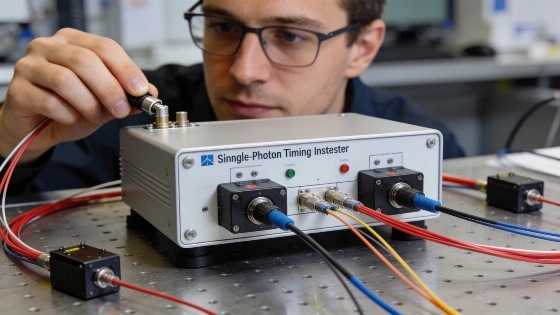
PicoQuant GmbH's HydraHarp 500 L won the quantum networking category. It is a multichannel Time-Correlated Single Photon Counting time-tagger with 64 or more input channels, 1 ps resolution, an ultra-short dead time of 680 ps and White Rabbit timing synchronization for distributed quantum key distribution networks.
These specifications describe measurement infrastructure. A time-tagger records the arrival times of individual detection events and correlates them across channels. In a distributed QKD system, that timing information can support synchronization and analysis of photon detections, but the award does not establish a complete operational network, a secret-key rate, a transmission distance or security against implementation flaws.
The distinction between infrastructure and protocol performance is essential. Better timing resolution and shorter dead time can help an experiment process closely spaced detection events, while White Rabbit synchronization can coordinate equipment across a distributed system. Neither specification alone demonstrates long-distance entanglement distribution, quantum repeaters or an unhackable communication service.
Taken together, these awards reward integration: connecting an annealing architecture to radar association, translating ordinary programming structures into quantum circuits, compressing atomic magnetometry onto a photonic chip and timing single-photon events across network equipment. Their strongest message is practical rather than sensational. Quantum Effects 2026 is recognizing systems that confront interfaces between quantum devices and industrial workflows, while the missing performance data still prevents claims of broad quantum advantage or commercial readiness.
A physical quantum device is only one part of a useful system. The surrounding software must control it, the measurement chain must capture reliable signals and the benchmark must compare the complete workflow with a credible classical alternative. These awards therefore mark credible application targets rather than finished solutions; their value will be determined by reproducible performance under the operating conditions that real users face.