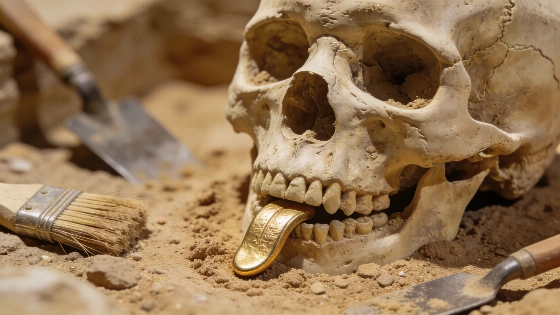
Archaeologists have uncovered 18 tombs in Egypt containing gold tongue amulets, while researchers in the Congo rainforest have identified a new monkey species. These discoveries highlight both the complexity of ancient mortuary practices and the ongoing potential for finding new species.
Recent archaeological work along Egypt's Mediterranean coast has revealed 18 tombs containing dozens of gold objects, many shaped as tongues. These finds, recovered from a necropolis with evidence of complex mortuary architecture, are interpreted as amulets intended to enable speech in the afterlife-a belief rooted in ancient Egyptian religious practice. However, not all the gold items are securely identified as tongues; at least one may represent a wheat ear, a symbol of fertility, and the presence of a possible false door within the tombs has prompted debate about their precise ritual function.
The tombs, dated to the Greco-Roman period based on associated artifacts and burial construction, contained both human remains and a range of grave goods. The gold tongue amulets were found in direct association with the skulls of several individuals, suggesting deliberate placement during burial. While the interpretation of these objects as aids for afterlife communication is supported by textual parallels, alternative readings-such as their use as status markers or fertility symbols-remain plausible given the diversity of forms and contexts.
Mortuary Evidence and Interpretation
Analysis of the skeletal remains from these tombs has also raised questions about the roles of women in ancient Egyptian society. A recent study of nearly 4,000-year-old remains attributed to royal women suggests that some may have participated in hunting or military training, based on musculoskeletal markers. However, this interpretation is contested, as such markers can result from a range of activities, and the evidence does not conclusively establish participation in combat or organized hunting. The debate highlights the challenges of inferring social roles from skeletal evidence alone, especially when preservation and contextual information are limited.
Elsewhere in the region, archaeologists have identified an ancient chariot among the remains of a settlement that appears to have been deliberately burned and abandoned. The context of this find, including the destruction layer and associated artifacts, suggests a complex social or political event, but the reasons for the burning and disappearance of the community remain unresolved. In another case, DNA analysis has revealed that a Bronze Age shaman previously identified as male was in fact biologically female, underscoring the importance of genetic methods in reassessing earlier interpretations based solely on skeletal morphology.
Remote Sensing and Ancient Craters
Remote sensing technologies continue to expand the archaeological toolkit. In Quebec's Côte-Nord region, an amateur astronomer using satellite imagery identified a 24-kilometer-wide depression, later confirmed by planetary geologists as a 390-million-year-old meteorite impact crater. This discovery, initially made through "geoguessing"-the practice of deducing locations from online maps-demonstrates the potential for non-specialists to contribute to the identification of geological and archaeological features, provided that subsequent field verification is conducted by experts.
Such approaches have also been applied to the study of mass burials. For example, isotope and DNA analysis of individuals buried on St. Helena after liberation from slave ships has traced their origins to diverse regions of West and Central Africa, as detailed in a recent Science Report feature. These methods illustrate how scientific advances can clarify the histories of displaced and marginalized populations, even when documentary records are incomplete.
New Species and Ancient DNA
In the Democratic Republic of the Congo, primatologists have described a new species of monkey, Colobus congoensis, distinguished by its orange lips and unique vocalizations. The identification of this large-bodied primate, based on years of field observation and collaboration with local communities, is notable given the rarity of new primate discoveries in Africa. The species' restricted range and distinctive morphology suggest that additional undocumented mammals may persist in the region's dense rainforests.
Advances in ancient DNA research are also reshaping expectations for future discoveries. A recent study has demonstrated that DNA can survive for up to 50,000 years in African contexts, far longer than previously assumed. This finding expands the potential for genetic analysis of ancient populations across the continent, although preservation remains highly variable depending on burial environment, temperature, and soil chemistry.
Other recent finds include rare iron shackles from Iron Age France, evidence of the Celtic slave trade, and the use of artificial intelligence to solve longstanding mathematical problems. These developments reflect the interdisciplinary nature of contemporary archaeological research, which increasingly draws on methods from genetics, chemistry, and computational science.
Ancient DNA analysis is a rapidly evolving field that allows researchers to extract and sequence genetic material from archaeological remains, including bones, teeth, and sediments. The preservation of DNA depends on environmental conditions such as temperature, humidity, and soil chemistry, with cooler and drier contexts generally favoring survival. In Africa, where heat and microbial activity often accelerate DNA degradation, the demonstration of long-term preservation opens new possibilities for reconstructing population histories, migration patterns, and biological relationships. However, successful recovery remains uneven, and destructive sampling must be balanced with ethical considerations and consultation with descendant communities.