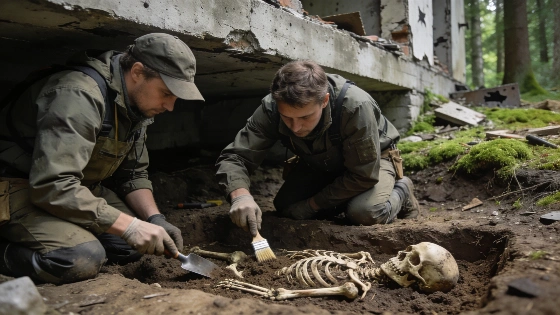
Archaeologists investigating human remains beneath Hermann Göring's former house at the Wolf's Lair have determined the Nazi-era structure was constructed atop a pre-existing cemetery, using stratigraphic and osteological analysis to clarify the context
Recent excavations at the Wolf's Lair, Adolf Hitler's principal military headquarters in northeastern Poland, have clarified the origin of human remains found beneath the former residence of Hermann Göring. Archaeologists from the Polish Academy of Sciences, in collaboration with the Latebra Foundation, have established that the Nazi-era building was constructed directly over an older cemetery, rather than being the site of wartime burials as previously speculated.
Human Remains and Archaeological Context
The investigation began after six skeletons, including both adults and children, were discovered in shallow graves just 20-30 centimeters below the floor of Göring's house. The remains, some missing hands and feet, prompted initial speculation about their origin and possible connection to World War II events. However, subsequent analysis found no evidence linking the burials to the Nazi period. Instead, the graves predate the construction of the Wolf's Lair complex, which was completed in 1944.
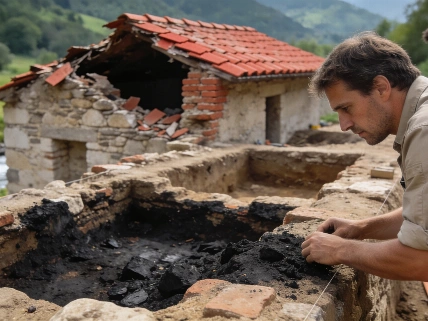
During three weeks of systematic excavation, researchers uncovered five additional skeletons and two concentrations of disarticulated human remains. One skeleton was found directly beneath the building's foundations, providing clear evidence that the construction cut through an existing burial ground. The disturbed state of some remains, including displaced bones and signs of burning on several skulls, suggests that graves were disrupted during the building process, with some material discarded or redeposited by construction workers.
Dating and Analytical Methods
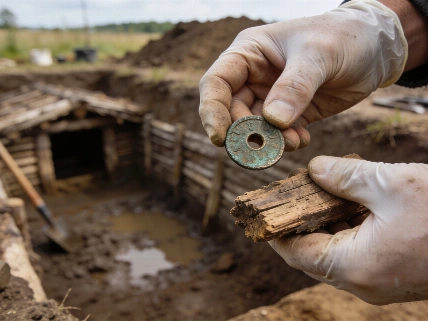
To establish the age of the cemetery, the team is conducting radiocarbon dating on bone samples and dendrochronological analysis of surviving coffin wood. Examination of coffin nails and the absence of grave goods or personal belongings further support the interpretation of an older, possibly unmarked burial ground. The cemetery appears to have been leveled by approximately 1.5 meters before construction began, which explains why the skeletons were found unusually close to the modern surface.
Researchers note that the urgency of wartime construction likely prevented formal exhumation or relocation of the cemetery. The Wolf's Lair was built in stages, and by 1944, Germany's military situation was deteriorating rapidly. This context may have contributed to the decision to proceed with building over the burial ground without systematic removal of earlier graves.
Implications for Site History
The Wolf's Lair is a site of major historical significance, known both for its role in Nazi military planning and as the location of the failed 20 July 1944 assassination attempt on Hitler. Göring's residence, adjacent to his fortified bunker, reflected the luxury associated with his status, though he reportedly preferred his hunting lodge in the Rominta Forest. The discovery of the underlying cemetery adds a new dimension to the site's history, revealing a complex palimpsest of occupation and reuse.
This investigation represents the first professional archaeological study of the Wolf's Lair. The findings highlight the importance of stratigraphic context and careful osteological analysis in distinguishing between burials of different periods. As further scientific analysis proceeds, including radiocarbon and dendrochronological dating, researchers hope to clarify the cemetery's chronological range and the circumstances of its disturbance.
Comparable challenges in interpreting disturbed burial grounds have been documented at other European sites, such as the necropolis beneath Gragnano in Italy, where construction and later reuse complicated the archaeological record. For example, a recent study of organic artifacts and burial practices in southern Italy provides a useful comparative framework for understanding how later building activities can obscure earlier funerary contexts (see analysis of burial disturbance in pre-Roman Campania).
Understanding Disturbed Burial Grounds
When archaeologists encounter human remains in disturbed contexts, distinguishing between primary and secondary deposition is essential. Stratigraphic relationships, the presence or absence of associated artifacts, and taphonomic indicators such as bone displacement or burning all contribute to reconstructing the sequence of events. In cases where later construction has cut through earlier cemeteries, as at the Wolf's Lair, careful documentation and scientific dating are required to separate overlapping phases of use and to avoid misattributing remains to historically prominent periods.
Radiocarbon dating, dendrochronology, and osteological analysis are central to establishing the age and context of burials. However, the absence of grave goods, incomplete preservation, and disturbance by later activity can limit the precision of interpretation. Ethical considerations also arise when human remains are encountered unexpectedly, particularly in sites with complex or contested histories. Responsible archaeological practice requires balancing scientific investigation with respect for the individuals and communities connected to the burial ground.
Stratigraphy is the study of the layering of soils, sediments, and archaeological deposits over time. In burial archaeology, stratigraphic analysis helps determine the relative sequence of graves, construction events, and later disturbances. When a later building cuts through an earlier cemetery, as at the Wolf's Lair, the stratigraphic relationship between the remains and the structure is crucial for establishing which activity came first. Careful excavation and recording of these layers allow archaeologists to reconstruct the site's history and to distinguish between burials of different periods, even when later activity has altered or partially destroyed the original context.