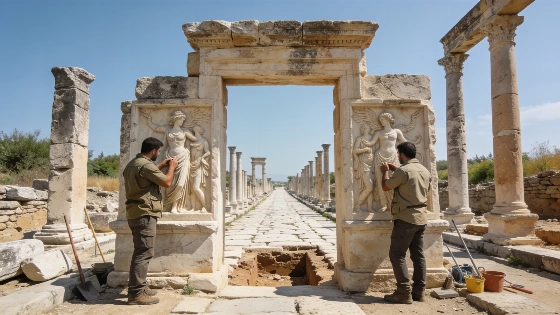
Archaeologists have completed the excavation of a nearly 390-meter-long monumental street in the ancient city of Side, southern Turkey, documenting how its architecture and function shifted from the Roman period into Late Antiquity
Archaeological excavations in the ancient city of Side, located on Turkey's southern Mediterranean coast, have exposed a nearly 390-meter stretch of a principal urban street, offering a detailed record of architectural and social transformation from the Roman period through Late Antiquity. The project, part of Turkey's Heritage for the Future initiative, focused on a route known as Street B, which served as a major thoroughfare in the city's urban plan.
Roman Architecture and Urban Layout
Excavators identified a colonnaded walkway, or stoa, running east-west along the northern side of Street B, with construction features dating to the second century CE. Behind the stoa, a series of rooms were uncovered, suggesting a complex arrangement of public and possibly commercial spaces. The street's original Roman-period layout is preserved in surviving threshold stones and doorways, which provide direct evidence for the organization of movement and access in the city's core.
Three monumental gateways were documented along the stoa: the West Gate, the Herakles Gate, and the North Baths Gate. Each entrance marks a significant point of transition along the street, but the Herakles Gate stands out for its elaborate sculptural program. The gate incorporates relief panels depicting the Twelve Labors of Herakles, as well as representations of deities including Athena, Zeus, Artemis, Hygieia, and Tyche. Stylistic analysis and contextual evidence suggest these reliefs were originally carved in the early third century CE, but were later reused as building material-a practice known as spolia-when the Herakles Gate was constructed in a subsequent phase.
Transformation in Late Antiquity
During the fifth century CE, the character of Street B changed substantially as Christianity became established in the region. Archaeological evidence indicates that a large area north of the street was incorporated into the Bishop's Palace complex, leading to the closure of several earlier entrances and the construction of new monumental gateways. These modifications altered both the appearance and the function of the street, which continued to serve as a main approach for travelers entering Side through the East Gate but now formed part of a more imposing urban axis associated with ecclesiastical authority.
The combination of Roman-period architecture, reused sculptural elements, and later Christian-period construction provides a rare opportunity to trace the evolution of a single urban space across multiple centuries. Rather than representing a single phase of development, the nearly 390-meter route preserves evidence for repeated adaptation in response to changing political, religious, and civic priorities. Comparable approaches to documenting urban transformation have been applied at other sites, such as the mapping of medieval monastic remains beneath modern infrastructure in Denmark, as seen in the investigation of the St Clara Monastery in Roskilde.
Material Evidence and Interpretation
The Herakles Gate's reliefs, while visually striking, illustrate the complexities of interpreting reused material in archaeological contexts. The panels' iconography and carving style are consistent with early third-century CE production, but their incorporation into a later gateway demonstrates how architectural elements could be repurposed to serve new functions and meanings. This practice complicates efforts to assign precise dates to structures based solely on decorative features, underscoring the importance of stratigraphic and contextual analysis in reconstructing urban histories.
Excavators have not reported the recovery of human remains or direct evidence for the identities of those who used or modified Street B. The absence of associated burials or inscribed dedications limits the ability to reconstruct the social composition of the area's inhabitants or users. However, the architectural sequence and material assemblage provide a robust framework for understanding the broader processes of urban change in Side during the Roman and Late Antique periods.
Across the nearly 390-meter length of Street B, the archaeological team documented multiple construction phases, architectural modifications, and episodes of reuse. The evidence supports a model of urban development characterized by continuity and adaptation rather than abrupt transformation, with each generation leaving its mark on the city's built environment.
In archaeological research, the concept of spolia refers to the reuse of architectural elements, sculpture, or building materials from earlier structures in later construction. This practice was common in both ancient and medieval contexts, often reflecting practical considerations such as resource availability, as well as symbolic intentions to connect new buildings with the prestige or authority of the past. The identification of spolia requires careful analysis of stylistic, material, and stratigraphic evidence to distinguish original context from later reuse. In the case of Side's Herakles Gate, the presence of earlier reliefs within a later gateway highlights the layered nature of urban history and the interpretive challenges posed by complex construction sequences.