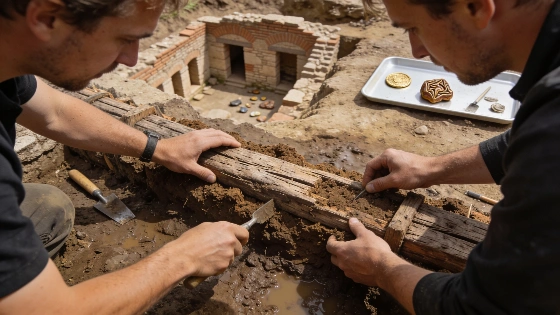
Archaeologists at Vindonissa, Switzerland's key Roman legionary camp, have uncovered the first confirmed section of its original defensive wall, a legionary barracks, and a rare gold coin, offering new evidence for the site's earliest military occupation
Archaeological excavations at Vindonissa, the most significant Roman legionary camp in Switzerland, have revealed new evidence for the site's earliest phase of military occupation. The discoveries, made during an 11-month rescue excavation in Windisch ahead of a planned residential development, include the first securely identified section of the camp's original timber-and-earth defensive wall, a legionary barracks, and a rare gold coin dating to the reign of Emperor Tiberius.
Mapping the Early Camp
The excavation, covering approximately 4,000 square meters, was conducted by the Cantonal Archaeology Department and has expanded the known layout of Vindonissa's initial Roman fortifications. Researchers identified a southern rampart constructed from timber and earth, accompanied by a V-shaped defensive ditch. While a portion of this ditch had been noted in Königsfelden Park over 90 years ago, the current work has allowed archaeologists to trace the course of the fortification for the first time, clarifying the camp's original boundaries and suggesting the likely location of further defenses beneath the modern town.
The newly documented section of rampart lies about 70 meters south of the later stone fortress wall, turning northwest beyond the current excavation area. Although the construction is attributed to the early reign of Emperor Tiberius (14-37 CE), the available finds do not yet permit a more precise date. Botanical remains preserved in the ditch indicate that the defenses were abandoned or left unmaintained for a significant period before later repairs.
Evidence of Daily Life
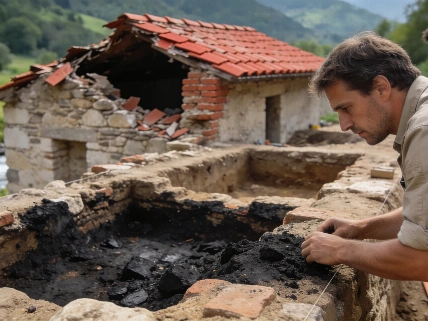
Beneath a later Roman road, archaeologists uncovered the remains of a substantial timber building, measuring roughly nine meters wide and at least 30 meters long. The structure, divided into regularly spaced rooms and entranceways, is interpreted as a barracks for Roman legionaries. Immediately inside the early camp wall, the team also found evidence of a military workshop, including the foundations of a field forge and an oven, suggesting the area was used for metalworking and other essential crafts during the camp's formative years.
Large deposits of rubble outside the later fortress yielded a diverse assemblage of artifacts spanning the Roman Republic through Late Antiquity. Among these were blacksmith's tools, leatherworking equipment, fragments of everyday objects, and a millstone from a Roman hand mill, providing insight into both military and civilian activities at the site. Notably, the excavation recovered a gold aureus struck during the reign of Tiberius, one of the most significant numismatic finds from Vindonissa, which attests to the circulation of wealth within the military settlement.
Exceptional Finds and Preservation
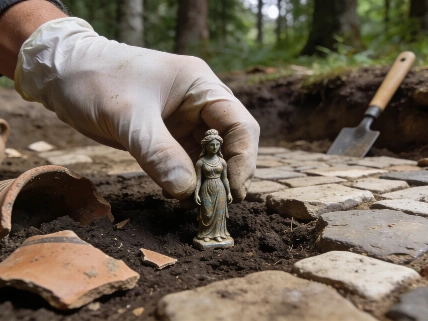
Additional discoveries include a finely carved carnelian gemstone, just one centimeter across, depicting the Roman goddess Victoria holding a wreath and staff. Two possible handles from Roman surgical scalpels were also recovered, hinting at the presence of military medical personnel. One of the most unusual finds is a remarkably preserved Roman loaf of bread, currently undergoing scientific analysis, which may offer rare evidence for the diet of soldiers stationed at Vindonissa nearly 2,000 years ago.
The excavation was completed on schedule by a team of around 20 archaeologists, who documented more than 2,200 square meters of archaeological remains before the site was handed over for construction in July 2026. The scale and preservation of the finds represent a major advance in understanding the origins and daily life of Vindonissa's early Roman occupation. Comparable discoveries of organic preservation, such as rare bread or textiles, have also been reported at other sites in the region, including the recovery of organic grave goods in southern Italy described in recent research on pre-Roman necropolises.
Interpreting the Archaeological Record
While the new evidence provides a clearer picture of Vindonissa's earliest military layout and activities, several uncertainties remain. The precise dating of the rampart and associated structures is limited by the available finds, and the full extent of the original defenses is likely still concealed beneath the modern town. The preservation of organic materials, such as the loaf of bread, is rare and may reflect unique depositional or environmental conditions at the site. Ongoing analysis of botanical, faunal, and material remains is expected to refine interpretations of diet, craft production, and daily routines within the camp.
Vindonissa's archaeological record demonstrates the complexity of Roman military settlements in the provinces, where fortifications, workshops, and domestic spaces coexisted and evolved over time. The integration of stratigraphic evidence, artifact analysis, and environmental sampling is essential for reconstructing the lived experience of soldiers and support personnel at the site.
Stratigraphy, the study of layered deposits at archaeological sites, is fundamental to interpreting the sequence of construction, occupation, and abandonment at Vindonissa. By analyzing the superposition of walls, ditches, buildings, and artifact layers, archaeologists can establish relative chronologies and identify episodes of repair, neglect, or reuse. However, post-depositional processes such as erosion, bioturbation, and later construction can disturb or obscure original contexts, complicating efforts to reconstruct the site's history. Careful documentation and sampling during excavation are critical for preserving the integrity of the archaeological record and supporting future research.