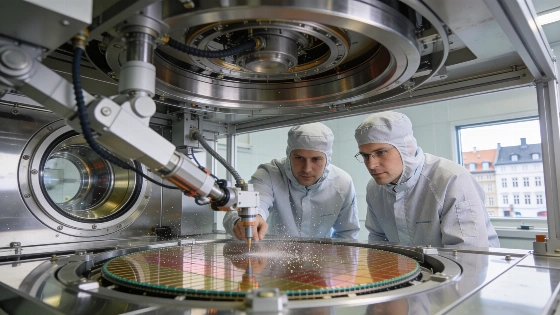
A 5300 m² quantum chip fabrication plant is set to open in Copenhagen by 2027, aiming to bridge the gap between academic research and industrial-scale quantum hardware production using ultra-high vacuum nanofabrication and advanced packaging lines
Europe's quantum ambitions are moving from theory to infrastructure as Denmark prepares to launch a 5300 m² commercial quantum chip fabrication facility in Copenhagen, backed by the Novo Nordisk Foundation. The project, led by Quantum Foundry Copenhagen, is designed to address a persistent bottleneck: the lack of dedicated, industrial-grade manufacturing for quantum hardware in the region.
Bridging Research and Production
Unlike laboratory-scale cleanrooms or university pilot lines, the planned facility will operate as a merchant foundry, offering contract wafer fabrication, atomic-precision material synthesis, and end-to-end chip packaging for quantum technology companies and research institutions worldwide. The goal is to provide the kind of ultra-high vacuum (UHV) nanofabrication and defect-minimized material growth that current academic setups cannot deliver at scale.
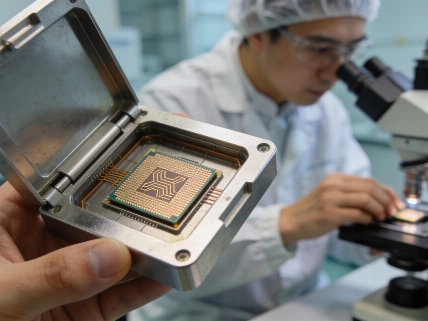
With a scheduled opening in 2027, the foundry will feature specialized cleanroom environments, automated chip testing, and wafer-scale assembly lines. The infrastructure is intended to support multiple qubit modalities, including superconducting, semiconductor, and photonic platforms, by supplying high-purity quantum materials and scalable device packaging.
Technical Scope and Funding
The Novo Nordisk Foundation has committed DKK 2.9 billion (approximately €390 million) to the initiative, making it one of the largest targeted investments in European quantum hardware infrastructure to date. The facility's integration with the Novo Nordisk Foundation Quantum Computing Programme (NQCP) at the Niels Bohr Institute signals a coordinated push toward building a fault-tolerant quantum computer before 2034, in line with the NQCP's stated target.
Key technical capabilities will include atomic-precision UHV processing for quantum materials, wafer-scale device fabrication, and advanced packaging lines. These are essential for reducing defect densities that cause decoherence in physical qubits-a critical challenge for all quantum computing platforms. The foundry's open-access model is intended to serve startups, established companies, and academic groups, providing a commercial-grade supply chain for quantum chips that has so far been missing in Europe.
Policy Alignment and Strategic Context
The Copenhagen foundry is being positioned as a cornerstone for European quantum sovereignty, aligning with the EU Chips Act, the Quantum Europe Strategy, and the anticipated European Quantum Act. By establishing regional capacity for quantum device manufacturing, the project aims to reduce dependence on non-European supply chains and support the continent's ambitions for secure, scalable quantum computing infrastructure.
While European research centers have produced strong results in quantum physics and device science, the transition from laboratory demonstration to manufacturable hardware has been hampered by limited access to industrial-scale fabrication. The new facility is intended to close this gap, providing the infrastructure needed for reproducible, high-yield quantum chip production. This approach echoes recent moves in other countries to secure domestic quantum supply chains, as seen in Sweden's national quantum strategy and in technical advances such as the reported earlier on cryogenic interconnects for large-scale quantum processors.
Engineering Challenges and Open Questions
Despite the scale of investment and the technical ambition, several engineering hurdles remain. Achieving atomic-precision material growth at wafer scale is a nontrivial task, with defect rates, interface roughness, and process variability all posing risks to device yield and coherence. The foundry's ability to deliver reproducible, high-fidelity quantum chips across different hardware platforms will depend on rigorous process control, advanced metrology, and close collaboration with both academic and industrial partners.
It is also unclear how quickly the facility can transition from initial operation to high-volume, high-yield production, or how it will balance the needs of competing quantum hardware approaches. The open-access model promises flexibility, but the technical requirements for superconducting, semiconductor, and photonic qubits differ substantially, and process optimization for one platform may not translate directly to another.
For now, the Copenhagen foundry represents a concrete step toward addressing Europe's quantum hardware bottleneck. The scale of funding and the integration with national and EU-level strategies give the project real weight, but the ultimate test will be whether the facility can deliver reproducible, scalable quantum chips that meet the demanding requirements of fault-tolerant quantum computing. Until then, claims of bridging the gap between research and industry remain conditional on engineering results, not just infrastructure announcements.
Physical qubits are the basic building blocks of quantum processors, realized in systems such as superconducting circuits, semiconductor spins, or photonic modes. Each physical qubit is susceptible to errors from environmental noise, material defects, and imperfect control. Logical qubits encode information across multiple physical qubits using error-correcting codes, allowing some errors to be detected and corrected. The transition from physical to logical qubits is essential for fault-tolerant quantum computing, but requires extremely low error rates and high device yield. Industrial-scale fabrication facilities like the planned Copenhagen foundry are intended to provide the reproducibility and process control needed to move from laboratory prototypes to manufacturable quantum hardware, but the challenge of producing large numbers of high-quality physical qubits remains a central obstacle for the field.