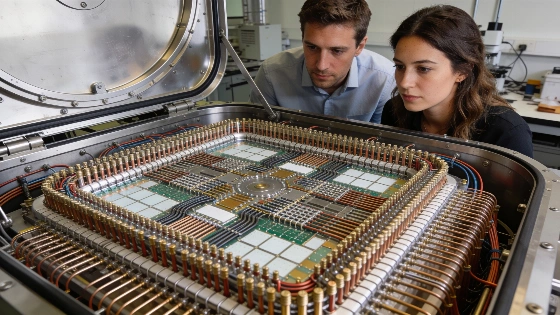
QTREX Quantum has announced a cryogenic interconnect architecture designed to support up to 17,280 coaxial lines per stage in commercial dilution refrigerators, aiming to address wiring density and thermal management for large-scale quantum processors
QTREX Quantum Ltd. (Nasdaq: QTEX) has disclosed plans to demonstrate a cryogenic interconnect architecture supporting up to 17,280 coaxial transmission lines per cryogenic stage, targeting the wiring and thermal bottlenecks that limit the scale of commercial quantum computing hardware. The company intends to present a physical demonstration of the system at IEEE Quantum Week 2026 in Toronto, Canada, from September 13-18, 2026. This architecture is designed for integration with commercial dilution refrigerators, which are essential for operating superconducting and spin-based quantum processors at millikelvin temperatures.
Monolithic Additive Manufacturing
The QTREX interconnect is fabricated using monolithic Additively Manufactured Electronics (AME), a process that integrates signal conductors, dielectric layers, crosstalk shielding, and mechanical routing into a single engineered assembly. Unlike conventional cryogenic wiring, which relies on discrete coaxial cables and connectors, the monolithic approach distributes transmission lines across both the perimeter and surface of each cryogenic stage. This design aims to reduce volumetric congestion, minimize thermal load, and improve reproducibility by eliminating manual assembly steps that introduce variability and limit scalability.
Wiring Density and Engineering Constraints
The reported wiring density-17,280 coaxial lines per stage-more than doubles the capacity of previously disclosed physical interconnects for commercial dilution refrigerators. Achieving this density requires careful management of thermal anchoring, electromagnetic shielding, and mechanical stability, as each additional line increases both the heat load and the risk of crosstalk. The architecture incorporates embedded conductors, dielectrics, and shielding, as well as integrated thermal anchoring structures to manage heat flow between temperature stages. QTREX states that the system is intended to replace traditional cable harnesses, which become impractical as quantum processors scale toward thousands of qubits.
Configuration and Commercialization Pathway
Following the Toronto demonstration, QTREX plans to launch structured configuration programs to translate customer requirements-such as quantum processor type, cryostat geometry, channel mix, and thermal budget-into tailored engineering solutions. The company reports ongoing engagement with commercial quantum computing vendors, U.S. federal laboratories, defense organizations, and university research centers. While the architecture is positioned as a step toward supporting larger quantum processors, the practical impact will depend on integration with specific quantum hardware platforms and the ability to maintain low error rates and stable operation at scale.
Comparison With Conventional Approaches
Conventional cryogenic interconnects typically use networks of discrete coaxial cables, each requiring individual connectors and manual thermal anchoring at each stage. As qubit counts increase, this approach leads to volumetric congestion, increased thermal load, and greater assembly variability. The QTREX architecture seeks to address these limitations by integrating all necessary wiring and thermal management into a single monolithic structure. This approach is part of a broader trend in quantum hardware engineering, as seen in efforts to improve processor integration and control infrastructure. For context, recent developments in quantum processor engineering, such as the expansion of silicon spin-qubit facilities in Santa Monica, have also highlighted the importance of scalable wiring and cryogenic integration (see coverage of silicon spin-qubit engineering expansion).
In quantum computing hardware, the challenge of scaling interconnects is closely linked to the physical requirements of qubit control and readout. Each qubit typically requires at least one dedicated control and measurement line, and as processor sizes grow, the wiring and thermal management become critical engineering constraints. The QTREX architecture represents an attempt to address these constraints through monolithic integration, but its effectiveness will depend on real-world deployment, compatibility with diverse quantum processor technologies, and the ability to maintain low error rates under operational conditions.
Cryogenic operation is essential for many quantum computing platforms, particularly those based on superconducting circuits and semiconductor spin qubits. Dilution refrigerators provide the ultra-low temperatures required for quantum coherence, but every additional control or readout line introduces heat and complexity. Effective cryogenic interconnects must balance wiring density, thermal load, electromagnetic shielding, and mechanical reliability. As quantum processors scale, advances in interconnect technology will be necessary to support larger, more complex systems without compromising performance or stability.