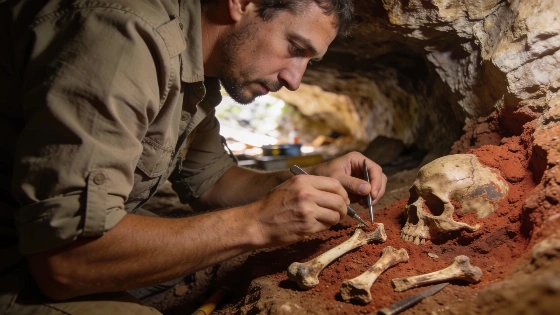
Archaeologists have identified new evidence of cannibalism among Homo antecessor at Gran Dolina cave in Spain, with cut marks on adult and juvenile bones dating to around 850,000 years ago, expanding our understanding of early human behavior
Recent excavations at Gran Dolina, a cave within the Sierra de Atapuerca archaeological complex in northern Spain, have produced new evidence that the extinct hominin species Homo antecessor practiced cannibalism. The latest finds include more than two dozen human bones and teeth, many bearing cut marks consistent with butchery using stone tools. Notably, these remains represent both adults and children, challenging earlier interpretations that cannibalism at the site primarily targeted juveniles.
Gran Dolina Excavations
The Gran Dolina cave has long been a key site for understanding early human presence in Europe. The newly recovered material includes fragments of skull, vertebrae, arm and leg bones, and three teeth, all attributed to Homo antecessor. This species is known from Europe between approximately 1.2 million and 770,000 years ago. The bones were found in stratified deposits dated to around 850,000 years ago, based on contextual geological and paleomagnetic evidence. Several of the human bones display clear cut marks, and some also show evidence of human bite marks, supporting the interpretation that the bodies were processed and consumed.
With the addition of these new remains, the minimum number of individuals identified at Gran Dolina now stands at 13, about half of whom are adults. This demographic profile is broader than previously recognized, as earlier studies had focused on infants and juveniles. The presence of adult remains with similar modifications suggests that cannibalistic behavior was not limited to the most vulnerable members of the group.
Material Evidence and Interpretation
Archaeologists also recovered a range of stone tools made from flint, quartzite, and sandstone, as well as animal bones from species such as hyena, beaver, deer, horse, and rhinoceros. The stone tools are technologically consistent with those used to process both animal and human remains. Butchery marks on animal bones at the site closely resemble those found on the human bones, indicating similar processing techniques. The combination of cut marks, percussion damage, and human bite marks on the bones provides strong evidence that cannibalism at Gran Dolina was practiced for nutritional purposes, rather than as a result of ritual or symbolic behavior.
Despite the extensive evidence for cannibalism, the reasons behind this behavior remain uncertain. Researchers have proposed that nutritional stress, competition between groups, or opportunistic exploitation of available bodies could have played a role. However, the current evidence does not allow for a definitive explanation. Ongoing analysis of the newly discovered adult remains may help clarify whether cannibalism was a regular subsistence strategy or a response to specific circumstances.
Broader Context and Ongoing Questions
The Gran Dolina findings contribute to a growing body of evidence for complex social and subsistence behaviors among early hominins in Europe. The site is notable for its exceptional preservation and stratigraphic integrity, allowing for detailed study of both human and faunal remains. The discovery of adult individuals with cut marks expands the demographic range of cannibalism at the site and raises new questions about group dynamics and social organization among Homo antecessor.
Further research is underway to investigate age-related differences in cannibalistic treatment, the frequency and duration of such episodes, and the broader ecological context. The scientific potential of the site remains high, as only a portion of the relevant deposits has been excavated. Comparable discoveries elsewhere, such as the recovery of rare organic artifacts from an archaic necropolis in southern Italy, highlight the importance of well-preserved contexts for reconstructing ancient lifeways (see this report on organic artifact preservation).
Understanding the evidence for cannibalism at Gran Dolina requires careful consideration of taphonomic processes, excavation methods, and the limitations of the archaeological record. As new material is recovered and analyzed, interpretations of early human behavior in Europe will continue to evolve.
In archaeological research on ancient human remains, the concept of minimum number of individuals (MNI) is used to estimate how many people are represented in a commingled assemblage. MNI is determined by counting the most frequently occurring unique skeletal element-such as a left femur or a specific tooth type-and provides a conservative estimate of the population present. This approach is especially important at sites like Gran Dolina, where bones from multiple individuals and age groups are mixed together. MNI helps researchers avoid overestimating the number of individuals and supports more accurate demographic and behavioral interpretations.