China aims to deploy quadruped robots to support astronauts and conduct research at its planned International Lunar Research Station by 2035, raising questions about autonomy, safety, and human-robot collaboration in extreme environments
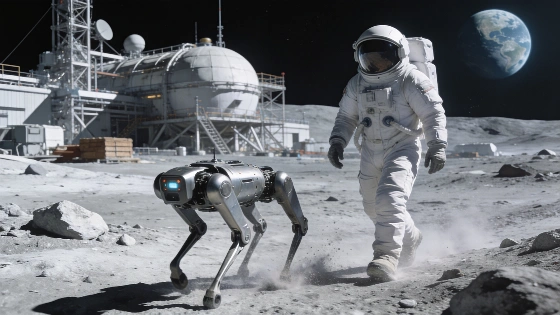
China has announced plans to incorporate quadruped robots-commonly referred to as robot dogs-into the construction and operation of its International Lunar Research Station (ILRS), targeted for completion in 2035. According to recent reporting in Chinese Space Science and Technology, these robots are intended to assist astronauts with scientific research, daily maintenance, and potentially even psychological support during extended lunar missions. The proposal reflects a growing trend in robotics research to adapt terrestrial autonomous systems for use in space, where human presence is limited and environmental hazards are significant.
Unlike traditional wheeled or tracked rovers, quadruped robots are designed to navigate uneven terrain and obstacles more effectively, a capability that could prove essential on the Moon's rugged surface. The envisioned lunar robot dogs would be equipped with a suite of sensors for navigation, inspection, and environmental monitoring. Their tasks may include patrolling research stations, transporting equipment, collecting geological samples, and performing routine inspections. The robots are also being considered for roles in habitat maintenance, such as regulating air and temperature, cleaning living spaces, and tending to experimental plant growth systems.
Technical and Operational Challenges
Adapting quadruped robots for lunar deployment presents substantial technical challenges. On Earth, such robots rely on high-bandwidth communication, GPS, and extensive training data-resources that are unavailable or severely limited on the Moon. The lunar environment introduces additional constraints, including extreme temperature fluctuations, abrasive dust, and reduced gravity. To address these issues, China's ILRS project will require the development of new communication and navigation systems, as well as robust autonomy algorithms capable of operating with minimal human intervention and limited external data.
Evidence from terrestrial deployments highlights both the promise and the limitations of current quadruped robots. For example, in 2023, Cape Cod Space Force Station began testing a semi-autonomous ground robot dog for base security and inspection tasks. While the system demonstrated reliable performance in controlled settings, it still required human supervision for complex or unexpected situations. The transition from semi-autonomous operation on Earth to greater autonomy in space remains an open engineering problem, with safety and reliability as central concerns.
Human-Robot Collaboration and Social Implications
The ILRS concept envisions close collaboration between astronauts and robot dogs, with the robots providing both practical assistance and potential psychological support. Proponents suggest that social robots could help mitigate the isolation and stress associated with long-duration lunar missions. However, the evidence for sustained psychological benefit from social robots remains limited, and the risk of over-reliance or automation bias must be considered. The robots' ability to communicate with astronauts, perform daily routines, and simulate social interaction will depend on advances in natural language processing and human-robot interaction design.
China's lunar robot initiative is part of a broader international effort to expand the use of mobile robots in extreme environments. Similar trends are visible in terrestrial robotics, such as the development of all-terrain humanoid and quadruped systems for industrial, security, and research applications. For instance, the demonstration of LUMO, a humanoid robot capable of adapting to varied environments, illustrates the rapid progress in mobility and interaction capabilities (see coverage of LUMO's all-terrain demonstration).
Deployment Timeline and Measurable Milestones
China's ILRS roadmap calls for the initial lunar base to be operational by 2035, with plans to expand to a larger orbiting complex by 2045. In August 2026, China is scheduled to launch a mission to extract water ice from the lunar South Pole, a critical step for supporting human habitation and robotic operations. The integration of quadruped robots into these missions will depend on successful adaptation of hardware and software to lunar conditions, as well as the establishment of reliable communication and navigation infrastructure. To date, no fully autonomous quadruped robot has been deployed beyond Earth, and the performance of such systems in lunar gravity and dust remains untested.
Current terrestrial quadruped robots typically operate for several hours on a single battery charge and can carry payloads of up to 14 kg, depending on the model. Lunar deployment will require further advances in energy efficiency, dust protection, and fault tolerance. The ILRS project has not yet disclosed detailed specifications or independent test results for its planned lunar robots, and it remains unclear how much human oversight will be required during initial operations.
Quadruped robots represent a promising but unproven approach to supporting human activity on the Moon. Their success will depend on overcoming significant technical, operational, and social challenges, as well as on transparent evaluation of their performance in the unique conditions of lunar exploration.
Understanding the distinction between automation and autonomy is essential when evaluating lunar robotics. Automation refers to the execution of predefined tasks with minimal variation, often under human supervision. Autonomy, by contrast, requires the system to make independent decisions in response to changing or uncertain environments. In space, where communication delays and environmental hazards are pronounced, achieving reliable autonomy is a major engineering hurdle. The degree of autonomy realized in lunar quadruped robots will determine not only their utility but also the level of human oversight and intervention required for safe and effective operation.