DOBOT has presented LUMO, a humanoid robot designed to navigate varied indoor and outdoor environments, combining computer vision, voice interaction, and motion control to adapt its behavior to different users and tasks
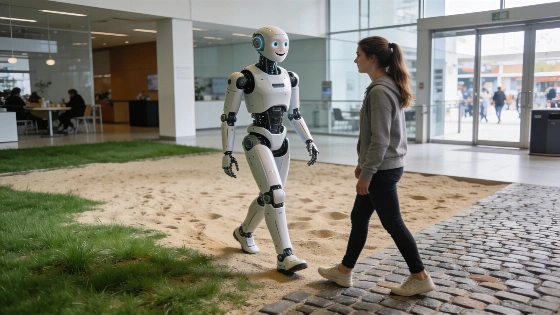
DOBOT has introduced LUMO, a humanoid robot designed to operate across a range of everyday environments, including homes, offices, schools, and public spaces. The company describes LUMO as an all-terrain system capable of traversing surfaces such as grass, sand, and cobblestones, while maintaining a human-like gait. The robot is intended to perform multiple roles, from household companionship to educational assistance, and is engineered to adapt its behavior based on user interaction and environmental context.
Multimodal Interaction and Environmental Awareness
LUMO integrates computer vision, voice recognition, and motion control, enabling it to perceive its surroundings, interpret spoken instructions, and execute physical actions. According to DOBOT, the robot can respond to environmental cues without relying exclusively on explicit commands, such as switching to a quieter walking mode or turning off lights after detecting a user has fallen asleep. The company also claims that LUMO can recognize basic emotional states and adjust its responses accordingly, though the underlying detection methods and accuracy rates have not been independently evaluated.
Demonstration Highlights Mobility and Human-Like Movement
During a recent demonstration, LUMO was shown navigating a variety of indoor and outdoor settings, performing actions such as boxing, dancing, and executing a backflip. The demonstration was presented as unedited video footage, but the company has not released detailed technical documentation or independent test results. LUMO stands approximately 1.3 meters tall and is designed with a non-threatening, approachable appearance to encourage user engagement. The robot's multimodal interaction system is intended to support natural communication, but the extent of its conversational and adaptive capabilities remains defined by company statements rather than peer-reviewed evidence.
Learning, Personalization, and Potential Applications
DOBOT emphasizes that LUMO is designed to learn from ongoing user interactions, with the goal of improving its performance and personalizing its assistance over time. However, the company has not disclosed the specific learning algorithms, data retention policies, or privacy safeguards associated with this feature. Potential applications cited by DOBOT include classroom instruction, STEM education, interactive museum exhibits, customer engagement in retail environments, and home companionship. The company has not published hardware specifications such as weight, battery life, payload, or onboard computing details, limiting independent assessment of the robot's operational constraints and safety features.
LUMO in the Wider Humanoid Robotics Landscape
While LUMO's demonstration focused on mobility and interaction, DOBOT has previously showcased remote operation capabilities with its Atom humanoid, including a teleoperated cooking task performed over a distance of 1,800 kilometers. The broader field of humanoid robotics is seeing increased attention, with companies and research groups pursuing general-purpose robots that can function in unstructured environments. For example, recent advances in full-body humanoid control by major AI labs, such as the Gemini Robotics 2 system from Google DeepMind, have highlighted the technical challenges of transferring learned behaviors across different robot platforms and tasks. Readers interested in the latest developments in this area can find further context in Science Report's coverage of Gemini Robotics 2's approach to multi-robot coordination.
Independent Verification and Safety Questions Remain
At present, LUMO remains a company-announced prototype without independent verification of its claimed capabilities or safety features. The absence of published technical specifications, systematic evaluation data, or regulatory certification means that the robot's real-world reliability, user safety, and privacy implications cannot be fully assessed. As with other emerging humanoid platforms, the transition from controlled demonstration to routine deployment will require further evidence, including transparent reporting of failure modes, human oversight requirements, and compliance with relevant safety standards.
Why Real-World Testing Matters for Humanoid Robots
Humanoid robots such as LUMO rely on a combination of sensors, actuators, and software to interpret their environment and interact with users. Sensor fusion-integrating data from cameras, microphones, inertial measurement units, and other sources-enables the robot to estimate its position, recognize objects, and respond to spoken commands. However, the accuracy and reliability of these systems depend on both hardware quality and the robustness of the underlying algorithms. In practice, environmental variability, sensor noise, and unanticipated user behavior can challenge even advanced robots, making systematic testing and transparent reporting essential for evaluating real-world performance and safety.