LinkerBot's LinkerHand O30 performed card and coin tricks in a company demonstration that showed precise finger coordination while leaving its reliability outside controlled tasks untested
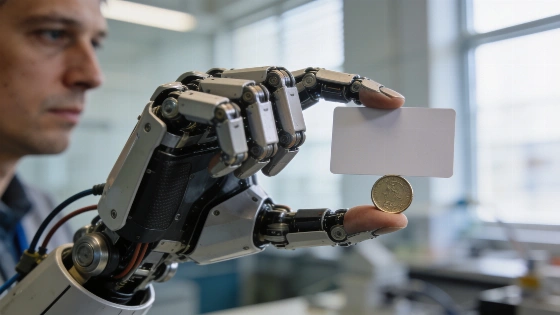
A robotic hand made a coin disappear and pulled a toy car from a playing card in a demonstration designed to expose the mechanics of dexterity rather than simulate a theatrical illusion. LinkerBot's LinkerHand O30 changed a card, handled a thin card and manipulated a small coin through three magic tricks that required coordinated movement across independently controlled fingers.
The performance is evidence of a carefully executed company demonstration. It is not a benchmark, a field trial or proof that a humanoid robot can perform general-purpose manipulation reliably. The material provides no trial count, failure rate or information about how many attempts were needed, so the footage supports a narrower claim: the hand can execute selected delicate movements under demonstration conditions.
LinkerHand O30 is built around 20 active and zero passive degrees of freedom. Independent product documentation describes separate brushless motors and worm-drive transmissions for each joint, making the O30 a fully actuated design rather than a simpler mechanically linked hand. In practical terms, each joint can receive its own position or force command instead of forcing several fingers to follow one fixed grip pattern. A product specification summary describes this architecture as allowing more precise control of finger position and force.
The hardware is reported to weigh about 730 grams, or 1.6 pounds, and is intended for installation in robotic systems. A commercial listing identifies standard fingertip sensors, but the available descriptions do not establish that the hand has a complete tactile skin covering the palm and fingers. That distinction matters because fingertip contact sensing is not equivalent to distributed pressure, shear and vibration sensing across the whole hand.
The O30 is presented as a platform for robotics research, dexterous-manipulation model training and industrial end-effector applications. The underlying engineering question resembles work studied at MIT and in the robotics literature published by Nature: how can a controller coordinate many actuators while using incomplete and noisy information about contact? More degrees of freedom expand the set of possible grasps, but they also expand the calibration and control problem.
The distinction matters. A high-degree-of-freedom mechanism supplies more control options; it does not automatically supply the perception, planning or recovery behavior needed for dependable autonomous work. The demonstration shows the hand moving through chosen sequences, but it does not show whether a robot can recognize an object, select a suitable grasp, detect a slip or recover when the intended motion fails. Those requirements are closer to a systems-engineering challenge than to a simple test of motor precision.
The reported specifications are unusually broad for a compact hand. LinkerBot lists a maximum static load of up to 30 kilograms, thumb fingertip force of up to 24 newtons, four-finger lateral pinch force of 30 newtons and five-finger grasping force of 70 newtons. The hand can reportedly open or close fully in about 0.8 seconds, receive commands at up to 500 hertz through CAN or CAN FD connections and repeatedly reach a position with an accuracy of ±0.20 millimeters.
That positioning figure describes repeatability under specified control conditions; it is not evidence that an autonomous system can locate or manipulate an unknown object with the same accuracy. The O30 operates from a 24-48 volt DC supply and has maximum power consumption rated at 150 watts, while its static current can be as low as 0.4 amps at 24 volts. Its thumb and four fingers have separately specified movement ranges and speeds, giving the controller access to the 20 active joints without showing how the complete system behaves under heat, wear, object variation or repeated industrial cycles.
Compared with the four-finger industrial hand described in an earlier report, the O30 emphasizes a larger independently controlled joint space. That comparison is useful but limited: finger count and degrees of freedom do not by themselves determine which hand will perform better on a particular assembly, grasping or tool-use task.
In control terms, a 500-hertz command interface can support frequent updates, but communication rate alone does not define closed-loop bandwidth. Sensor latency, motor dynamics, transmission backlash, filtering and contact-model errors all affect the response actually delivered at the fingertips. Similar distinctions appear in precision instrumentation developed for NASA and CERN, where nominal resolution is reported separately from uncertainty, calibration stability and performance under operating conditions.
The card change and coin disappearance make a useful visual test because thin cards and small objects expose errors in alignment and contact. The toy-car trick adds another sequence of coordinated actions. Together, the demonstrations show precise object handling and rapid finger motion, but they remain selected examples rather than a systematic evaluation of general manipulation.
LinkerBot was founded in 2023 and has developed dexterous robotic hands with different degrees of freedom for customers across multiple applications. The company says the O30 is suitable for precision manufacturing in electronics, automotive and aerospace production. Those proposed uses will depend on integration with sensing, control software, safety systems and task-specific programming that are not described in the available material.
Available search results describe the O30 as a serially produced product, but independent evidence about units delivered, mass-deployment performance, failure rates or confirmed industrial installations was not identified. A commercial listing for the O30 supports the approximate mass and fingertip-sensor description, but it does not substitute for an independently audited reliability study.
The same hardware could support research into manipulation models because researchers need an actuator platform capable of producing varied finger movements. Yet training a control model on a hand is not equivalent to giving the hand human-like dexterity. Reliable deployment would require evidence about repeatability, failure recovery, object diversity and human intervention, none of which the magic demonstration reports. The history of experimental robotics, including work associated with Stanford and the Max Planck Society, shows why these measures must be separated from a successful single sequence.
The central concept is closed-loop control: a controller compares a desired position or torque with measurements from the mechanism and adjusts the motors. More independently controlled joints can give that loop finer options, but they also create more states to coordinate and more ways for calibration or contact errors to affect the task. A successful scripted sequence therefore demonstrates available mechanical control without establishing robust autonomy.
LinkerHand O30 is best understood as a capable robotic hand platform whose public evidence currently consists of a tightly bounded company demonstration and a set of manufacturer-reported specifications. The magic tricks make the engineering legible, while the missing repeatability and failure data set a clear limit on the claim. For humanoid robotics, that is still meaningful progress in hardware design-but not evidence that dexterity has been solved.