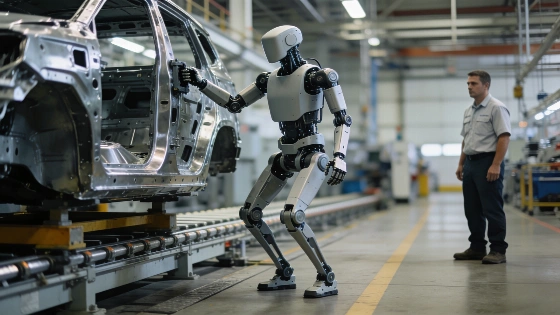
Boston Dynamics and Hyundai have opened a Georgia facility where trainers are teaching Atlas humanoid robots to sort parts and sequence factory work before planned industrial expansion
Boston Dynamics is moving Atlas from choreographed demonstrations into an automotive factory environment where human trainers are teaching the humanoid robot to handle parts logistics and assembly-line sequencing. The project is an example of physical AI: software-driven perception and decision-making connected to a machine that must act under real mechanical, spatial and safety constraints.
The work is taking place at the Robotics Metaplant Application Center inside Hyundai Motor Group's Metaplant America campus near Savannah, Georgia. Industry reports describe RMAC as a testbed and training center launched in September 2026 to integrate Atlas into Hyundai operations. The facility is intended to optimize the supply chain, production, testing and deployment of the robot, but current evidence describes supervised training and teleoperation rather than a fully independent production workforce.
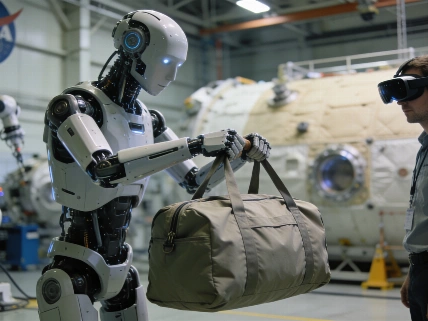
Atlas is being used in real-world factory conditions to sort automotive parts, organize components and support production-line sequencing. Human operators control or supervise the machines while training them on physical tasks. That detail matters: a robot can perform a movement in a factory without independently deciding what to do or reliably recovering when the environment changes.
Robotic manipulation combines several technical problems that are usually evaluated separately: visual perception, pose estimation, grasp planning, force control and recovery from errors. In a changing factory, success depends not only on whether a gripper can lift an object, but also on whether the system can detect a misplaced part, recognize contact forces and stop safely when a person enters the workspace. These are engineering questions about repeatability and risk, not just demonstrations of mobility.
Research programs at MIT and NASA have long treated robotics as a systems-engineering problem in which sensing, control, hardware reliability and human factors must be evaluated together. The same principle applies here: Atlas's ability to walk or lift a component does not establish that it can complete a production task reliably across an entire shift.
Hyundai's plan is to expand the system in stages. RMAC is expected to become roughly ten times larger in 2027, with testing extending beyond automotive manufacturing into aerospace, logistics, and food and beverage applications. Updated reports place Atlas's expected entry into HMGMA production processes in 2028, while broader tasks, including component assembly, are associated with a 2030 goal.
The proposed scale is substantial. Hyundai plans to deploy 25,000 Atlas units across global Hyundai and Kia facilities over time and has discussed United States production infrastructure capable of producing 30,000 robots annually. These are deployment and manufacturing plans rather than independently verified operating results. They indicate the intended scale of the program, not a demonstrated level of autonomous performance.
Boston Dynamics says Atlas can lift a peak payload of 50 kilograms and carry 30 kilograms continuously. The robot has an operating runtime of about four hours, supports autonomous battery swaps and uses custom tactile grippers for automotive components. Its 56 degrees of freedom allow coordinated movement across the body, while its stated operating range runs from -20°C to 40°C.
Those specifications describe physical capability rather than dependable factory performance. The public material does not provide a success rate, number of trials, failure rate, intervention count or independent assessment of how Atlas performs when parts are misplaced, lighting changes or workers move unpredictably through the workspace. It also does not establish that the robot can complete a full assembly process without human intervention.
Studies discussed in journals such as Nature and Science commonly distinguish laboratory capability from performance under uncontrolled conditions. For industrial robots, meaningful evaluation would include task-completion rates, recovery time, unplanned interventions, near misses, maintenance downtime and confidence intervals across repeated trials. No such dataset has been publicly reported for Atlas at RMAC, so the current claims should be read as an industrial development program rather than a completed validation study.
Atlas has become widely known through videos of acrobatics and other laboratory demonstrations. Factory handling is a different engineering problem. Manipulating automotive components requires perception, force control, grasping and recovery from small variations in object position; a short demonstration cannot establish repeatable reliability across an entire production shift. A recent robot sprint report concerns a controlled speed test, while Atlas is being developed for manipulation and logistics. Neither kind of demonstration by itself establishes general-purpose physical intelligence or safe industrial autonomy.
The distinction is visible in the current deployment. Trainers are not merely supervising an already autonomous worker; they are providing control and experience through which the system is being prepared for later automation. RMAC is therefore a development and integration site first and a proof of large-scale autonomous manufacturing second. This staged approach resembles established practice in aviation and space robotics, where NASA-style verification separates component tests, supervised operations and safety-critical autonomy.
Hyundai says automation will shift dangerous, repetitive and physically demanding tasks away from human workers while people remain necessary to operate, train and maintain the robotic fleet. Kia Corp's labor union has requested a dedicated body to protect labor rights in an era of workplace AI after automation plans prompted concern about job losses.
Those concerns are not answered by a promise that humans will remain involved. The quality of oversight will depend on whether workers can intervene quickly, whether unusual failures are logged and whether responsibility for an unsafe action is clear. The public material gives no details about safety certification, emergency-stop arrangements or the rules governing shared workspaces, so the announced expansion cannot yet be treated as evidence that these problems have been solved.
Boston Dynamics is also working with existing clients to extend Atlas into aerospace, semiconductor fabrication and life sciences. The range of proposed sectors increases the importance of testing outside the carefully defined tasks now reported at RMAC. A robot trained to sort or sequence automotive parts is not automatically validated for environments with different materials, tolerances, hazards or regulatory requirements.
For that reason, industrial deployment should be assessed using transparent human-robot performance measures rather than unit counts alone. Useful metrics would include the proportion of tasks completed without intervention, the frequency and severity of safety stops, mean time between failures, maintenance burden and the number of human hours required to supervise each robot. Without these measurements, a larger fleet could scale both productivity and hidden supervisory labor.
RMAC therefore represents a serious industrial experiment rather than a completed robotics revolution. Hyundai has committed to a large deployment target, and Boston Dynamics has placed trainers inside a working manufacturing setting, but the public evidence still stops short of showing autonomous component assembly at production scale. The credible significance is that humanoid robots are being evaluated against actual factory work; the unresolved question is whether they can perform that work consistently without transferring hidden labor and risk to human operators.
Teleoperation means that a person remotely guides some or all of a robot's actions, while autonomy means the machine makes defined task decisions without continuous control. A system can combine both modes by using human input during training and automated behavior during selected operations. Battery swapping or automatic movement does not by itself make the entire manufacturing process autonomous. For Atlas, the decisive evidence will be repeatable results across real shifts, intervention data, independent safety review and clear responsibility for failures. Without that evidence, the announcement is a strong industrial plan but not proof of independent robotic labor.