Excavations at Chengba in eastern Sichuan have revealed a fortified Han settlement with workshops, streets, bamboo documents and a possible water gateway associated with the ancient county of Dangqu, although the identification remains an archaeological interpretation rather than a confirmed administrative decision.
A riverside settlement in south-west China may finally give physical form to Dangqu County, a place known from Han historical records but not previously tied to a securely identified urban site. At Chengba in eastern Sichuan, archaeologists have found fortified walls, streets, workshops, administrative materials and roof tiles carrying the characters for "Dangqu". The evidence is substantial, but current reporting does not establish that Chengba has been officially and finally recognized as the historical city or county of Dangqu.
The site occupies the eastern bank of the Qujiang River, part of a water route leading through the Jialing River toward the Yangtze. Northward, the Micang Pass crosses the Daba Mountains toward China's Central Plains. That combination made Chengba more than an isolated county seat: river transport and mountain travel connected it to wider systems of administration, trade and production. Such geographic positioning is consistent with a broader pattern in which early Han settlements in Sichuan developed along transport corridors and later became subjects of museum and heritage policy.
The enclosed urban area covers approximately 50,000 square metres. Its gated wall measures about 725 metres in circumference and was paired with a moat. Inside the enclosure, excavation has identified streets and building foundations; outside it, archaeologists have documented a cemetery, pottery production and a riverside dock. These spatial relationships are important because they allow researchers to compare administrative, residential, industrial and mortuary activity within one settlement landscape rather than treating isolated finds as independent discoveries.
The walls appear to have been established during the early Western Han Dynasty, between 202 and 141 BCE, before being repaired in later phases. The settlement has been described as the first Han Dynasty city identified in eastern Sichuan, where other known Han urban sites are concentrated mainly around the Chengdu Plain. That claim should be understood as a statement about the current archaeological record, not proof that no comparable site remains undiscovered or incompletely excavated.
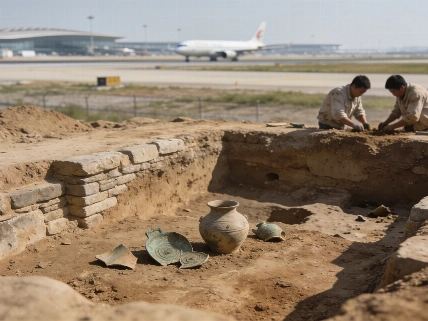
Chengba's history extends further back than the Han period. Bronze ritual vessels and weapons from the Warring States Period indicate that the location was already an important centre when the region formed part of the ancient Ba state. Researchers associate this earlier phase with Cong City, while the Han settlement may represent Dangqu County within Ba Commandery. The earlier layers therefore suggest continuity and reorganisation across political periods rather than the sudden creation of an urban centre with Han rule.
The identification rests on several kinds of evidence rather than on one object. Large numbers of roof tiles bear inscriptions containing the characters for "Dangqu", while the site's location corresponds with historical descriptions of the county. Together, those clues make Chengba a strong candidate for Dangqu City, although the conclusion remains an archaeological interpretation rather than a direct observation of the ancient city's name in use. Recent Xinhua reporting has focused on Chengba's archaeological importance and heritage protection, including its designation as a National Archaeological Site Park in 2025, rather than on a new legal ruling that definitively settles the Dangqu identification.
The written evidence is unusually valuable. Bamboo documents recovered at Chengba concern finance, judicial affairs and education, including calligraphy, literature and arithmetic. Some relate to household registration, a category of Western Han bamboo document rarely recovered in China. Chengba has consequently been part of academic discussion for years through publications on wooden and bamboo slips from the site, rather than being simply a newly discovered city. As another field record shows, archaeological interpretation depends heavily on preserving context; at Chengba, the relationship between documents, structures and the riverfront is central to understanding how the settlement functioned.
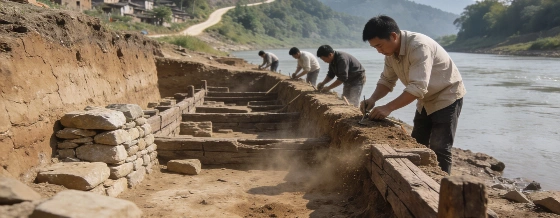
The most distinctive proposed feature lies northwest of the enclosed city beside the Qujiang River. Archaeologists have identified a dock and argue from its position and the bamboo documents found there that it may have served as a combined land and water gateway. The interpretation links physical access routes with the administrative information preserved on the slips, but the surviving evidence does not reveal every stage of activity at the waterfront.
Such a facility could have allowed officials to inspect travellers and boats while regulating goods and other resources moving through the settlement. That reconstruction is plausible because Chengba sat at a junction of river and mountain routes, but the available evidence does not establish every administrative procedure carried out at the dock. If the interpretation is confirmed, researchers say it would be the only Han Dynasty water gateway discovered so far in China; this remains a provisional comparative claim that could change with future excavations.
Industrial evidence gives the city another dimension. More than 20,000 pieces of iron-smelting debris have been recovered, including slag, furnace lining and tuyeres, the nozzles that forced air into furnaces. Radiocarbon dating indicates that smelting continued from the late Western Han Dynasty into the middle of the Eastern Han Dynasty. The material shows sustained production, but the debris alone cannot establish how much iron was exported, who controlled the workshops or how the industry was organized.
Chengba therefore offers an unusually dense archaeological record of county-level urban life: administrative texts, transport infrastructure, craft production and residential architecture occupy the same broader settlement landscape. The evidence places the site within a long sequence running from roughly the fourth century BCE through the Qin and Han dynasties, rather than presenting it as a city that appeared suddenly with Han rule.
That distinction matters. Chengba is not important because it supplies a dramatic "lost city" narrative; it is important because its material remains connect political geography to ordinary mechanisms of urban life. The walls, dock, documents and industrial waste show how a regional centre could combine government, movement and production, while the Dangqu identification remains strongest when those independent lines of evidence are considered together.
Archaeological dating works here at several levels. The wall's early Western Han placement comes from archaeological context and associated evidence, while radiocarbon dating is specifically reported for the iron-smelting sequence. Neither method alone proves the city's historical name: that case depends on the convergence of inscriptions, geography, chronology and written records. This layered reasoning follows the same principle of separating observation from interpretation that is expected in journals such as Nature and in comparative archaeological research associated with institutions including the Max Planck Society.
The Chengba record also illustrates why excavation reports should distinguish measurements, associations and historical hypotheses. The dimensions of the enclosure and the quantity of industrial debris describe what has been recovered; the proposed gateway and Dangqu identification explain what those findings may mean. Further stratigraphic study, publication of primary excavation data and comparison with other Han sites will be necessary to test the interpretation. For now, Chengba is best described as a well-supported candidate for ancient Dangqu and a major archaeological site in eastern Sichuan, not as a legally settled identification.