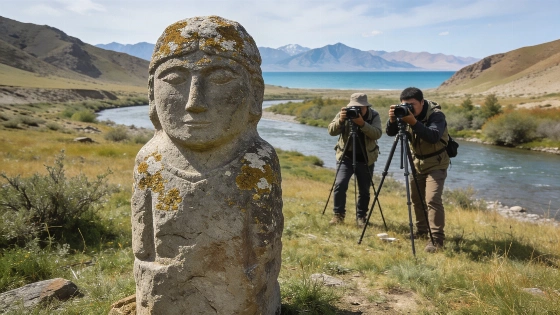
A previously undocumented Turkic stone statue has been recorded in situ near Lake Issyk-Kul in Kyrgyzstan using photogrammetry, contributing to a growing digital archive of early medieval monuments and raising questions about preservation and context
Archaeologists have added a new piece to the early medieval record of Central Asia with the documentation of a previously unknown Turkic stone statue in the Dzhuuku River valley, southeast of Lake Issyk-Kul. Rather than removing the sculpture, the team used photogrammetry to create a detailed three-dimensional record, leaving the object in its original context for now. This approach reflects a shift toward non-invasive documentation and digital preservation, especially for monuments at risk of damage or loss.
Context and Documentation
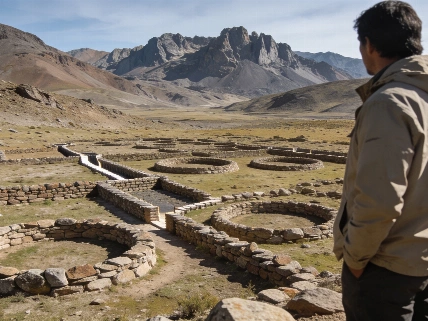
The statue was identified during an international field survey in August, targeting a complex of nine Turkic-period enclosures along the Dzhuuku River. These enclosures are associated with the Turkic populations that occupied the region during the early medieval period, roughly between the sixth and ninth centuries CE. The newly recorded statue joins a wider body of stone monuments-often called balbals or stone figures-distributed across Central Asia and linked to Turkic mortuary and commemorative practices.
Photogrammetry, the method used to document the statue, involves capturing hundreds of overlapping photographs from multiple angles and processing them into a high-resolution three-dimensional model. This technique preserves the monument's shape, surface detail, and condition without physical intervention, allowing for future study and virtual display. The project forms part of a broader initiative to create a digital archive of Turkic heritage, with the aim of supporting both research and public access.
Comparative Evidence and Preservation
During the same expedition, researchers extended their survey to other collections and sites in the region. More than 80 stone sculptures were examined at the Burana Tower Archaeological and Architectural Museum Complex, and additional statues were recorded at the National History Museum of Kyrgyzstan and the Kalen Zhetimishbaev Historical and Genealogical Museum in Orgochor. The team's systematic approach is generating a comparative dataset for analyzing regional variation in monument style, construction, and context.
One notable object documented was a fragment of a stone stele from a Buddhist temple, depicting two intertwined dragons. Unlike similar stelae from Central Mongolia, this example lacks the tamga-an emblem associated with the Ashina clan, the ruling dynasty of the early Turkic khaganates. The absence of this symbol may indicate that the monument was unfinished or served a different function. Further analysis will be needed to clarify its date and relationship to other monuments in the region.
Numbers and Uncertainty
The fieldwork covered a substantial sample: nine Turkic enclosures in the Dzhuuku valley, over 80 stone sculptures at Burana, and multiple statues in museum collections. The newly documented statue remains in situ, but researchers have proposed relocating it to the Orgochor museum for improved protection and interpretation. The digital models produced will be incorporated into the "Greater Altai - the Homeland of the Turks" virtual museum project, which aims to centralize 3D records of Turkic archaeological heritage.
While the documentation effort is extensive, the archaeological context of many stone monuments in Central Asia remains only partially understood. The function, chronology, and social meaning of these statues are still debated, and the absence of inscriptions or associated burials often limits interpretation. As with other recent discoveries-such as the reported earlier burial with a tooth necklace in Poland-contextual evidence is critical for reconstructing past practices and identities.
Digital Heritage and Future Research
The next phase of the project will focus on converting photogrammetric data into detailed 3D models and preparing scientific publications that examine the monuments' archaeological significance. By expanding the digital archive, researchers hope to facilitate comparative studies across Central Asia and improve strategies for heritage management. The decision to leave the Dzhuuku statue in place, at least temporarily, reflects ongoing debates about the balance between in situ preservation and museum curation, especially in regions where monuments face environmental or human threats.
Efforts to document and digitally preserve Turkic stone monuments are advancing the field's ability to analyze regional variation, construction techniques, and the broader historical landscape of early medieval Central Asia. However, the interpretive value of these monuments depends on secure archaeological context, careful documentation, and transparent acknowledgment of uncertainty. The current project demonstrates the potential of digital methods to protect vulnerable heritage, but also highlights the need for continued fieldwork, contextual analysis, and critical evaluation of what the evidence can-and cannot-reveal about the societies that created these enduring stone figures.
Photogrammetry is a non-destructive recording method that creates three-dimensional models from overlapping photographs. In archaeology, it allows researchers to document artifacts, monuments, and excavation contexts in high detail without removing or altering the original material. The resulting digital models can be used for measurement, analysis, virtual display, and long-term preservation. While photogrammetry cannot replace the information gained from excavation or direct analysis, it is especially valuable for recording objects that are difficult to move, at risk of damage, or located in remote or politically sensitive areas. The method's accuracy depends on the quality and coverage of the photographs, as well as the software used for processing. As digital archives expand, photogrammetry is becoming a standard tool for heritage documentation and research.