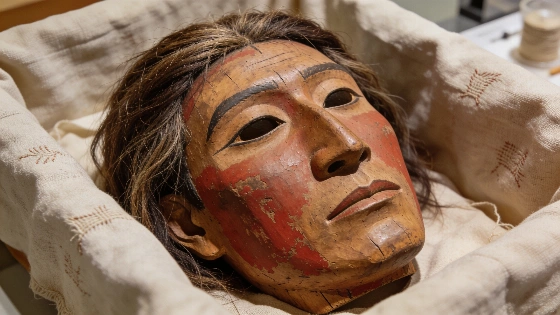
A wooden mask with human hair and cinnabar pigment, crafted by the Chancay people between 1000 and 1450 CE, offers new insight into pre-Inca mortuary traditions and the use of symbolic 'false heads' in Andean burial bundles
An intricately carved wooden mask, attributed to the Chancay culture of Peru's central coast, has provided archaeologists with a rare example of pre-Inca funerary art and ritual. The mask, now held in The Walters Art Museum, is notable for its life-sized proportions, simplified facial features, and the presence of a wig made from real human hair. Its surface is painted with cinnabar, a mercury-based red pigment historically associated with purification and commemoration in Andean mortuary contexts.
Funerary Bundles and 'False Heads'
The Chancay people, who flourished during the Late Intermediate Period (circa 1000-1450 CE), practiced a distinctive form of burial involving funerary bundles. Deceased individuals were wrapped in multiple layers of textiles, vegetal fibers, and animal skins, often placed in a flexed or fetal position. This complex wrapping process could obscure the location of the actual head within the bundle, leading to the creation of 'false heads'-stylized representations made from wood or textiles that were attached to the exterior of the burial. These masks served as focal points for ancestor veneration and ritual activity, rather than as realistic portraits of the deceased.
The mask in question measures approximately 30.5 by 20.3 centimeters (12 by 8 inches), closely matching human facial dimensions but intentionally abstracted. Features such as diamond-shaped eyes, a triangular nose, and a small U-shaped mouth reflect Chancay artistic conventions. Microscopic analysis conducted by The Walters Art Museum in 2017 confirmed that the wig was constructed from human hair, further emphasizing the symbolic connection between the mask and the individual within the bundle.
Material Evidence and Analytical Methods
The use of cinnabar (mercury sulfide) as a pigment is a significant detail, as this mineral was both valued and hazardous. Its brick-red color was commonly employed in Andean funerary rituals, but cinnabar's toxicity also raises questions about the health risks faced by those who handled it. The mask's surface bears patterned impressions, likely resulting from additional textile wrappings, suggesting it was not displayed on the outermost layer of the burial but was instead enveloped within the bundle itself. This detail provides insight into the layering and construction of Chancay funerary packages.
While the Chancay are less widely recognized than the Inca, recent research into their ceramics and tattooed mummified remains has highlighted their artistic complexity and social organization. The Walters Art Museum's collection history indicates that the mask was acquired through the antiquities market, and its precise archaeological provenance is therefore uncertain. This limitation is common among museum-held artifacts from the region and period, and it restricts the degree to which the mask can be securely linked to a specific burial or site.
Interpretation and Uncertainty
Interpretations of Chancay funerary masks rely on comparative analysis with excavated burial bundles and associated grave goods. The simplified features and use of human hair suggest a symbolic rather than literal representation of the deceased. The presence of cinnabar aligns with broader Andean traditions of using red pigment in mortuary contexts, but the specific ritual meanings remain a subject of ongoing research. The lack of secure excavation context for this mask means that some aspects of its original use and significance must remain provisional.
Archaeologists continue to debate the extent to which such masks reflected individual identity, social status, or broader communal beliefs. The Chancay tradition of funerary bundles, with their complex layering and inclusion of grave goods, is echoed in other Andean societies, but the precise symbolic role of 'false heads' is not fully understood. For comparison, discoveries of burial goods in other ancient societies, such as the placement of swords in Iron Age child burials, have also prompted questions about ritual, identity, and the interpretation of mortuary evidence-see this discussion of Iron Age burial practices in Gaul.
Numerical Context and Preservation
The mask measures 30.5 by 20.3 centimeters and is constructed from carved wood, human hair, and textile elements. Its estimated date of manufacture, based on stylistic and comparative analysis, falls between 1000 and 1450 CE. The use of cinnabar pigment is consistent with other Andean funerary artifacts from the same period. However, the absence of direct radiocarbon dating or secure stratigraphic association limits chronological precision. The mask's preservation is relatively good, allowing for microscopic and pigment analysis, but its collection history highlights the challenges of interpreting unprovenanced artifacts.
Understanding the archaeological value of such objects depends on both their material characteristics and their documented context. When artifacts are acquired without secure excavation records, their interpretive potential is reduced, and researchers must rely on comparative typology, laboratory analysis, and broader regional patterns to reconstruct their significance. This case illustrates the importance of provenance in archaeological interpretation and the ongoing need for careful documentation and ethical stewardship of cultural heritage.
Archaeological provenance refers to the documented origin and context of an artifact, including its recovery location, stratigraphic association, and relationship to other finds. Secure provenance allows researchers to interpret objects within their original cultural and chronological framework, supporting more robust conclusions about past behavior and belief. When provenance is lacking, as with many museum-held artifacts from the antiquities market, interpretations must be more cautious, and the potential for reconstructing ancient practices is correspondingly limited. This underscores the value of controlled excavation and transparent collection histories in archaeological research.