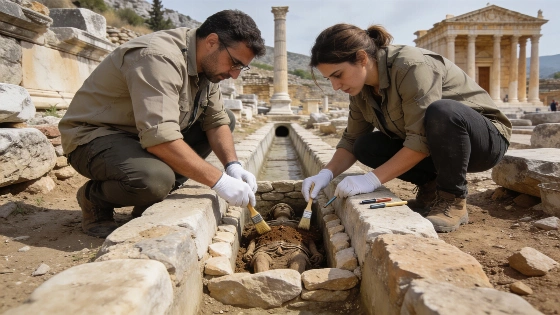
Archaeologists have identified a 1,200-year-old grave containing two premature infants near the Temple of Artemis at Ephesus, Turkey, revealing rare evidence of twin burial and a genetic anomaly in one skeleton
A recently published study details the discovery of a rare twin infant burial from the middle Byzantine period, found within the ancient city of Ephesus in western Turkey. The grave, dated to the eighth or ninth century CE, was uncovered inside an abandoned latrine channel associated with a Roman odeum, itself located within the sacred precinct of the Temple of Artemis-one of the Seven Wonders of the Ancient World. This context is highly unusual, as most known burials from Ephesus were placed in formal cemeteries outside the temple boundaries.
Unusual Burial Context
The grave consisted of a stone-lined cist containing the remains of two infants, positioned side by side. Osteological analysis indicated that both individuals were born prematurely, with estimated gestational ages of approximately 33 to 34 weeks. The similarity in age and burial arrangement suggests they may have been twins, although this interpretation awaits confirmation through future ancient DNA analysis. No evidence of trauma or infectious disease was observed on the skeletons, and the preservation of the bones was aided by the protective construction of the cist within the latrine channel.
Researchers identified a rare anatomical feature in one of the infants: a supernumerary cervical rib, which is an extra rib arising from the neck vertebrae. This condition, present in about 1% of modern populations, is associated with genetic anomalies affecting embryonic development and has been linked to increased risks of stillbirth, prematurity, and sudden infant death. The presence of this trait in one of the twins adds a unique dimension to the find, as documented cases of twins with cervical ribs are extremely rare in the archaeological record.
Mortuary Practice and Interpretation
The choice to inter the infants in a disused latrine rather than a formal cemetery raises questions about mortuary customs and social attitudes toward infant death in Byzantine Ephesus. The researchers propose that the location may reflect a compromise between Christian burial norms and local traditions, particularly for infants who died before baptism. The careful construction of the grave and the absence of evidence for hasty disposal indicate that the burial was intended to be respectful and protective, rather than marginalizing the deceased.
No maternal remains were found in association with the infants, either in the immediate context or in the broader Ephesus cemetery. While maternal mortality was high in the period, the absence of the mother's remains means her fate cannot be determined from the available evidence. The burial's preservation over more than a millennium provides a rare opportunity to examine both the biological and cultural aspects of infant death in the Byzantine world.
Comparative and Regional Context
This discovery contributes to a growing body of evidence on childhood and infant mortality in ancient urban centers. The Ephesus twin burial stands out for its combination of archaeological context, skeletal preservation, and the identification of a rare genetic anomaly. Comparable cases of unusual child burials, such as those involving grave goods or atypical locations, have been reported elsewhere in Europe and the Mediterranean. For example, research on Iron Age child burials with distinctive artifacts, as discussed in recent studies of Gaulish funerary practices, highlights the diversity of responses to childhood death across time and space.
The Ephesus find also underscores the importance of integrating osteological, genetic, and contextual analysis to interpret mortuary evidence. While the identification of twins remains provisional pending DNA results, the case illustrates the challenges of reconstructing family relationships and social attitudes from fragmentary remains. The study's publication in a peer-reviewed journal provides a foundation for further research, including potential genetic and isotopic analyses to clarify biological relatedness and geographic origins.
Estimating age at death in infants relies primarily on measurements of bone length and dental development, which are more precise in early life than in adulthood. In this case, the close correspondence in skeletal development between the two individuals supports the hypothesis of twinship, but only genetic analysis can confirm biological relatedness. The presence of a cervical rib is a rare but informative marker of developmental instability, and its identification in archaeological remains requires careful examination and comparative reference data. Such findings contribute to our understanding of health, mortality, and social care in past populations, while also highlighting the limitations imposed by preservation and sample size.