A rare bronze helmet from southwestern Iran, dated to 1500-1100 BCE, features gold-plated divine figures and a raptor motif. Researchers analyze its construction, iconography, and uncertain archaeological context to interpret its significance.
A distinctive bronze helmet attributed to the Elamite culture, which flourished in southwestern Iran before the rise of the Persian Empire, offers a rare example of ancient armor decorated with religious iconography. Now held in the Metropolitan Museum of Art, the helmet is notable for its elaborate gold-plated figures and a prominent bird of prey motif. Although its precise archaeological context is unclear, the artifact provides insight into the intersection of warfare, status, and religious symbolism in the ancient Near East.
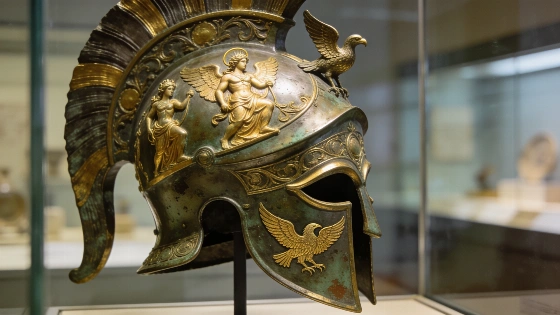
The helmet measures approximately 21.6 centimeters in diameter and is shaped to fit closely over the head, with a cutaway at the front for the eyebrows and a projection that would have protected the nose. Along the edge, gold-covered silver studs are set into the bronze, and a tubular fitting at the rear likely once held a plume of feathers or hair. The helmet's surface is decorated with three gold figures-two female and one male-arranged beneath a large raptor, possibly an eagle or vulture, rendered in relief above them.
Material Evidence
Based on stylistic and technical analysis, the helmet is dated to between 1500 and 1100 BCE, a period when the Elamite polity was frequently in conflict with neighboring Mesopotamian states. The artifact's construction demonstrates advanced metalworking skills, with the use of bronze as the primary material and gold-plated silver for decorative elements. The helmet's dimensions and features suggest it was designed for both protection and display, likely reserved for an individual of high status, possibly a ruler or elite warrior.
The iconography on the helmet is unusual for the region and period. The male deity is depicted holding a vessel from which water flows, a motif consistent with Elamite representations of water gods. The two female figures, shown with horned headdresses and jewelry, raise their hands in a gesture interpreted as prayer or invocation. The raptor above them may symbolize a battlefield scavenger or a divine protector, but its precise meaning remains debated among specialists.
Interpretation and Limitations
While the helmet's craftsmanship and iconography are well documented, its lack of secure archaeological provenance limits interpretation. The object was not recovered from a controlled excavation, and its original findspot is uncertain, reducing the ability to associate it with a specific burial, settlement, or historical event. As a result, interpretations of its function-whether as battle armor, ceremonial regalia, or a votive object-remain provisional.
Scholars have suggested that the inclusion of deities on the helmet may have been intended to invoke divine protection or legitimize the authority of its wearer. However, without contextual evidence, such as associated grave goods or inscriptions, these interpretations cannot be confirmed. The helmet's unique combination of materials and motifs distinguishes it from other known Elamite armor, but also complicates efforts to situate it within broader patterns of ancient Near Eastern material culture.
Numerical Context
The helmet measures about 21.6 centimeters in diameter and features three gold-plated divine figures on its front. Its estimated date range of 1500-1100 BCE places it within the Middle to Late Bronze Age, a period marked by frequent conflict and cultural exchange in southwestern Iran. The artifact's preservation allows for detailed study of its construction, but the absence of excavation records means that its original archaeological context is unknown.
Understanding the significance of artifacts like the Elamite helmet depends on the concept of archaeological provenance. Provenance refers to the documented origin and recovery context of an object, including its findspot, stratigraphic layer, and association with other materials. Secure provenance allows archaeologists to interpret artifacts within their historical and cultural setting, while objects lacking this information-such as those acquired through the antiquities market-present challenges for reliable analysis. Without provenance, interpretations of function, symbolism, and social meaning must remain cautious and provisional, relying on comparative material and stylistic analysis rather than direct contextual evidence.