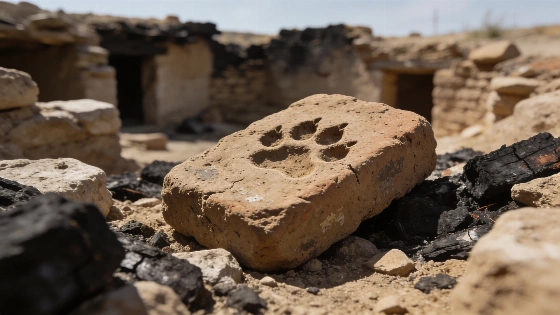
A mudbrick recovered from a fire-damaged Bronze Age house at Tavşanlı Höyük bears impressions attributed to a dog. The report gives no dating method or measurements for the marks
A mudbrick bearing impressions attributed to a dog was recovered from the collapsed remains of a fire-damaged Bronze Age house at Tavşanlı Höyük in western Türkiye. Archaeologists reported the discovery on October 26, 2026, describing the brick as approximately 4,000 years old.
The impressions were made while the brick's clay was still drying. A dog crossed its surface before the brick was used in the house wall, leaving a trace from the brick-making stage. The brick remained part of the structure until a fire destroyed the building and it collapsed into rubble.
Household context
Tavşanlı Höyük, in Kütahya province, is described as one of western Anatolia's largest Bronze Age settlements. Excavations have been conducted there since 2021 under the leadership of Professor Erkan Fidan of Bilecik Şeyh Edebali University, with coordination by Türkiye's Ministry of Culture and Tourism.
The discovery was announced by Türkiye's Minister of Culture and Tourism, Mehmet Nuri Ersoy. In his announcement, Ersoy described the paw prints as preserving a small moment of daily life from 4,000 years ago.
Reading the marks
The impressions are an accidental trace left by movement across wet building material, rather than a deliberately made object. In that respect, they offer a different kind of evidence from manufactured items. A separate account of fingerprints in clay considers another case in which impressions survived on archaeological material, though the finds answer different questions.
The paw prints document a dog's passage across clay used in construction at the settlement. They do not establish whether the animal belonged to a household or how people treated dogs. The brick's archaeological context connects the impressions with building activity and the later destruction of the house.
Reporting by Arkeonews describes the find as a mudbrick recovered among the remains of a Bronze Age structure. Its reported age of approximately 4,000 years places the trace within the settlement's Bronze Age past.