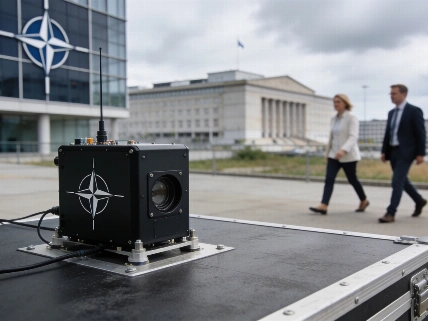
The atomic-sensor system reads Earth's magnetic field to navigate without satellite signals. Q-CTRL reports RNP 0.3 accuracy and environmental flight qualification, while field evaluations have involved commercial and defense partners
GPS jamming and spoofing are reported to disrupt more than 1,500 commercial flights daily. The two threats work differently: jamming overwhelms or blocks genuine satellite signals, while spoofing broadcasts counterfeit signals that can mislead a receiver about its position or time, as outlined in GPS interference guidance. Q-CTRL says its Ironstone Opal system has achieved safety-of-flight qualification under RTCA DO-160, an environmental testing standard used to assess airborne equipment under conditions including electromagnetic interference and vibration.
Two distinct tests
DO-160 environmental qualification addresses equipment performance under aircraft operating stresses; it is distinct from aircraft-level certification and from the system's reported navigation accuracy. Q-CTRL gives an RNP 0.3 benchmark, described as staying within 0.3 nautical miles for 95% of a flight without satellite signals. The company-stated accuracy figure and environmental qualification describe separate performance measures.
Ironstone Opal uses quantum magnetic sensors to measure variations in Earth's crustal magnetic field and compares those readings with onboard geomagnetic maps to estimate position. Conventional inertial navigation systems can accumulate positional drift over long flights as sensor measurements are integrated without an external position reference. Magnetic navigation instead uses geological magnetic features as navigational references when GNSS is unavailable or unreliable.
Filtering aircraft interference
An aircraft's own structure can create magnetic interference. Q-CTRL says Ironstone Opal combines quantum magnetometers with AI-driven software that filters airframe interference in real time. Its passive, non-emitting design does not transmit a navigation signal, allowing it to provide an independent navigation input when satellite signals are unavailable or unreliable.
The company describes separate hardware for crewed aircraft and uncrewed aircraft, including a UAV module weighing less than one kilogram and intended for NATO Class II+ drones. The units are designed for fuselage or wing mounting. Q-CTRL also describes the system as ITAR-free, which the company says supports international commercial and allied-defense deployment without U.S. munitions restrictions.
Field evaluations
Q-CTRL says Ironstone Opal has undergone flight evaluations with commercial and defense partners, including Airbus and Lockheed Martin, as well as U.S. defense programs. The company reports the RNP 0.3 benchmark alongside these evaluations; the figure refers to the navigation system's stated accuracy, not to its DO-160 environmental qualification.
GPSInterference.com explains that its aircraft map uses reported navigation-accuracy data and cannot reliably distinguish jamming from spoofing in every case. Its map methodology also notes that individual affected map areas can reflect reports from only a small number of aircraft.
For a separate approach to magnetic measurement, earlier SQIF coverage described a superconducting array designed to establish an absolute magnetic-field baseline. Ironstone Opal's approach centers on atomic sensors and onboard geomagnetic maps.