

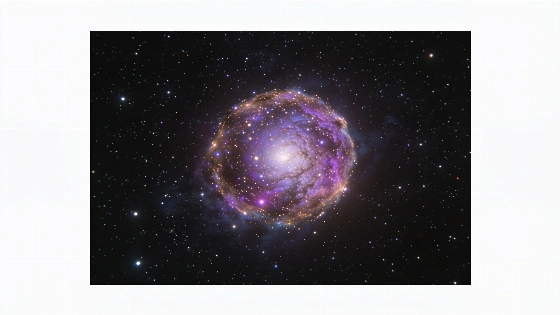
Hubble's combined observations of Messier 30 span ultraviolet through near-infrared light, while the cluster's counter-rotating orbit raises a separate possibility: the Milky Way may have captured it long ago
About 27,500 light-years away in Capricornus, the globular cluster Messier 30, also known as NGC 7099, follows an orbit that runs opposite the Milky Way's spin. That retrograde motion raises the possibility that our galaxy captured M30 long ago rather than forming it within its own borders. Orbital direction alone, however, does not establish when the cluster arrived or prove its place of origin.
An unusual orbit
M30 is among the globular clusters that orbit opposite the Milky Way's overall rotation, a pattern also seen in many other clusters. Such motion is consistent with a halo object brought into the galaxy through the disruption or accretion of another stellar system, but it does not identify a specific parent galaxy or establish a capture date.
Globular clusters are roughly spherical groups containing tens of thousands to millions of stars. The Milky Way has at least 150 known clusters, most orbiting in its diffuse outer halo. Their estimated ages range from about 11.5 billion to 13.5 billion years, making them some of the oldest stellar systems used to reconstruct the galaxy's early history.
Clues across the halo
The clusters' ages and chemical compositions make them useful records of the Milky Way's early history. Those formed within the galaxy can preserve clues to the conditions and chemistry of its young stars; accreted clusters can retain signatures of the smaller systems in which they formed. Astronomers use globular-cluster motions, alongside data from missions such as Gaia and Hubble, to study the Milky Way's gravitational structure, including its dark-matter halo.
More than a century ago, Harlow Shapley used variable stars, including pulsating stars whose intrinsic brightness could be estimated, to map the locations and distances of globular clusters. His work showed that the Sun is not at the Milky Way's center and placed the galactic center toward Sagittarius. His distance estimates were too large, leading him to conclude that the galaxy was about twice its actual size.
Hubble's sharp views have also supported research on gravitational lenses, as this Hubble lensing report describes. For M30, repeated observations let astronomers compare stars in the cluster over time and investigate its stellar populations. The images provide detailed views of the stars; the cluster's orbit is a separate line of evidence about its history.
Three observing programs
Hubble's Advanced Camera for Surveys first contributed data through program #10775, led by principal investigator Ata Sarajedini. The survey observed dozens of Milky Way globular clusters in red and near-infrared light, detecting stars with masses down to about 20% of the Sun's mass.
Program #13297, led by Giovanni Piotto, returned to M30 and other clusters with Hubble's Wide Field Camera 3. Its three bluer-light filters provided data used to study blue straggler stars and the multiple stellar populations that can coexist in one cluster.
In program #16298, the Advanced Camera for Surveys observed many of the clusters again. Researchers could compare stellar motions with observations taken 15 years earlier. The resulting M30 image combines data from all three programs, including ultraviolet observations alongside visible and near-infrared light. Each wavelength range helps researchers investigate how the stars formed and evolved, while the cluster's retrograde orbit remains compatible with-but does not by itself establish-a history of capture.







