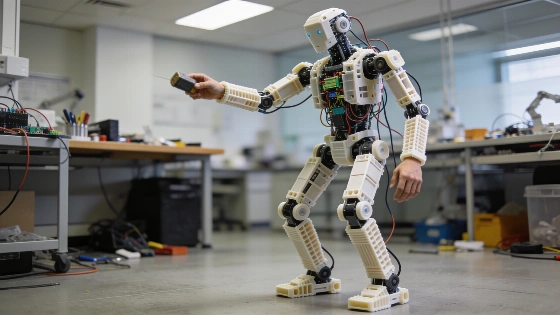
A research team at UC Berkeley has released the open-source Berkeley Humanoid Lite, a customizable robot platform built with 3D-printed actuators and off-the-shelf parts, aiming to lower the barrier to humanoid robotics research and experimentation
Building a functional humanoid robot for under $5,000 was once a fantasy reserved for well-funded labs or industry giants. The Berkeley Humanoid Lite, developed at the University of California, Berkeley, upends that assumption by demonstrating a modular, open-source robot platform that relies on 3D-printed actuators and widely available electronics. The result: a research-grade humanoid that can be assembled and modified by individuals or small teams, not just institutional players.
Instead of offering a finished product, the Berkeley team has published a reference design that prioritizes accessibility and adaptability. The robot's frame and actuators are fabricated using standard desktop FDM 3D printers, with all printed parts designed to fit within a 200 x 200 x 200 mm build volume. PLA plastic is used for the housings, gears, and shafts, while off-the-shelf brushless DC motors, drivers, and encoders provide the core actuation. The design's modularity means that users can reconfigure limb lengths, joint arrangements, and even overall robot morphology without specialized manufacturing.
At 0.8 meters tall and weighing 16 kilograms, the Berkeley Humanoid Lite is not a toy. Its 22 actuators-10 large and 12 small-drive the robot's arms and legs, with each actuator combining a BLDC drone motor, a 3D-printed cycloidal gearbox, and a position encoder. The larger 6512 actuator costs about $188 per unit, while the smaller 5010 actuator is listed at $136. The actuators' cycloidal gearboxes distribute mechanical loads across multiple teeth, and embedded brass supports and screws reinforce the plastic structure, addressing the typical weaknesses of 3D-printed components. The team reports that the gearboxes achieve roughly 90% mechanical efficiency under most conditions, though efficiency drops at high torque and speed due to heat buildup.
Durability and consistency were tested through a 60-hour endurance run, during which actuator efficiency remained stable but mechanical backlash increased as the plastic components wore down. Six actuators produced on two different 3D printers showed torque-tracking errors within 0.5 newton-meters, suggesting that the design is robust to minor variations in printer quality. The robot's modular actuators require only power and CAN bus communication, enabling rapid reconfiguration for bipedal, quadrupedal, or centaur-like forms, and even scaling up to adult-sized variants by extending limb segments.
Control is handled by an onboard Intel N95 mini PC and a motion sensor. The team transferred a reinforcement-learning controller, trained in simulation, directly to the physical robot, enabling it to walk in response to user-specified velocity commands. Teleoperation is also supported via SteamVR controllers, allowing users to perform tasks such as writing, object manipulation, box packing, and even solving a Rubik's Cube. However, the long-term effects of heat on the PLA structure remain an open question, and the system's reliability under continuous, high-load operation has not been fully established.
Open-source documentation and build resources are provided, making the Berkeley Humanoid Lite a practical entry point for researchers and developers who have previously been priced out of humanoid robotics. The approach stands in contrast to proprietary commercial robots, which often restrict modification and experimentation. For those tracking the evolution of accessible robotics, this release follows a series of recent advances in modular and learning-enabled robots, including the reported earlier development of a six-legged robot that adapts its gait using insect-inspired learning algorithms.
By stripping away the cost and complexity barriers that have long defined humanoid robotics, the Berkeley Humanoid Lite exposes both the promise and the fragility of democratized robot hardware. The platform's reliance on 3D-printed plastic and commodity electronics is a double-edged sword: it enables rapid iteration and customization, but also introduces durability and performance trade-offs that cannot be ignored. Until long-term reliability and safety are independently validated, the system remains a research tool rather than a deployable solution. Still, the open-source release marks a decisive shift in who can participate in humanoid robotics research, and it will force established players to reckon with a new generation of low-cost, modifiable machines that are no longer locked behind institutional walls.
Understanding the distinction between automation and autonomy is essential in robotics. Automation refers to systems that follow predefined instructions or scripts, often requiring human oversight or intervention for unexpected situations. Autonomy, by contrast, describes robots capable of making independent decisions in unstructured environments, adapting to new tasks or failures without direct human input. The Berkeley Humanoid Lite demonstrates automated and teleoperated behaviors, but its ability to operate autonomously is limited by the current state of reinforcement learning, hardware durability, and the need for ongoing human supervision. As open-source platforms proliferate, careful attention to these boundaries will remain critical for both safety and progress.